


Bidirectional natural hybridization between sympatric Ligularia vellerea and L. subspicata
- PMID: 30159514
- PMCID: PMC6112292
- DOI: 10.1016/j.pld.2017.07.001
Bidirectional natural hybridization between sympatric Ligularia vellerea and L. subspicata
Abstract
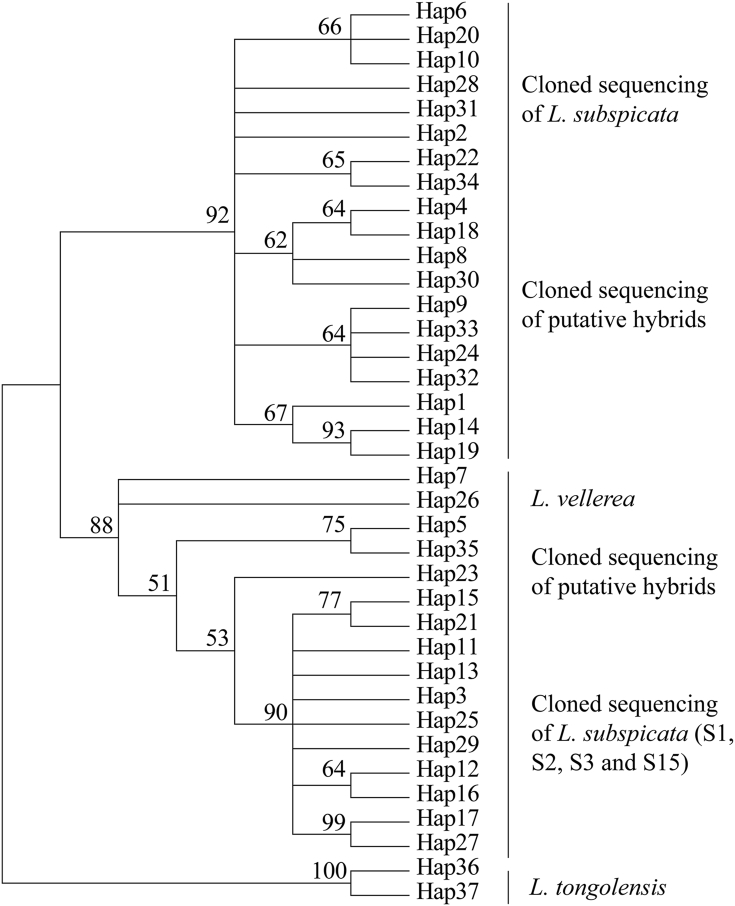
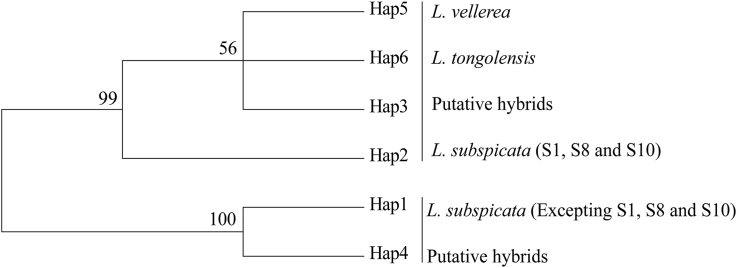
Natural hybridization has been regarded as a crucial pathway of speciation and provides the raw materials for the evolution of biodiversity. The interspecific natural hybridization of the genus Ligularia Cass. is universal and has been considered to be an important factor driving the high diversity of Ligularia species in the Hengduan Mountains, China. Although the natural hybridization between L. vellerea and L. subspicata was reported previously, the direction of hybridization was uncertain due to the limitation of sampling. Thus, in this study, we sampled more individuals and increased two fragments of chloroplast DNA on the basis of the previous study to further verify the natural hybridization between L. vellerea and L. subspicata and confirm the direction of hybridization. Based on DNA sequences (atpB-rbcL, trnL-rpl32, trnQ-5'rps16, and nuclear ribosomal internal transcribed spacer region) data, we concluded that putative hybrids were primary products of hybridization between L. vellerea and L. subspicata and the hybridization was bidirectional. Moreover, sympatric L. tongolensis was not apparently involved in the hybridization. Surprisingly, some pure L. subspicata individuals showed the disaccordance between morphology and DNA data, which might indicate that introgression occurs between L. vellerea and L. subspicata.
Keywords: ITS; Introgression; Ligularia; Natural hybridization; cpDNA.
Figures
Similar articles
-
Natural hybridization and introgression between Ligularia cymbulifera and L. tongolensis (Asteraceae, Senecioneae) in four different locations.PLoS One. 2014 Dec 31;9(12):e115167. doi: 10.1371/journal.pone.0115167. eCollection 2014. PLoS One. 2014. PMID: 25551379 Free PMC article.
-
Evidence for continual hybridization rather than hybrid speciation between Ligularia duciformis and L. paradoxa (Asteraceae).PeerJ. 2017 Oct 11;5:e3884. doi: 10.7717/peerj.3884. eCollection 2017. PeerJ. 2017. PMID: 29038755 Free PMC article.
-
Chemical constituents of hybrids of Ligularia cyathiceps and L. lamarum/L. subspicata collected in China: Structures of subspicatins M, N, O1, and O2, and related compounds.Phytochemistry. 2017 Aug;140:69-76. doi: 10.1016/j.phytochem.2017.04.015. Epub 2017 Apr 29. Phytochemistry. 2017. PMID: 28460262
-
[Chemical and genetic diversity of Ligularia plants collected in the Hengduan Mountains, China].Yakugaku Zasshi. 2012;132(12):1451-9. doi: 10.1248/yakushi.12-00207. Yakugaku Zasshi. 2012. PMID: 23208053 Review. Japanese.
-
[Diversity of Plants Belonging to the Genus Ligularia (Asteraceae) Based on Terpenoids and Synthetic Studies on Some Terpenoids].Yakugaku Zasshi. 2016;136(2):309-27. doi: 10.1248/yakushi.15-00238. Yakugaku Zasshi. 2016. PMID: 26831809 Review. Japanese.
Cited by
-
The natural hybridization between species Ligularia nelumbifolia and Cremanthodium stenoglossum (Senecioneae, Asteraceae) suggests underdeveloped reproductive isolation and ambiguous intergeneric boundary.AoB Plants. 2021 Mar 4;13(2):plab012. doi: 10.1093/aobpla/plab012. eCollection 2021 Apr. AoB Plants. 2021. PMID: 33796247 Free PMC article.
-
Origins and evolution of plant diversity in the Hengduan Mountains, China.Plant Divers. 2017 Sep 18;39(4):161-166. doi: 10.1016/j.pld.2017.09.004. eCollection 2017 Aug. Plant Divers. 2017. PMID: 30159507 Free PMC article. No abstract available.
-
Molecular evidence for natural hybridization between Rumex crispus and R. obtusifolius (Polygonaceae) in Korea.Sci Rep. 2022 Mar 31;12(1):5423. doi: 10.1038/s41598-022-09292-9. Sci Rep. 2022. PMID: 35361815 Free PMC article.
References
-
- Aanderson E. Wiley; New York: 1949. Introgressive Hybridization.
-
- Arnold M.L. Natural hybridization as an evolutionary process. Annu. Rev. Ecol. Syst. 1992:237–261.
-
- Arnold M.L., Hodges S.A. Are natural hybrids fit or unfit relative to their parents? Trends Ecol. Evol. 1995;10:67–71. - PubMed
-
- Arnold M.L. Oxford University Press; New York: 1997. Natural Hybridization and Evolution.
-
- Arnold M.L. Oxford University Press; New York: 2006. Evolution through Genetic Exchange.
LinkOut - more resources
Full Text Sources
Other Literature Sources
