


Risk factors for chronic lung disease and asthma differ among children born extremely preterm
- PMID: 30160065
- PMCID: PMC6716602
- DOI: 10.1002/ppul.24148
Risk factors for chronic lung disease and asthma differ among children born extremely preterm
Abstract
Objectives: To evaluate the hypothesis that chronic lung disease of prematurity (CLD) is a risk factor for asthma in children born extremely preterm, and the hypothesis that the risk factors for CLD are similar to those for asthma.
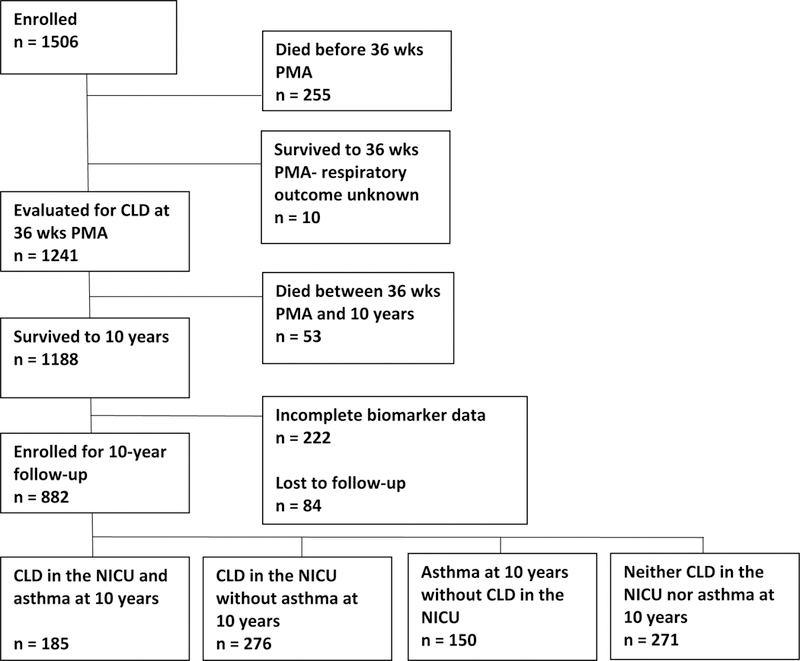
Methods: A retrospective analysis was performed using data collected prospectively from 882 children born before the 28th week of gestation between 2002 and 2004 who returned for follow-up at ages 12 and 24 months and 10 years. We created time-oriented logistic regression models to compare risk factors for CLD, defined as need for supplemental oxygen at 36 weeks postmenstrual age, and parent-reported asthma at 10 years of age.
Results: CLD diagnosed during neonatal admission was associated with bronchodilator use at 12 months and 24 months (P < 0.001), but not with an asthma diagnosis at 10 years (Odds Ratio 1.3; 95% confidence interval 0.98-1.8). While risk factors for CLD include lower gestational age (OR 2.7; 1.5-4.7) and fetal growth restriction (OR 2.3; 1.4-3.7), risk factors for asthma include mother's eligibility for public insurance (Medicaid) (OR 1.8; 1.1-2.8), and higher weight gain velocity during the first year (OR 1.5; 1.02-2.2) and between the 2nd and 10th year (OR 1.7; 1.2-2.4).
Conclusions: Among children born extremely preterm, the diagnosis of CLD and its antecedents were associated with transient preschool wheezing, but not with asthma. Post-NICU factors, such as growth velocity and socioeconomic disadvantage, appear to have stronger associations with asthma than exposures during NICU admission.
Keywords: asthma and early wheeze; bronchopulmonary dysplasia; epidemiology; extremely low birth weight infants; socioeconomic factors.
© 2018 Wiley Periodicals, Inc.
Figures
References
-
- Bhandari A, Panitch HB. Pulmonary outcomes in bronchopulmonary dysplasia. Semin Perinatol 2006;30(4):219–226. - PubMed
-
- Goncalves C, Wandalsen G, Lanza F, Goulart AL, Sole D, Dos Santos A. Repercussions of preterm birth on symptoms of asthma, allergic diseases and pulmonary function, 6–14 years later. Allergol Immunopathol (Madr) 2016;44(6):489–496. - PubMed
-
- Jobe AH, Bancalari E. Bronchopulmonary dysplasia. Am J Respir Crit Care Med 2001;163(7):1723–1729. - PubMed
-
- Stoll BJ, Hansen NI, Bell EF, Walsh MC, Carlo WA, Shankaran S, Laptook AR, Sanchez PJ, Van Meurs KP, Wyckoff M, Das A, Hale EC, Ball MB, Newman NS, Schibler K, Poindexter BB, Kennedy KA, Cotten CM, Watterberg KL, D’Angio CT, DeMauro SB, Truog WE, Devaskar U, Higgins RD, Eunice Kennedy Shriver National Institute of Child H, Human Development Neonatal Research N. Trends in Care Practices, Morbidity, and Mortality of Extremely Preterm Neonates, 1993–2012. JAMA 2015;314(10):1039–1051. - PMC - PubMed
Publication types
MeSH terms
Grants and funding
LinkOut - more resources
Full Text Sources
Other Literature Sources
Medical
