


SCN1Bβ mutations that affect their association with Kv4.3 underlie early repolarization syndrome
- PMID: 30160358
- PMCID: PMC6201368
- DOI: 10.1111/jcmm.13839
SCN1Bβ mutations that affect their association with Kv4.3 underlie early repolarization syndrome
Abstract
Background: Abnormal cardiac ion channels current, including transient outward potassium current (Ito ), is associated with early repolarization syndrome (ERS). Previous studies showed that mutations in SCN1Bβ both to increase the Ito current and to decrease the sodium current. Yet its role in ERS remains unknown.
Objective: To determine the role of mutations in the SCN1Bβ subunits in ERS.
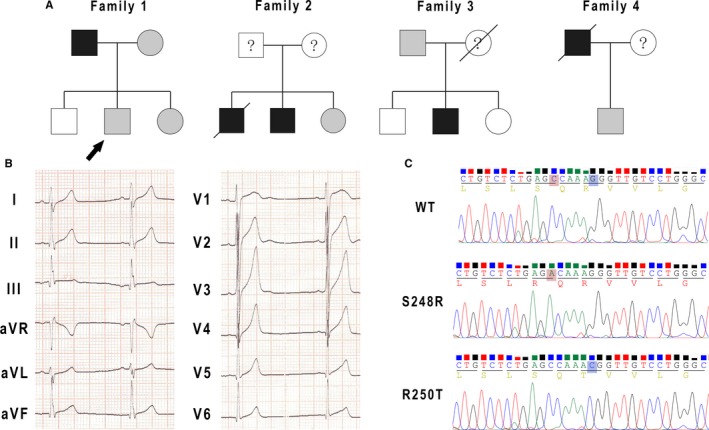
Methods: We screened for mutations in the SCN1B genes from four families with ERS. Wild-type and mutant SCN1Bβ genes were co-expressed with wild-type KCND3 in human embryonic kidney cells (HEK293). Whole-cell patch-clamp technique and co-immunoprecipitation were used to study the electrophysiological properties and explore the underlying mechanisms.
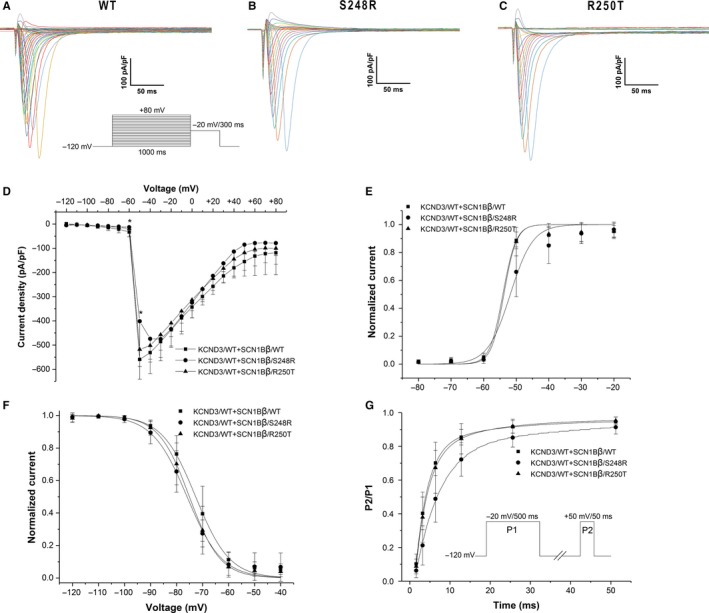
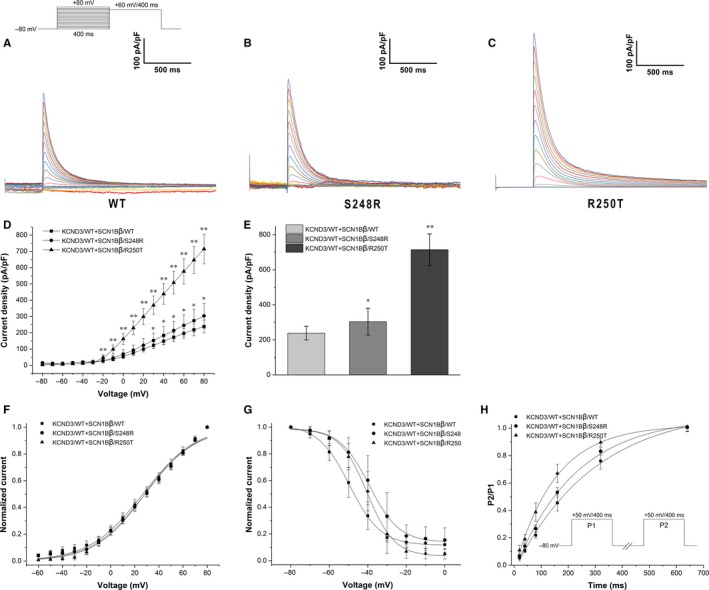
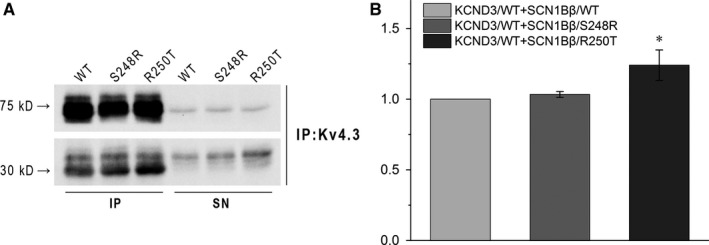
Results: S248R and R250T mutations in SCN1Bβ were detected in 4 families' probands. Neither S248R nor R250T mutation had significant influence on the sodium channel current density (INa ) when co-expressed with SCN5A/WT. Co-expression of KCND3/WT and SCN1Bβ/S248R or SCN1Bβ/R250T increased the transient outward potassium current Ito by 27.44% and 199.89%, respectively (P < 0.05 and P < 0.01, respectively) when compared with SCN1Bβ/WT. Electrophysiological properties showed that S248R and R250T mutations decreased the steady-state inactivation and recovery from inactivation of Ito channel. Co-immunoprecipitation study demonstrated an increased association between SCN1Bβ mutations and Kv4.3 compared with SCN1Bβ/WT (P < 0.05 and P < 0.01, respectively).
Conclusion: The S248R and R250T mutations of SCN1Bβ gene caused gain-of-function of Ito by associated with Kv4.3, which maybe underlie the ERS phenotype of the probands.
Keywords: SCN1Bβ; early repolarization syndrome; transient outward potassium current.
© 2018 The Authors. Journal of Cellular and Molecular Medicine published by John Wiley & Sons Ltd and Foundation for Cellular and Molecular Medicine.
Figures
References
-
- Steinfurt J, Odening KE. Early repolarization: a risk factor in Brugada syndrome. J Am Coll Cardiol. 2015;66(2):205‐206. - PubMed
-
- Mahida S, Derval N, Sacher F, et al. Role of electrophysiological studies in predicting risk of ventricular arrhythmia in early repolarization syndrome. J Am Coll Cardiol. 2015;65(2):151‐159. - PubMed
-
- Wu SH, Lin XX, Cheng YJ, Qiang CC, Zhang J. Early repolarization pattern and risk for arrhythmia death: a meta‐analysis. J Am Coll Cardiol. 2013;61(6):645‐650. - PubMed
-
- Junttila MJ, Sager SJ, Tikkanen JT, Anttonen O, Huikuri HV, Myerburg RJ. Clinical significance of variants of J‐points and J‐waves: early repolarization patterns and risk. Eur Heart J. 2012;33(21):2639‐2643. - PubMed
-
- Tikkanen JT, Junttila MJ, Anttonen O, et al. Early repolarization: electrocardiographic phenotypes associated with favorable long‐term outcome. Circulation. 2011;123(23):2666‐2673. - PubMed
Publication types
MeSH terms
Substances
LinkOut - more resources
Full Text Sources
Other Literature Sources
Medical
Miscellaneous
