. 2018 Nov 1;315(5):L673-L681.
doi: 10.1152/ajplung.00459.2017. Epub 2018 Aug 30.

Obesity increases airway smooth muscle responses to contractile agonists

Affiliations

Obesity increases airway smooth muscle responses to contractile agonists

Sarah Orfanos et al. Am J Physiol Lung Cell Mol Physiol. .

Abstract

The asthma-obesity syndrome represents a major public health concern that disproportionately contributes to asthma severity and induces insensitivity to therapy. To date, no study has shown an intrinsic difference between human airway smooth muscle (HASM) cells derived from nonobese subjects and those derived from obese subjects. The objective of this study was to address whether there is a greater response to agonist-induced calcium mobilization, phosphorylation of myosin light chain (MLC), and greater shortening in HASM cells derived from obese subjects. HASM cells derived from nonobese and obese subjects were age and sex matched. Phosphorylation of MLC was measured after having been stimulated by carbachol. Carbachol- or histamine-induced mobilization of calcium and cell shortening were assessed in HASM cells derived from nonobese and obese donors. Agonist-induced MLC phosphorylation, mobilization of calcium, and cell shortening were greater in obese compared with non-obese-derived HASM cells. The MLC response was comparable in HASM cells derived from obese nonasthma and nonobese fatal asthma subjects. HASM cells derived from obese female subjects were more responsive to carbachol than HASM cells derived from obese male subjects. Insulin pretreatment had little effect on these responses. Our results show an increase in agonist-induced calcium mobilization associated with an increase in MLC phosphorylation and an increase in ASM cell shortening in favor of agonist-induced hyperresponsiveness in HASM cells derived from obese subjects. Our studies suggest that obesity induces a retained phenotype of hyperresponsiveness in cultured human airway smooth muscle cells.

Keywords: asthma; body mass index; obesity; remodeling; wheezing.


Figures
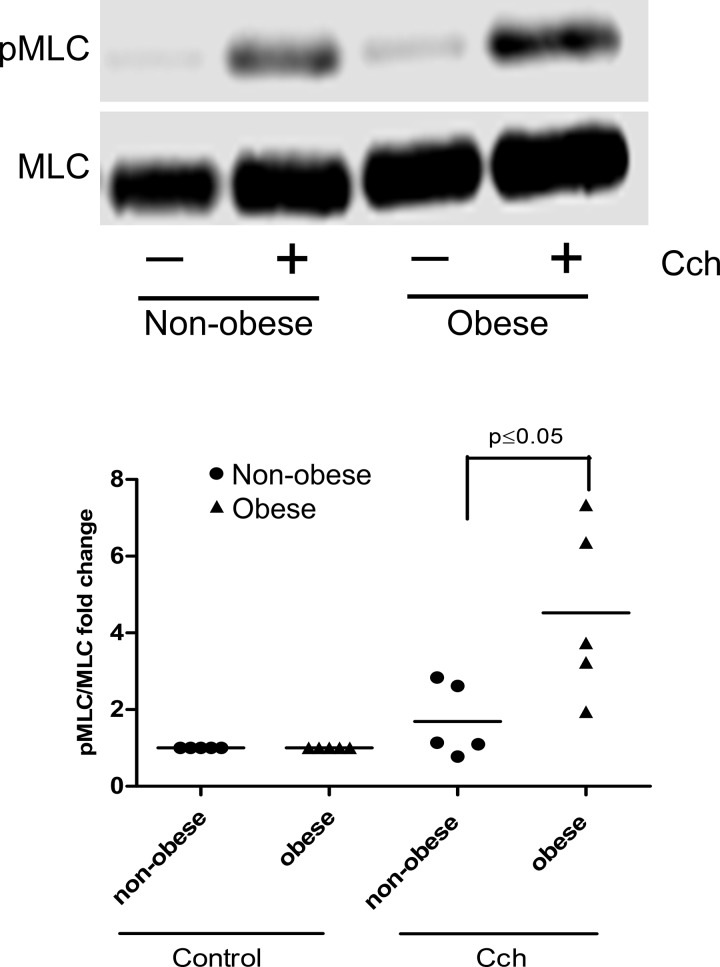
Fig. 1.
Fig. 1.
Immunoblot: carbachol (CCh, 10 µM, 10 min)-induced phosphorylation (p) of myosin light chain (MLC) in human airway smooth muscle (HASM) cells derived from nonobese (n = 5) and obese (n = 5) subjects. CCh induces more MLC phosphorylation in HASM cells derived from obese subjects than those derived from nonobese subjects (P ≤ 0.05).
Fig. 2.
Fig. 2.
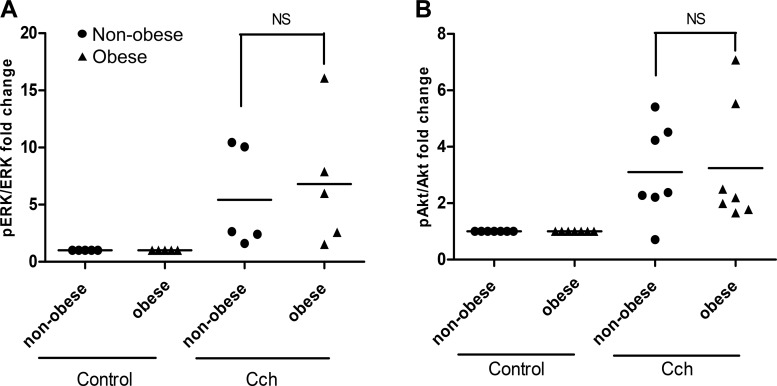
Immunoblot: carbachol (CCh, 10 µM, 10 min)-induced phosphorylation of extracellular-regulated kinase (ERK, A) and protein kinase B (Akt, B) in human airway smooth muscle (HASM) cells derived from nonobese and obese subjects. There is no significant (NS) difference in the phosphorylation of ERK and Akt in response to CCh between nonobese and obese HASM cells.
Fig. 3.
Fig. 3.
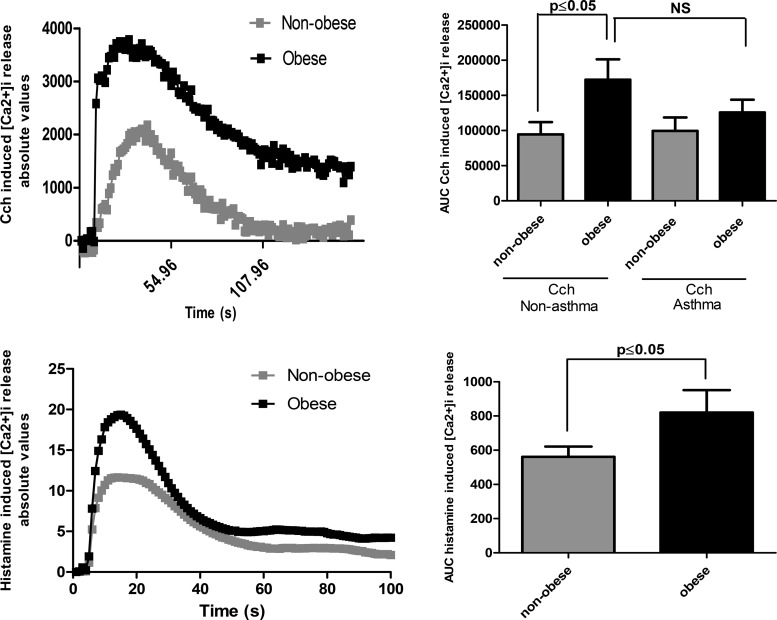
Carbachol (CCh, 10 µM)- and histamine (1 µM)-induced mobilization of intracellular calcium ([Ca2+]i) in human airway smooth muscle (HASM) cells derived from obese and nonobese and nonasthma (n = 19) and fatal asthma (n = 10) subjects. Data are expressed as means and SE. HASM cells derived from obese subjects have a significantly greater calcium response to CCh (P < 0.05) and histamine (P < 0.05) than those derived from nonobese (P < 0.05). HASM cells derived from obese nonasthma subjects have a response to CCh comparable to those derived from fatal asthma subjects.
Fig. 4.
Fig. 4.
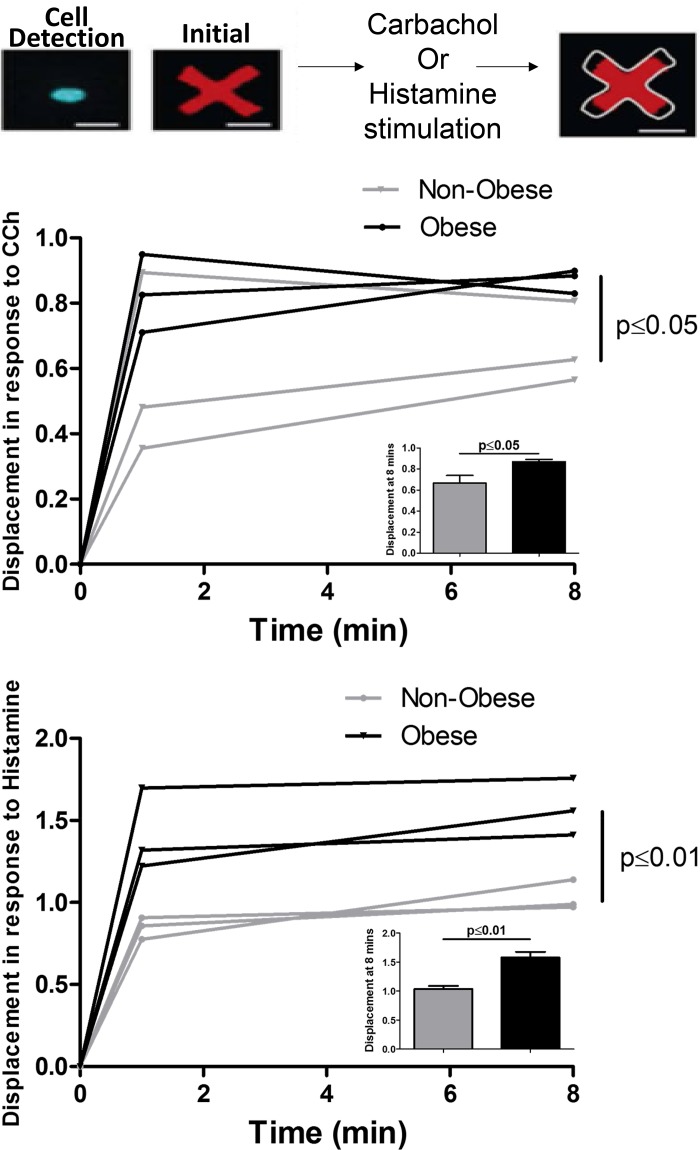
Quantification of human airway smooth muscle (HASM) cell contraction in response to carbachol (CCh) and histamine in nonobese and obese donors using high-throughput single-cell force cytometry (fluorescently labeled elastomeric contractible surfaces) technology (n = 3 nonobese, n = 3 obese). The inset bar graphs show means ± SE of single cell shortening force at 8 min (P ≤ 0.05 for CCh and P < 0.01 for histamine). Representative images of a single HASM cell bound to a contractible fluorescent micropattern and of the resulting decrement in the area of the pattern once the cell contracts in response to carbachol or histamine. At 8 min the displacement of the micropattern in response to histamine was significantly higher in HASM cells isolated from obese donors than in those isolated from nonobese donors (P < 0.01). The same trend was noted after stimulating the HASM cells with CCh (P ≤ 0.05).
Fig. 5.
Fig. 5.
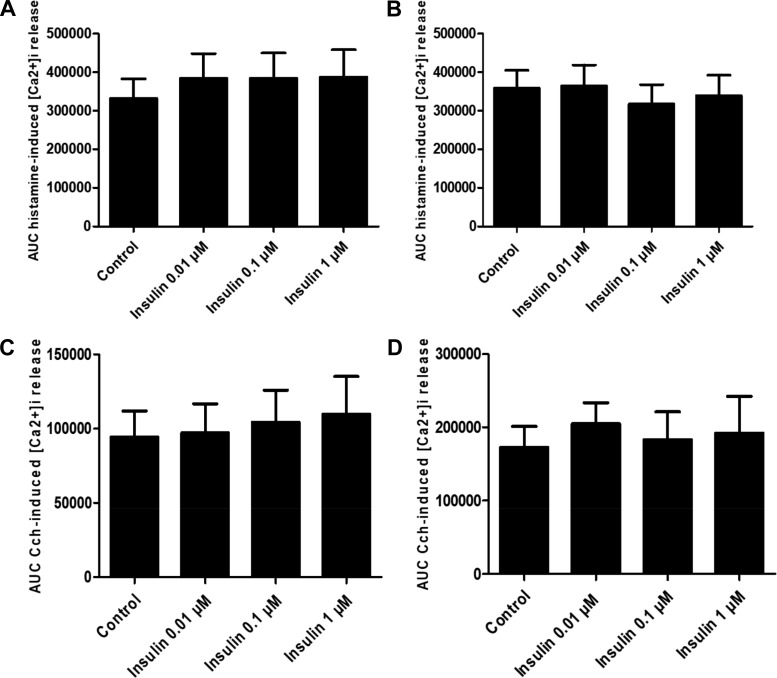
Area under the curve (AUC) of histamine (1 µm, A and B)- and carbachol (10 µM ,CCh, C and D)-induced mobilization of intracellular calcium ([Ca2+]i) in human airway smooth muscle (HASM) cells derived from obese (n = 10, BD) and nonobese (n = 9, AC) subjects, with insulin pretreatment. Data are expressed as means ± SE; 24 h insulin pretreatment has no effect on histamine-induced mobilization of [Ca2+]i in HASM cells isolated from nonobese (A) and obese (B) donors or CCh-induced mobilization of [Ca2+]i in HASM cells isolated from nonobese (C) and obese (D) donors.
Fig. 6.
Fig. 6.
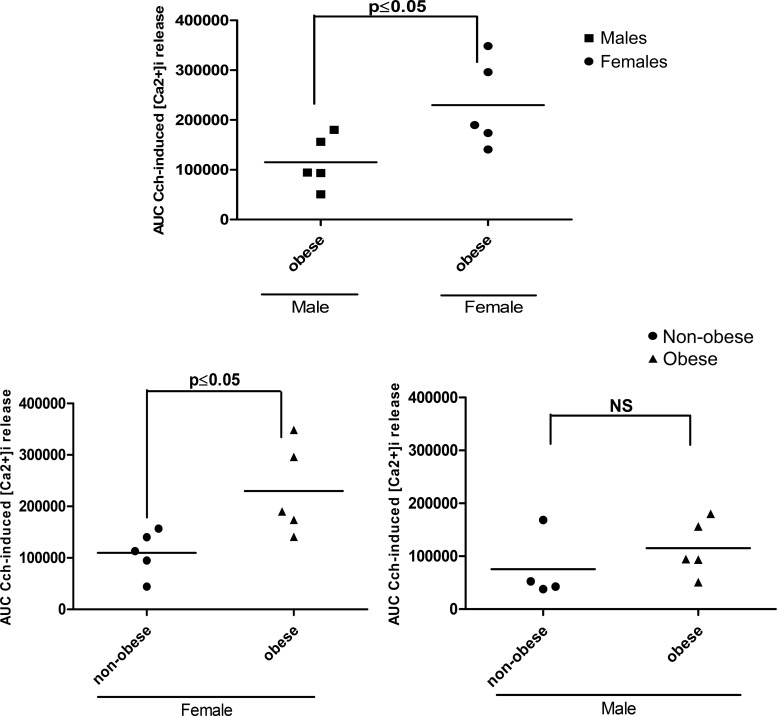
Area under the curve of carbachol (CCh)-induced intracellular calcium ([Ca2+]i) in human airway smooth muscle (HASM) cells derived from obese and nonobese male and female subjects. HASM cells derived from obese females mobilize significantly more [Ca2+]i in response to CCh than HASM cells isolated from nonobese females (P < 0.05). The same trend is not noted in obese men [not significant (NS), P > 0.05]. The obese female phenotype is more responsive to CCh than the obese male phenotype (P < 0.05).

References

    1. Ahangari F, Sood A, Ma B, Takyar S, Schuyler M, Qualls C, Dela Cruz CS, Chupp GL, Lee CG, Elias JA. Chitinase 3-like-1 regulates both visceral fat accumulation and asthma-like Th2 inflammation. Am J Respir Crit Care Med 191: 746–757, 2015. doi:10.1164/rccm.201405-0796OC. - DOI - PMC - PubMed
    1. Akinbami LJ, Fryar CD. Current asthma prevalence by weight status among adults: United States, 2001–2014. NCHS Data Brief 239: 1–8, 2016. - PubMed
    1. Appleton SL, Adams RJ, Wilson DH, Taylor AW, Ruffin RE; North West Adelaide Health Study Team . Central obesity is associated with nonatopic but not atopic asthma in a representative population sample. J Allergy Clin Immunol 118: 1284–1291, 2006. doi:10.1016/j.jaci.2006.08.011. - DOI - PubMed
    1. Ballantyne D, Scott H, MacDonald-Wicks L, Gibson PG, Wood LG. Resistin is a predictor of asthma risk and resistin:adiponectin ratio is a negative predictor of lung function in asthma. Clin Exp Allergy 46: 1056–1065, 2016. doi:10.1111/cea.12742. - DOI - PubMed
    1. Bianco A, Nigro E, Monaco ML, Matera MG, Scudiero O, Mazzarella G, Daniele A. The burden of obesity in asthma and COPD: Role of adiponectin. Pulm Pharmacol Ther 43: 20–25, 2017. doi:10.1016/j.pupt.2017.01.004. - DOI - PubMed

Publication types

MeSH terms