


New horizons in the compression of functional decline
- PMID: 30165372
- PMCID: PMC6201827
- DOI: 10.1093/ageing/afy145
New horizons in the compression of functional decline
Abstract
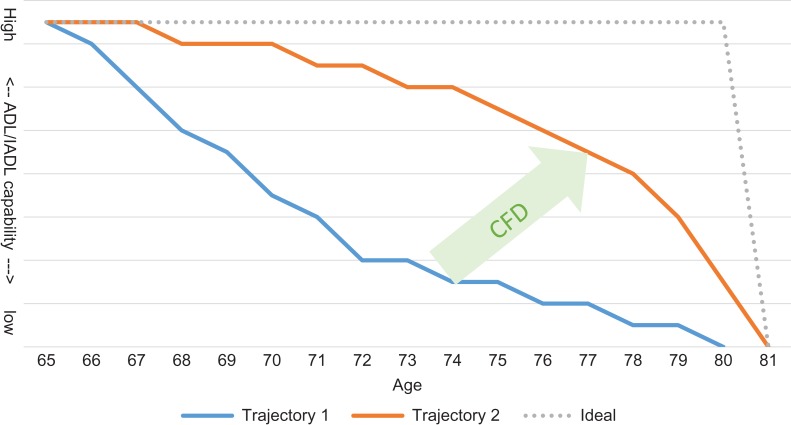
Population ageing, which has come about through the combination of increases in life expectancy, larger post-war cohorts reaching older age and reductions in fertility, is challenging societies and particularly health and care providers, worldwide. In Europe, the USA and Japan, there have been increases in years spent with disability and dependency. The majority of such research, as well as professional health and social care practice, measures loss of functional capability or need for social care, by aggregate disability scores, based around activities of daily living and instrumental activities of daily living. Although useful for defining whether an individual has passed a threshold, aggregate scores obscure how functional decline unfolds, and therefore where early intervention might improve intrinsic capacity and reverse or slow down decline, or maintain function. We propose a framework, the compression of functional decline (CFD), based on the latest understanding of the hierarchy of age-related functional decline, which has the potential to (i) help people understand how to live better for longer, (ii) allow the various stakeholders to be able to measure, at a population level, whether that is happening and (iii) identify which interventions are most effective at which stages. CFD is coherent with the World Health Organisation's Healthy Ageing model and is more easily understood by stakeholders and older people themselves, than current indicators such as frailty. CFD thus provides a realistic view of age-related functional decline in the context of modifiable behaviour to counter widespread public misconceptions about ageing and inform improvements.
Figures
References
-
- United Nations, Department of Economic and Social Affairs, Population Division (2013). World Population Ageing 2013. ST/ESA/SER.A/348.
-
- Fries JF. Aging, natural death, and the compression of morbidity. N Engl J Med 1980; 303: 130–135. - PubMed
-
- Gruenberg EM. The failures of success. Milbank Mem Fund Q Health Soc 1977; 55: 3–24. - PubMed
MeSH terms
Grants and funding
LinkOut - more resources
Full Text Sources
Other Literature Sources
Medical
Miscellaneous
