Review
. 2018 Dec 1;18(8):foy088.
doi: 10.1093/femsyr/foy088.

Mitochondria-cytosol-nucleus crosstalk: learning from Saccharomyces cerevisiae

Affiliations
Review

Mitochondria-cytosol-nucleus crosstalk: learning from Saccharomyces cerevisiae

Nicoletta Guaragnella et al. FEMS Yeast Res. .

Abstract

Mitochondria are key cell organelles with a prominent role in both energetic metabolism and the maintenance of cellular homeostasis. Since mitochondria harbor their own genome, which encodes a limited number of proteins critical for oxidative phosphorylation and protein translation, their function and biogenesis strictly depend upon nuclear control. The yeast Saccharomyces cerevisiae has been a unique model for understanding mitochondrial DNA organization and inheritance as well as for deciphering the process of assembly of mitochondrial components. In the last three decades, yeast also provided a powerful tool for unveiling the communication network that coordinates the functions of the nucleus, the cytosol and mitochondria. This crosstalk regulates how cells respond to extra- and intracellular changes either to maintain cellular homeostasis or to activate cell death. This review is focused on the key pathways that mediate nucleus-cytosol-mitochondria communications through both transcriptional regulation and proteostatic signaling. We aim to highlight yeast that likely continues to serve as a productive model organism for mitochondrial research in the years to come.


Figures
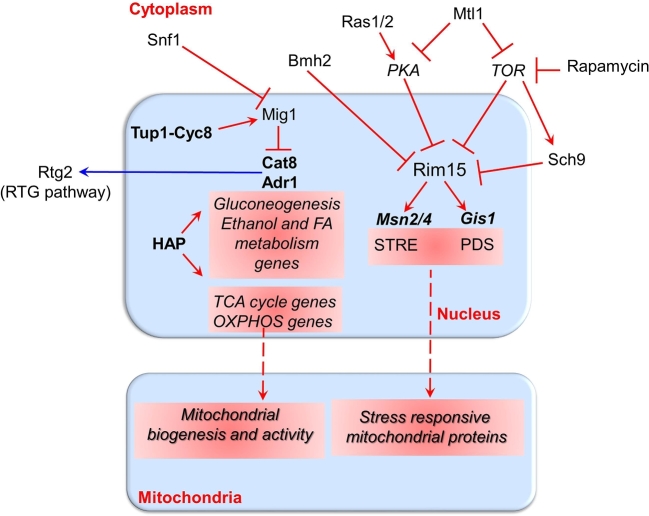
Figure 1.
Figure 1.
Anterograde communication pathways regulating gene transcription in yeast. Key yeast genes and proteins involved in the transcriptional regulatory network of signaling pathways among the nucleus, the cytoplasm and mitochondria (see text for details). The nucleus regulates biosynthesis and function of mitochondria through anterograde pathways (red lines), which are also sensitive to carbon and nitrogen sources. Glucose and preferred nitrogen sources activate PKA and TOR kinases and inhibit Snf1. Rim15 and of Mig1 are regulated by shuttling between nucleus and cytoplasm. Anterograde regulation control the transcription of genes encoding proteins destined to mitochondria (red dashed lines). Nuclear genes highlighted in red are upregulated by the bolded transcription factors located above them. Cat8 and Adr1 can also regulate activation of RTG-dependent retrograde communication pathway (see Fig. 2, blue line).
Figure 2.
Figure 2.
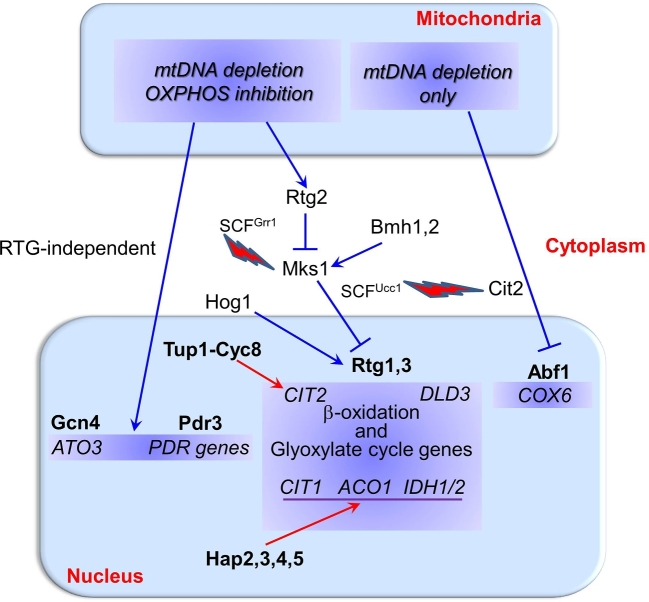
Retrograde communication pathways regulating gene transcription in yeast. Key yeast genes and proteins involved in the transcriptional regulatory network of signaling pathways from mitochondria to the cytoplasm and the nucleus (see text for details). Mitochondrial dysfunction due to mtDNA depletion or OXPHOS enzyme complex inhibition can trigger retrograde pathways (blue lines), which activate-nuclear transcription to induce cell adaptation (see text for details). Dysfunctional mitochondria can activate different retrograde transcriptional responses that can be regulated by either RTG genes or alternative transcription factors and regulators, such as Abf1, Gcn4 and Pdr3. Hog1 can regulate RTG-dependent target genes. Nuclear genes highlighted in blue are upregulated by the bolded transcription factors located above them. Certain RTG-pathway target genes can also be regulated by anterograde transcription factors (see Fig. 1, red lines). The level of both retrograde target-gene products (e.g. Cit2) and regulators (e.g. Mks1) is under proteasomal degradation control, as indicated by the lightning bolts associated with the SCF ubiquitin ligase complexes.
Figure 3.
Figure 3.
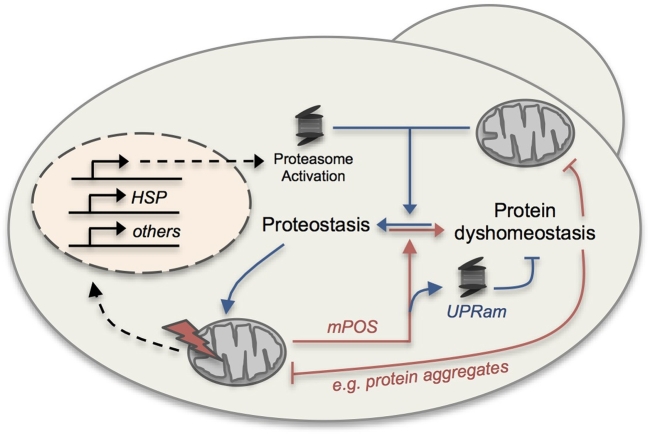
Proteostatic crosstalk between mitochondria and the cytosol in yeast. A schematic of proteostatic crosstalk between mitochondria and the cytosol. Dysfunctional mitochondria (depicted with the red lightning bolt) can compromise cytosolic proteostasis via mitochondrial precursor overaccumulation stress (mPOS), which induces the unfolded protein response activated by mistargeting of proteins (UPRam) to improve cytosolic protein dyshomeostasis. Healthy mitochondria (without the lightning bolt) can benefit cytosolic proteostasis via mechanisms including increase in ATP supply, decrease in ROS production and the MAGIC pathway. Conversely, cytosolic proteostasis influences mitochondrial function. Beneficial and deleterious interactions are depicted by blue and red lines, respectively.

References

    1. Amigoni L, Martegani E, Colombo S. Lack of HXK2 induces localization of active ras in mitochondria and triggers apoptosis in the yeast Saccharomyces cerevisiae. Oxid Med Cell Longev 2013;2013:1–10. - PMC - PubMed
    1. Arnold I, Wagner-Ecker M, Ansorge W et al. Evidence for a novel mitochondria-to-nucleus signalling pathway in respiring cells lacking i-AAA protease and the ABC-transporter Mdl1. Gene 2006;367:74–88. - PubMed
    1. Baker BM, Nargund AM, Sun T et al. Protective coupling of mitochondrial function and protein synthesis via the eIF2alpha kinase GCN-2. PLoS Genet 2012;8:e1002760. - PMC - PubMed
    1. Behan A, Doyle S, Farrell M. Adaptive responses to mitochondrial dysfunction in the rho degrees Namalwa cell. Mitochondrion 2005;5:173–93. - PubMed
    1. Belotti F, Tisi R, Paiardi C et al. Localization of Ras signaling complex in budding yeast. Biochim Biophys Acta 2012;1823:1208–16. - PubMed

Publication types

MeSH terms

LinkOut - more resources