


Genome-wide definition of selective sweeps reveals molecular evidence of trait-driven domestication among elite goat (Capra species) breeds for the production of dairy, cashmere, and meat
- PMID: 30165633
- PMCID: PMC6287099
- DOI: 10.1093/gigascience/giy105
Genome-wide definition of selective sweeps reveals molecular evidence of trait-driven domestication among elite goat (Capra species) breeds for the production of dairy, cashmere, and meat
Abstract
Background: The domestication of wild goats and subsequent intensive trait-driven crossing, inbreeding, and selection have led to dramatic phenotypic purification and intermediate breeds for the high-quality production of dairy, cashmere wool, and meat. Genomic resequencing provides a powerful means for the direct identification of trait-associated sequence variations that underlie molecular mechanisms of domestication.
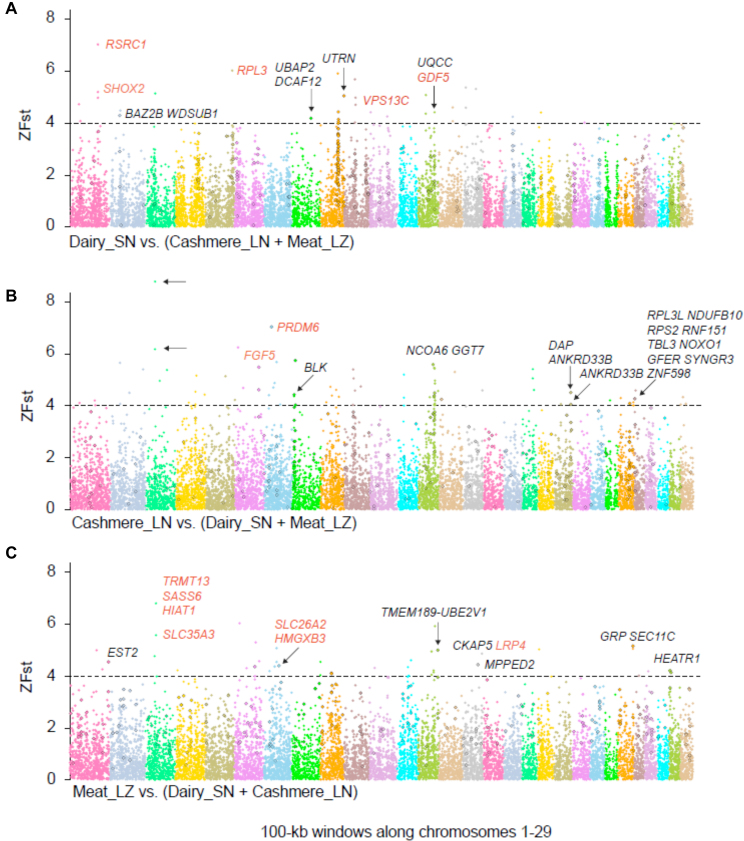
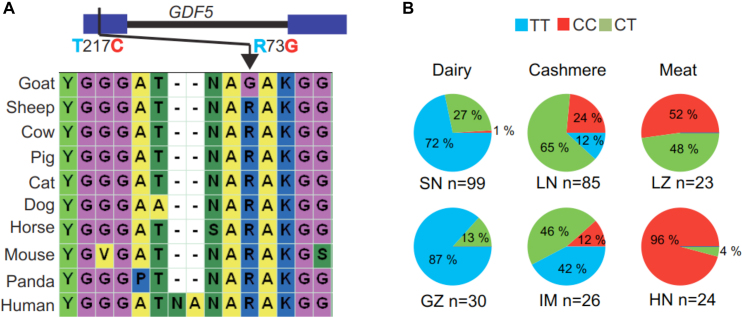
Results: Here, we report our effort to define such variations based on data from domestic goat breeds (Capra aegagrus hircus; five each) selected for dairy, cashmere, and meat production in reference to their wild ancestors, the Sindh ibex (Capra aegagrus blythi; two) and the Markhor (Capra falconeri; two). Using ∼24 million high-quality single nucleotide polymorphisms (SNPs), ∼1.9 million insertions/deletions, and 2,317 copy number variations, we define SNP-desert-associated genes (SAGs), domestic-associated genes (DAGs), and trait-associated genes (TAGs) and attempt to associate them with quantitative trait loci (QTL), domestication, and agronomic traits. A greater majority of SAGs shared by all domestic breeds are classified into Gene Ontology categories of metabolism and cell cycle. DAGs, together with some SAGs, are most relevant to behavior, immunity, and trait specificity. Whereas, TAGs such as growth differentiation factor 5 and fibroblast growth factor 5 for bone and hair growth, respectively, appear to be directly involved in growth regulation.
Conclusions: When investigating the divergence of Capra populations, the sequence variations and candidate function-associated genes we have identified provide valuable molecular markers for trait-driven genetic mapping and breeding.
Figures
References
-
- Zeder MA, Hesse B. The initial domestication of goats (Capra hircus) in the Zagros Mountains 10,000 years ago. Science. 2000;287(5461):2254–7. - PubMed
-
- Taberlet P, Valentini A, Rezaei HR, et al. Are cattle, sheep, and goats endangered species?. Mol Ecol. 2008;17(1):275–84. - PubMed
-
- Hatziminaoglou Y, Boyazoglu J. The goat in ancient civilisations: from the Fertile Crescent to the Aegean Sea. Small Ruminant Res. 2004;51(2):123–9.
-
- Taberlet P, Coissac E, Pansu J, et al. Conservation genetics of cattle, sheep, and goats. CR Biol. 2011;334(3):247–54. - PubMed
Publication types
MeSH terms
Substances
LinkOut - more resources
Full Text Sources
Other Literature Sources
