Review
. 2018 Oct 2;38(5):BSR20180705.
doi: 10.1042/BSR20180705. Print 2018 Oct 31.

Plasminogen-binding proteins as an evasion mechanism of the host's innate immunity in infectious diseases

Affiliations
Review

Plasminogen-binding proteins as an evasion mechanism of the host's innate immunity in infectious diseases

Dolores A Ayón-Núñez et al. Biosci Rep. .

Abstract

Pathogens have developed particular strategies to infect and invade their hosts. Amongst these strategies' figures the modulation of several components of the innate immune system participating in early host defenses, such as the coagulation and complement cascades, as well as the fibrinolytic system. The components of the coagulation cascade and the fibrinolytic system have been proposed to be interfered during host invasion and tissue migration of bacteria, fungi, protozoa, and more recently, helminths. One of the components that has been proposed to facilitate pathogen migration is plasminogen (Plg), a protein found in the host's plasma, which is activated into plasmin (Plm), a serine protease that degrades fibrin networks and promotes degradation of extracellular matrix (ECM), aiding maintenance of homeostasis. However, pathogens possess Plg-binding proteins that can activate it, therefore taking advantage of the fibrin degradation to facilitate establishment in their hosts. Emergence of Plg-binding proteins appears to have occurred in diverse infectious agents along evolutionary history of host-pathogen relationships. The goal of the present review is to list, summarize, and analyze different examples of Plg-binding proteins used by infectious agents to invade and establish in their hosts. Emphasis was placed on mechanisms used by helminth parasites, particularly taeniid cestodes, where enolase has been identified as a major Plg-binding and activating protein. A new picture is starting to arise about how this glycolytic enzyme could acquire an entirely new role as modulator of the innate immune system in the context of the host-parasite relationship.

Keywords: Plasminogen; enolase; fibrinolytic system; host/parasite relationship; immune evasion.


Conflict of interest statement

The authors declare that there are no competing interests associated with the manuscript.

Figures

Figure 1
Figure 1. Relationship of coagulation and complement cascades with the fibrinolytic system
The coagulation cascade has two pathways: the intrinsic and the extrinsic. Both pathways merge through factors V and X, resulting in the formation of clots. The fibrinolytic system relates with the final stage of the coagulation cascade, and its primary function is the proteolytic elimination of clots on blood vessels. Complement C5 can be activated by several coagulation enzymes (thrombin, factor IXa, factor Xa, factor XIa, and kallikrein). Plm can also activate complement through C5 degradation.
Figure 2
Figure 2. The structure of human Plg
Domains are labeled and colored as follows: Pap, blue; KR1, pink; KR2, yellow; KR3, orange; KR4, green; KR5, purple; SP, cyan. The chloride ions (Cl) 1 and 2 are in the interface KR4/PAp and KR2/SP, respectively, and are shown as spheres. Two other chloride ions 3 and 4, bind to the KR2 and SP domain, respectively. The position of the activation loop is marked with a red sphere. The LR of KR1 is marked with an asterisk (*). Figure taken from Law et al. (2012) [38].
Figure 3
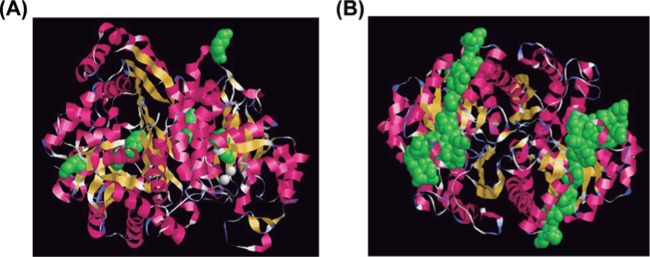
Figure 3. Molecular modeling of T. solium enolase A (TsEnoA) showing Plg binding sites
(A) Identification of the C-terminal lysine residues are shown in green; (B) identification of the internal Plg-binding motif of T. solium enolase (also shown in green). The modeling was done in: http://www.openrasmol.org/.

References

    1. Figuera L., Gómez-Arreaza A. and Avilán L. (2013) Parasitism in optima forma: Exploiting the host fibrinolytic system for invasion. Acta Trop. 128, 116–123 10.1016/j.actatropica.2013.06.023 - DOI - PubMed
    1. Raymond B.B. and Djordjevic S. (2015) Exploitation of plasmin(ogen) by bacterial pathogens of veterinary significance. Vet. Microbiol. 178, 1–13 10.1016/j.vetmic.2015.04.008 - DOI - PubMed
    1. González-Miguel J., Siles-Lucas M., Kartashev V., Morchón R. and Simón F. (2016) Plasmin in parasitic chronic infections: friend or foe? Trends Parasitol. 32, 325–335 10.1016/j.pt.2015.12.012 - DOI - PubMed
    1. Hansell E., Braschi S., Medzihradszky K.F., Sajid M., Debnath M., Ingram J. et al. (2008) Proteomic analysis of skin invasion by blood fluke larvae. PLoS Negl. Trop. Dis. 16, e262 10.1371/journal.pntd.0000262 - DOI - PMC - PubMed
    1. Harnett W. (2014) Secretory products of helminth parasites as immunomodulators. Mol. Biochem. Parasitol. 195, 130–136 10.1016/j.molbiopara.2014.03.007 - DOI - PubMed

Publication types

MeSH terms