. 2018 Aug 30;9(1):3534.
doi: 10.1038/s41467-018-05877-z.

Reprogramming of the antimycin NRPS-PKS assembly lines inspired by gene evolution

Affiliations

Reprogramming of the antimycin NRPS-PKS assembly lines inspired by gene evolution

Takayoshi Awakawa et al. Nat Commun. .

Abstract

Reprogramming of the NRPS/PKS assembly line is an attractive method for the production of new bioactive molecules. However, it is usually hampered by the loss of intimate domain/module interactions required for the precise control of chain transfer and elongation reactions. In this study, we first establish heterologous expression systems of the unique antimycin-type cyclic depsipeptides: JBIR-06 (tri-lactone) and neoantimycin (tetra-lactone), and engineer their biosyntheses by taking advantage of bioinformatic analyses and evolutionary insights. As a result, we successfully accomplish three manipulations: (i) ring contraction of neoantimycin (from tetra-lactone to tri-lactone), (ii) ring expansion of JBIR-06 (from tri-lactone to tetra-lactone), and (iii) alkyl chain diversification of JBIR-06 by the incorporation of various alkylmalonyl-CoA extender units, to generate a set of unnatural derivatives in practical yields. This study presents a useful strategy for engineering NRPS-PKS module enzymes, based on nature's diversification of the domain and module organizations.


Conflict of interest statement

The authors declare no competing interests.

Figures
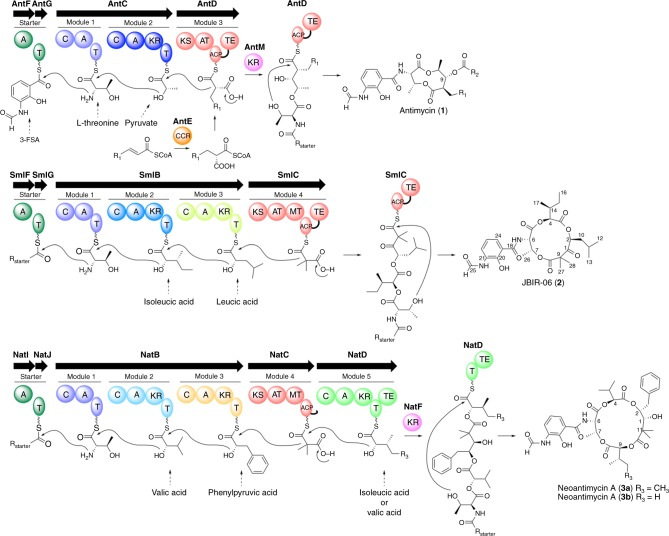
Fig. 1
Fig. 1
Organization of modular enzymes involved in the biosynthesis of antimycin-type depsipeptides. C condensation, A adenylation, T thiolation, KR ketoreductase, KS ketosynthase, AT acyltransferase, ACP acyl carrier protein, MT methyltransferase, TE thioesterase, CCR crotonyl-CoA reductase/carboxylase, R1 and R2 various alkyl groups, Rstarter the acyl moiety of 3-FSA. The module and domain organizations of the starter, the module 1, and the module 2 are identical among the all three systems. The starter and the module 1 uptake 3-FSA and L-threonine, respectively, common to all pathways, but the module 2 uptake pyruvate (AntC), isoleucic acid (SmlB), and valic acid (NatB), respectively. JBIR-06 and neoantimycin systems include an additional NRPS modules (module 3) after the module 2 in the same ORF. The module 3 in SmlB uptakes phenylpyruvic acid, and the module 3 in NatB uptakes leucic acid. The PKS modules of JBIR-06 and neoantimycin systems (module 4) contain MT domain between AT and ACP, and accept malonyl-CoA as an extender unit, to yield dimethyl group at the α-position of polyketide moiety, differently from antimycin system. Furthermore, neoantimycin system includes an extra NRPS module (module 5 as NatD) which uptakes isoleucic acid or valic acid
Fig. 2
Fig. 2
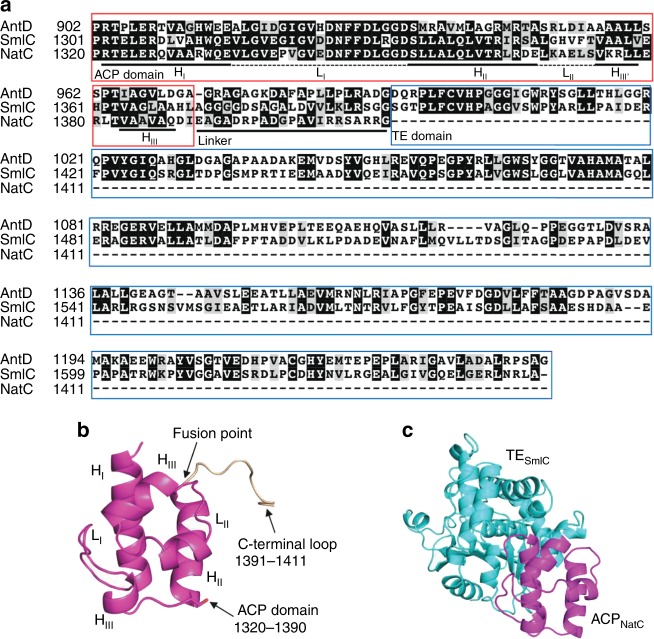
Bioinformatic analyses of the antimycin PKS modules. a Alignment of the PKS modules, AntD, SmlC, and NatC. We annotated SmlC1301–1371 as an ACP domain (region 1), SmlC1372–1392 as an interdomain linker, SmlC1393–1647 as a TE domain (region 2), and NatC1391–1411 as a docking domain. b A homology model of ACPNatC (1320–1411), based on the reported crystal structure of the surfactin synthase ACP subunit (PBD: 2VSQ) as the template. c A homology model of the ACPNatC-TESmlC domains, the NRPS module from Acinetobacter baumannii (NCBI PBD ID 4ZXH_A, https://www.ncbi.nlm.nih.gov/protein/4ZXH_A) was used as the template
Fig. 3
Fig. 3
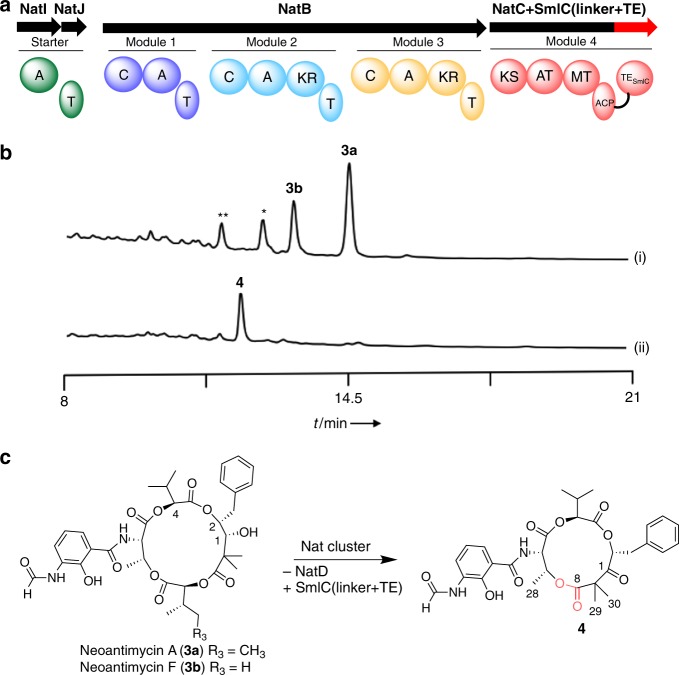
Ring contraction of neoantimycin A. a The reconstructed module structure for ring contraction. b HPLC analyses of the metabolites from transformants harboring (i) pKU518nant and (ii) pKU518nantΔnatD::smlCTE. The chromatogram represents the UV absorbance at 320 nm. * and ** indicate unidentified analogs with m/z values that were 14 and 28 less than 3b, respectively. c Engineering scheme and structure of 4
Fig. 4
Fig. 4
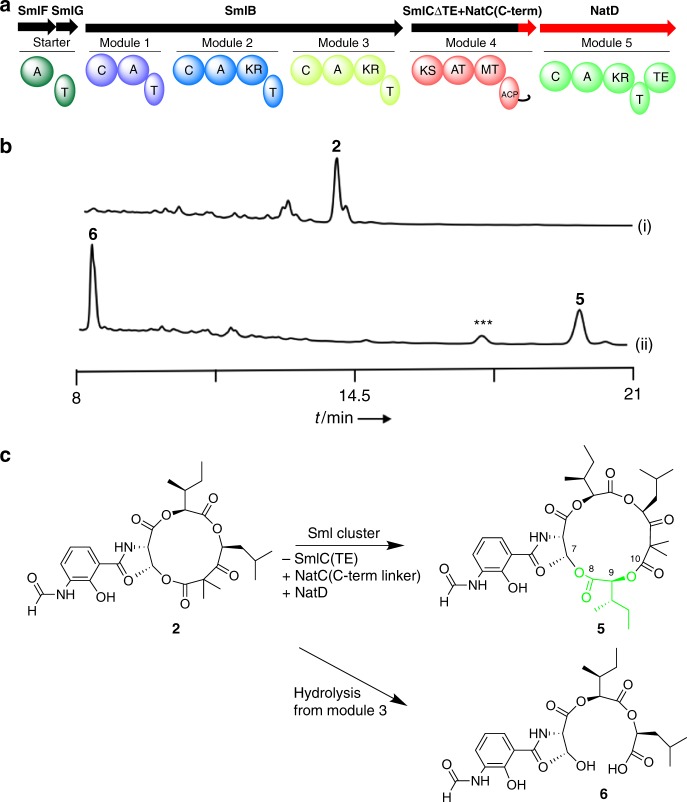
Ring expansion of JBIR-06. a The reconstructed module structure for ring expansion. b HPLC analyses of the metabolites from transformants harboring (i) pKU518J06 and (ii) pKU518J06ΔsmlCTE/pZH2-NatD. The chromatogram represents the UV absorbance at 320 nm. *** indicates a mixture of analogs with m/z values that are 14 less than 5. c Engineering scheme and structure of 5 and 6
Fig. 5
Fig. 5
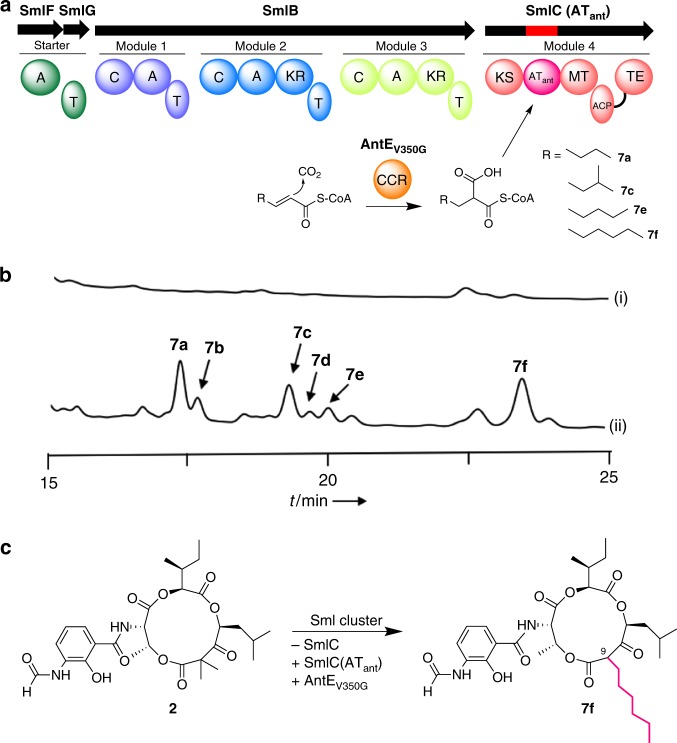
Alkyl chain diversification of JBIR-06. a The reconstituted module structure for alkyl chain diversification. b HPLC analysis of the metabolites from transformants harboring (i) pKU518J06 and (ii) pKU518J06ΔSmlC/pZH2-SmlCATant-AntEV350G. The chromatogram represents the UV absorbance at 320 nm. c Engineering scheme and structure of the representative product 7f

References

    1. Walsh CT. Polyketide and nonribosomal peptide antibiotics: modularity and versatility. Science. 2004;303:1805–1810. doi: 10.1126/science.1094318. - DOI - PubMed
    1. Walsh CT, O’Connor SE, Schneider TL. Polyketide-nonribosomal peptide epothilone antitumor agents: the EpoA, B, C subunits. J. Ind. Microbiol. Biotechnol. 2003;30:448–455. doi: 10.1007/s10295-003-0044-2. - DOI - PubMed
    1. Wakimoto T, et al. Calyculin biogenesis from a pyrophosphate protoxin produced by a sponge symbiont. Nat. Chem. Biol. 2014;10:648–655. doi: 10.1038/nchembio.1573. - DOI - PubMed
    1. Wakimoto T, Egami Y, Abe I. Calyculin: nature’s way of making the sponge-derived cytotoxin. Nat. Prod. Rep. 2016;33:751–760. doi: 10.1039/C5NP00123D. - DOI - PubMed
    1. Sattely ES, Fischbach MA, Walsh CT. Total biosynthesis: in vitro reconstitution of polyketide and nonribosomal peptide pathways. Nat. Prod. Rep. 2008;25:757. doi: 10.1039/b801747f. - DOI - PubMed

Publication types

MeSH terms