Review
. 2017 Sep 22;6(9):e17039.
doi: 10.1038/lsa.2017.39. eCollection 2017 Sep.

Optical manipulation from the microscale to the nanoscale: fundamentals, advances and prospects

Affiliations
Review

Optical manipulation from the microscale to the nanoscale: fundamentals, advances and prospects

Dongliang Gao et al. Light Sci Appl. .

Abstract

Since the invention of optical tweezers, optical manipulation has advanced significantly in scientific areas such as atomic physics, optics and biological science. Especially in the past decade, numerous optical beams and nanoscale devices have been proposed to mechanically act on nanoparticles in increasingly precise, stable and flexible ways. Both the linear and angular momenta of light can be exploited to produce optical tractor beams, tweezers and optical torque from the microscale to the nanoscale. Research on optical forces helps to reveal the nature of light-matter interactions and to resolve the fundamental aspects, which require an appropriate description of momenta and the forces on objects in matter. In this review, starting from basic theories and computational approaches, we highlight the latest optical trapping configurations and their applications in bioscience, as well as recent advances down to the nanoscale. Finally, we discuss the future prospects of nanomanipulation, which has considerable potential applications in a variety of scientific fields and everyday life.

Keywords: biochemical manipulation; microscale; nanoscale; optical force; optical tweezer; plasmonics.


Conflict of interest statement

The authors declare no conflict of interest.

Figures
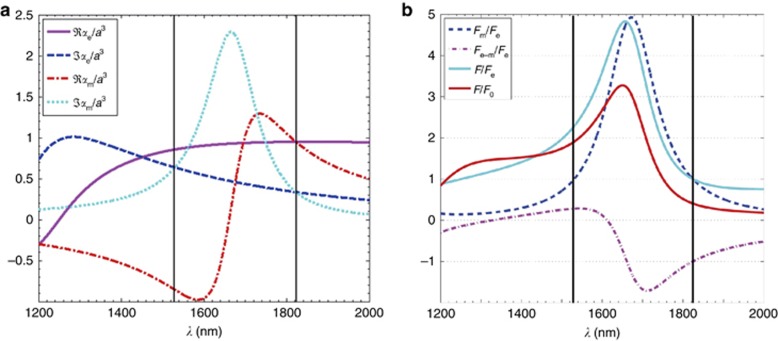
Figure 1
Figure 1
The contribution of electric and magnetic terms on optical force. (a) Real and imaginary parts of the electric and magnetic polarizabilities of a Si sphere with a=230 nm normalized to a3. (b) Electric, magnetic and electric–magnetic interference contributions to the optical force on the Si particle. F0=ka3/2. The right and left vertical lines mark the wavelengths corresponding to the first and second Kerker conditions, respectively. Reprinted with permission from Ref. , © 2011 Optical Society of America.
Figure 2
Figure 2
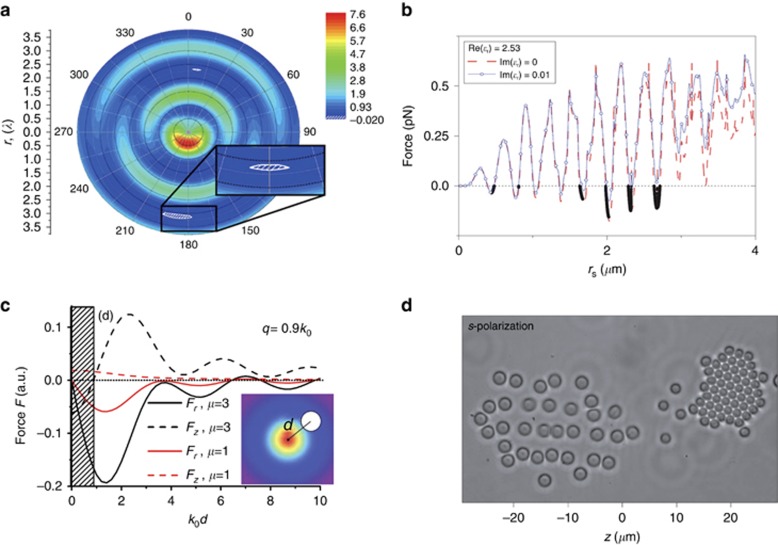
Optical trapping by structured beams. (a) Distribution of the optical force along the wave axis of a silver nanoparticle at 400 nm. The inset shows the region of the NOF. (b) The optical force on a polystyrene sphere by a Bessel beam. Optical pulling force is possible for different radii of polystyrene particles. (c) The longitudinal forces Fz and radial forces Fr with a change in the radial distance between the particle and beam axis. The shaded region represents a stable pulling effect due to Fz<0 and Fr<0. Objects near the axis are confined by the gradient force and are transported in the propagation direction by the scattering force. (d) Polystyrene particles with radii of 800 and 1000 nm are separated by an s-polarized beam. Figure a reprinted with permission from Ref. , © 2010 Optical Society of America, b from Ref. , © 2011 Nature Publishing Group, c from Ref. , © 2011 American Physical Society, and d from Ref. , © 2013 Nature Publishing Group.
Figure 3
Figure 3
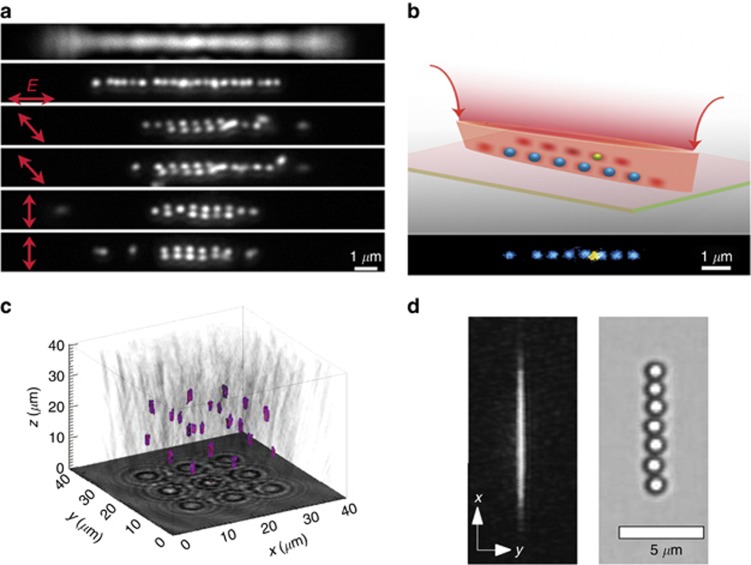
Optical binding forces between multiple particles. (a) Induced by optical binding, Ag nanoparticles with a 50 nm radius assemble into lines for different polarization directions. (b) Ag nanoparticles are formed into linear chains under coherent light. (c) Twenty-two silica spheres are arranged into a crystalline lattice with holographic optical tweezers. The colored regions are the positions of the particles in the lattice. (d) Holographic optical line tweezers in the focal plane and the image of seven silica spheres trapped along the line. Figure a reprinted with permission from Ref. and b from Ref. , © 2013 American Chemical Society, c from Ref. , © 2011 Optical Society of America, and d from Ref. , © 2008 American Physical Society.
Figure 4
Figure 4
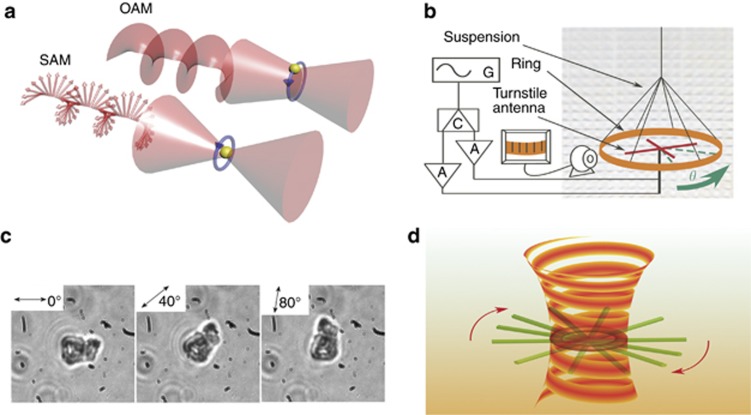
Optical torque via angular momentum. (a) In optical trapping, the transfer of OAM (associated with helical phase fronts) rotates a particle around the beam axis, whereas the transfer of SAM (associated with a polarization vector) causes a particle to spin around its own center. (b) Experimental set-up of the transfer of OAM to a suspended copper ring in the microwave region. (c) The trapped birefringent particles were rotated by rotating the half-wave plate that controlled the polarization of the trapping beam. (d) The rotation of a single silver nanowire was due to plasmonic interactions of nanowires with the optical vortex beam. Figure b reprinted with permission from Ref. , © 2014 American Physical Society; c from Ref. and its erratum, © 1998 Nature Publishing Group, and d from Ref. , © 2013 American Chemical Society.
Figure 5
Figure 5
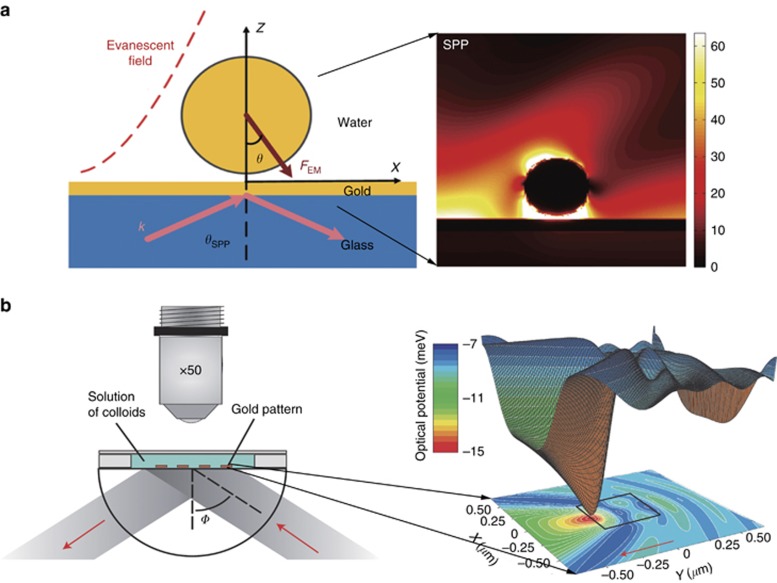
The enhancement of optical force via plasmonics. (a) Schematic of OM and power flow magnitudes for SPP excitation. (b) Scheme of the experimental configuration and the computed optical potential for a 200 nm polystyrene bead near a gold pad. Figure a reprinted with permission from Ref. , © 2009 American Chemical Society, and b from Ref. , © 2007 Nature Publishing Group.
Figure 6
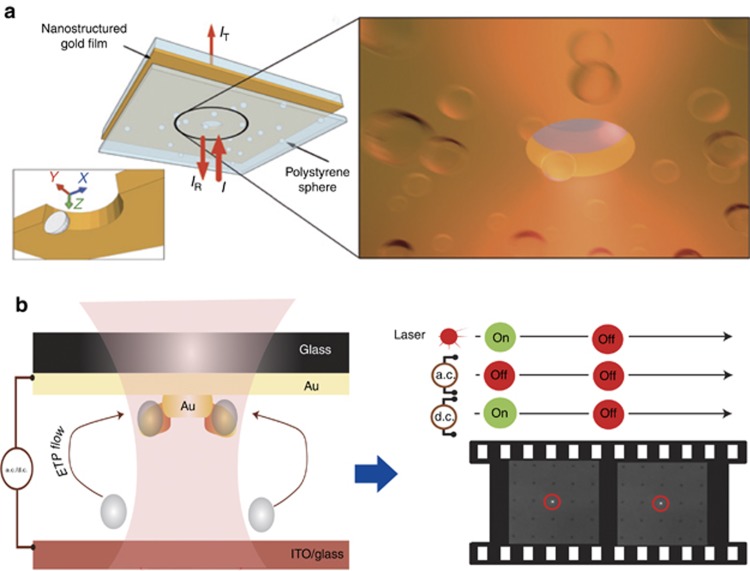
Figure 6
Plasmonic traps manipulating nanoparticles. (a) Self-induced back-action plasmonic trap for 100 nm polystyrene spheres in water. The trapped spheres play an active role: their positions strongly affect the aperture transmission, whereas departure from their equilibrium point leads to an automatic restoring force. Figure reprinted with permission from Ref. , © 2009 Nature Publishing Group. (b) Experimental set-up for the electrothermoplasmonic nanotweezer (left). Particles are delivered to plasmonic hotspots and immobilized by an applied d.c. field (right). Figure reprinted with permission from Ref. , © 2015 Nature Publishing Group.
Figure 7
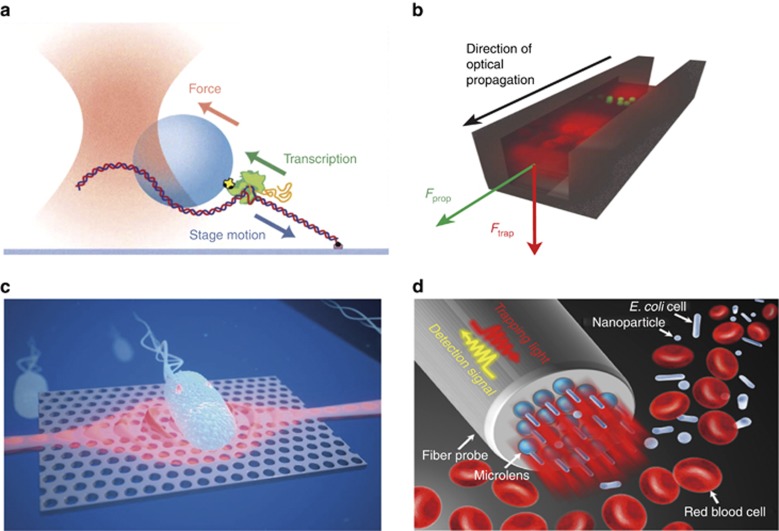
Figure 7
The applications of optical traps in biochemical manipulation. (a) Schematic of an optical tweezers-based assay for measuring the force on RNA polymerase during DNA transcription. (b) Schematic of the slot waveguide used to transport small particles and λ-DNA. (c) Artist’s impression of a photonic crystal with a cavity for trapping bacteria. (d) Trapping and biosensing: parallel photonic nanojet array can be used to selectively trap and detect nanoparticles and biological cells. Figure a reprinted with permission from Ref. , © 2003 Elsevier, b from Ref. , © 2009 Nature Publishing Group, c from Ref. , © 2013 Royal Society of Chemistry (Great Britain), and d from Ref. , © 2016 American Chemical Society.
Figure 8
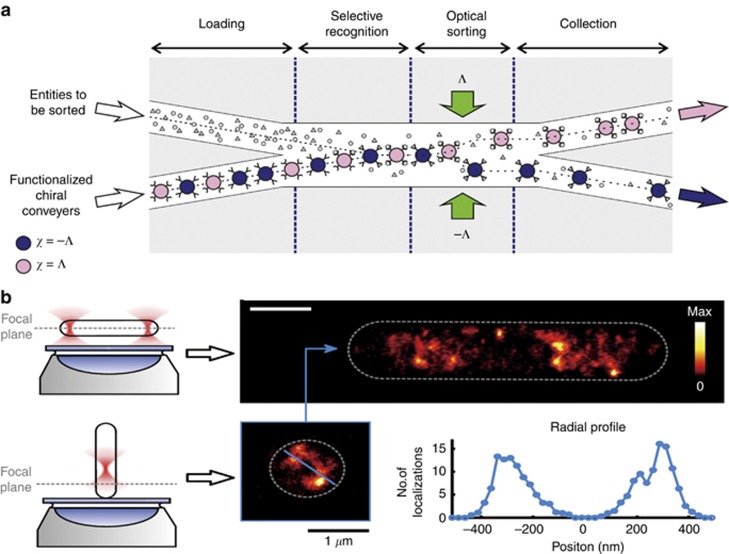
Figure 8
Optical sorting and imaging. (a) Optical chiral sorting for a random sequence of mixed chiral microparticles. (b) Holographic optical tweezers render high-resolution images of one cell from horizontal alignment and vertical alignment. Figure a reprinted with permission from Ref. , © 2014 Nature Publishing Group, and b from Ref. , © 2016 Nature Publishing Group.

References

    1. Ashkin A, Dziedzic JM, Bjorkholm JE, Chu S. Observation of a single-beam gradient force optical trap for dielectric particles. Opt Lett 1986; 11: 288–290. - PubMed
    1. Ashkin A. Acceleration and trapping of particles by radiation pressure. Phys Rev Lett 1970; 24: 156–159.
    1. Dholakia K, Zemánek P. Colloquium: gripped by light: optical binding. Rev Mod Phys 2010; 82: 1767–1791.
    1. Burns MM, Fournier J-M, Golovchenko JA. Optical binding. Phys Rev Lett 1989; 63: 1233–1236. - PubMed
    1. Chaumet PC, Nieto-Vesperinas M. Optical binding of particles with or without the presence of a flat dielectric surface. Phys Rev B 2001; 64: 035422.