Risk Factors Associated With Attempted Suicide Among US Army Soldiers Without a History of Mental Health Diagnosis
- PMID: 30167650
- PMCID: PMC6233801
- DOI: 10.1001/jamapsychiatry.2018.2069
Risk Factors Associated With Attempted Suicide Among US Army Soldiers Without a History of Mental Health Diagnosis
Abstract
Importance: The US Army suicide attempt rate increased sharply during the wars in Afghanistan and Iraq. Although soldiers with a prior mental health diagnosis (MH-Dx) are known to be at risk, little is known about risk among those with no history of diagnosis.
Objective: To examine risk factors for suicide attempt among soldiers without a previous MH-Dx.
Design, setting, and participants: In this retrospective longitudinal cohort study using administrative data from the Army Study to Assess Risk and Resilience in Servicemembers (Army STARRS), person-month records were identified for all active-duty Regular Army enlisted soldiers who had a medically documented suicide attempt from January 1, 2004, through December 31, 2009 (n = 9650), and an equal-probability sample of control person-months (n = 153 528). Data analysis in our study was from September 16, 2017, to June 6, 2018. In a stratified sample, it was examined whether risk factors for suicide attempt varied by history of MH-Dx.
Main outcomes and measures: Suicide attempts were identified using Department of Defense Suicide Event Report records and International Classification of Diseases, Ninth Revision, Clinical Modification E95 × diagnostic codes. Mental health diagnoses and related codes, as well as sociodemographic, service-related, physical health care, injury, subjection to crime, crime perpetration, and family violence variables, were constructed from Army personnel, medical, legal, and family services records.
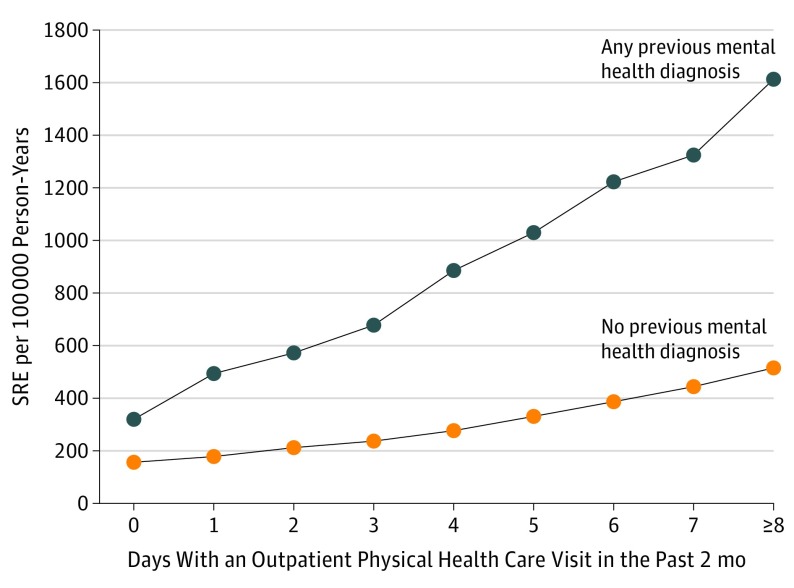
Results: Among 9650 enlisted soldiers with a documented suicide attempt (74.8% male), 3507 (36.3%) did not have a previous MH-Dx. Among soldiers with no previous diagnosis, the highest adjusted odds of suicide attempt were for the following: female sex (odds ratio [OR], 2.6; 95% CI, 2.4-2.8), less than high school education (OR, 1.9; 95% CI, 1.8-2.0), first year of service (OR, 6.0; 95% CI, 4.7-7.7), previously deployed (OR, 2.4; 95% CI, 2.1-2.8), promotion delayed 2 months or less (OR, 2.1; 95% CI, 1.7-2.6), past-year demotion (OR, 1.6; 95% CI, 1.3-1.8), 8 or more outpatient physical health care visits in the past 2 months (OR, 3.3; 95% CI, 2.9-3.8), past-month injury-related outpatient (OR, 3.0; 95% CI, 2.8-3.3) and inpatient (OR, 3.8; 95% CI, 2.3-6.3) health care visits, previous combat injury (OR, 1.6; 95% CI, 1.0-2.4), subjection to minor violent crime (OR, 1.6; 95% CI, 1.1-2.4), major violent crime perpetration (OR, 2.0; 95% CI, 1.3-3.0), and family violence (OR, 2.9; 95% CI, 1.9-4.4). Most of these variables were also associated with suicide attempts among soldiers with a previous MH-Dx, although the strength of associations differed.
Conclusions and relevance: Suicide attempt risk among soldiers with unrecognized mental health problems is a significant and important challenge. Administrative records from personnel, medical, legal, and family services systems can assist in identifying soldiers at risk.
Conflict of interest statement
Figures
Comment in
-
Suicide Prevention in the US Army: A Mission for More Than Mental Health Clinicians.JAMA Psychiatry. 2018 Oct 1;75(10):991-992. doi: 10.1001/jamapsychiatry.2018.2042. JAMA Psychiatry. 2018. PMID: 30167637 No abstract available.
References
-
- Schoenbaum M, Kessler RC, Gilman SE, et al. ; Army STARRS Collaborators . Predictors of suicide and accident death in the Army Study to Assess Risk and Resilience in Servicemembers (Army STARRS): results from the Army Study to Assess Risk and Resilience in Servicemembers (Army STARRS). JAMA Psychiatry. 2014;71(5):493-503. doi: 10.1001/jamapsychiatry.2013.4417 - DOI - PMC - PubMed
-
- Black SA, Gallaway MS, Bell MR, Ritchie EC. Prevalence and risk factors associated with suicides of Army soldiers 2001-2009. Mil Psychol. 2011;23(4):433-451.
Publication types
MeSH terms
Grants and funding
LinkOut - more resources
Full Text Sources
Other Literature Sources
Medical
Miscellaneous