


Methods to Compare Adverse Events in Twitter to FAERS, Drug Information Databases, and Systematic Reviews: Proof of Concept with Adalimumab
- PMID: 30167992
- PMCID: PMC6223697
- DOI: 10.1007/s40264-018-0707-6
Methods to Compare Adverse Events in Twitter to FAERS, Drug Information Databases, and Systematic Reviews: Proof of Concept with Adalimumab
Abstract
Introduction: Adverse drug reactions (ADRs) are associated with significant health-related and financial burden, and multiple sources are currently utilized to actively discover them. Social media has been proposed as a potential resource for monitoring ADRs, but drug-specific analytical studies comparing social media with other sources are scarce.
Objectives: Our objective was to develop methods to compare ADRs mentioned in social media with those in traditional sources: the US FDA Adverse Event Reporting System (FAERS), drug information databases (DIDs), and systematic reviews.
Methods: A total of 10,188 tweets mentioning adalimumab collected between June 2014 and August 2016 were included. ADRs in the corpus were extracted semi-automatically and manually mapped to standardized concepts in the Unified Medical Language System. ADRs were grouped into 16 biologic categories for comparisons. Frequencies, relative frequencies, disproportionality analyses, and rank ordering were used as metrics.
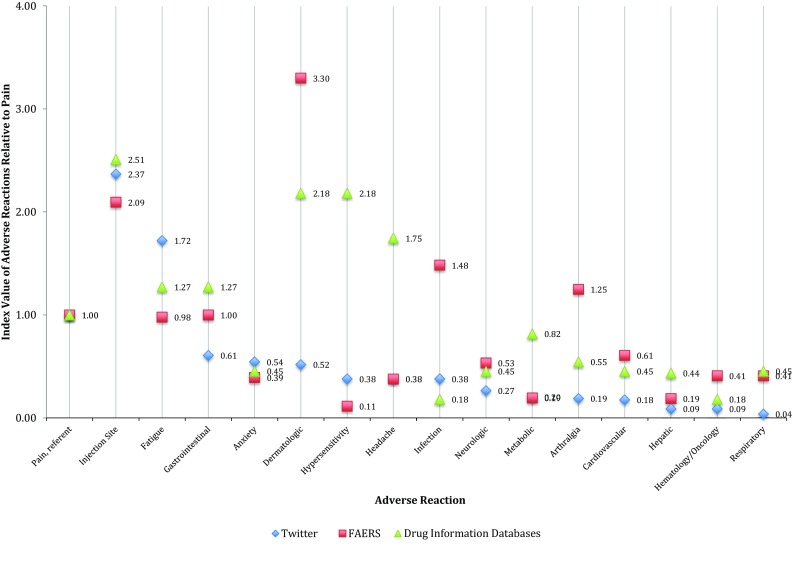
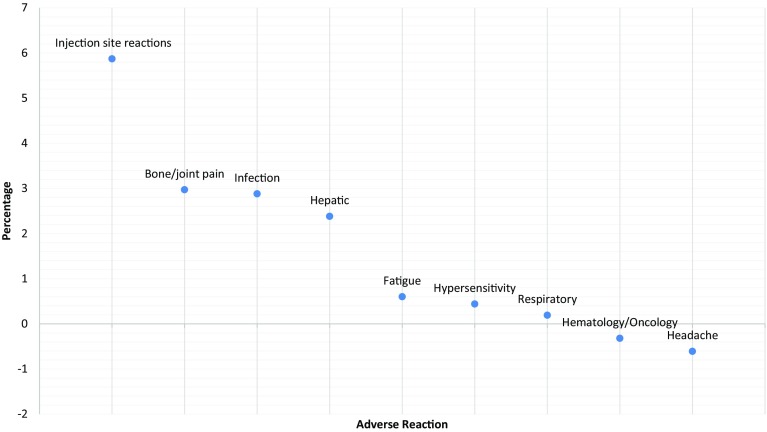
Results: There was moderate agreement between ADRs in social media and traditional sources. "Local and injection site reactions" was the top ADR in Twitter, DIDs, and systematic reviews by frequency, ranked frequency, and index ranking. The next highest ADR in Twitter-fatigue-ranked fifth and seventh in FAERS and DIDs.
Conclusion: Social media posts often express mild and symptomatic ADRs, but rates are measured differently in scientific sources. ADRs in FAERS are reported as absolute numbers, in DIDs as percentages, and in systematic reviews as percentages, risk ratios, or other metrics, which makes comparisons challenging; however, overlap is substantial. Social media analysis facilitates open-ended investigation of patient perspectives and may reveal concepts (e.g. anxiety) not available in traditional sources.
Conflict of interest statement
Karen Smith, Su Golder, Abeed Sarker, Yoon Loke, Karen O’Connor, and Graciela Gonzalez-Hernandez have no conflicts of interest that are directly relevant to the contents of this study. After the commencement of this study, Graciela Gonzalez-Hernandez received funding from AbbVie Inc. for an unrelated research project focusing on using social media to complement pregnancy registry information. AbbVie or its employees had no influence on or knowledge of the design, methodology, or findings discussed in this paper.
Figures
References
-
- Kongkaew C, Noyce PR, Ashcroft DM. Hospital admissions associated with adverse drug reactions: a systematic review of prospective observational studies. Ann Pharmacother. 2008;42(7):1017–1025. - PubMed
-
- FDA Adverse Event Reporting System (FAERS). http://www.fda.gov/Drugs/InformationOnDrugs/ucm135151.htm. Accessed 6 Jan 2016.
-
- Heinrich J. Adverse drug events: Substantial problem but magnitude uncertain: United States General Accounting Office; 2000. p. 6. http://www.gao.gov/new.items/he00053t.pdf. Accessed 10 Aug 2018.
-
- World Health Organization. Safety of medicines—a guide to detecting and reporting adverse drug reactions—why health professionals need to take action: World Health Organization; 2017. http://apps.who.int/medicinedocs/en/d/Jh2992e/3.html. Accessed Apr 2017.
Publication types
MeSH terms
Substances
Grants and funding
LinkOut - more resources
Full Text Sources
Other Literature Sources
Research Materials
