


Multi-sectoral action in non-communicable disease prevention policy development in five African countries
- PMID: 30168391
- PMCID: PMC6117629
- DOI: 10.1186/s12889-018-5826-6
Multi-sectoral action in non-communicable disease prevention policy development in five African countries
Abstract
Background: The rise of non-communicable diseases (NCDs) in Africa requires a multi-sectoral action (MSA) in their prevention and control. This study aimed to generate evidence on the extent of MSA application in NCD prevention policy development in five sub-Saharan African countries (Kenya, South Africa, Cameroon, Nigeria and Malawi) focusing on policies around the major NCD risk factors.
Methods: The broader study applied a multiple case study design to capture rich descriptions of policy contents, processes and actors as well as contextual factors related to the policies around the major NCD risk factors at single- and multi-country levels. Data were collected through document reviews and key informant interviews with decision-makers and implementers in various sectors. Further consultations were conducted with NCD experts on MSA application in NCD prevention policies in the region. For this paper, we report on how MSA was applied in the policy process.
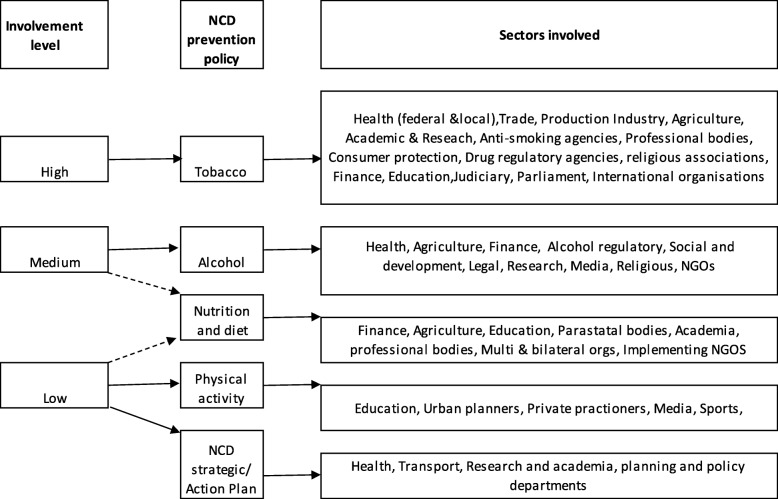
Results: The findings revealed some degree of application of MSA in NCD prevention policy development in these countries. However, the level of sector engagement varies across different NCD policies, from passive participation to active engagement, and by country. There was higher engagement of sectors in developing tobacco policies across the countries, followed by alcohol policies. Multi-sectoral action for tobacco and to some extent, alcohol, was enabled through established structures at national levels including inter-ministerial and parliamentary committees. More often coordination was enabled through expert or technical working groups driven by the health sectors. The main barriers to multi-sectoral action included lack of awareness by various sectors about their potential contribution, weak political will, coordination complexity and inadequate resources.
Conclusion: MSA is possible in NCD prevention policy development in African countries. However, the findings illustrate various challenges in bringing sectors together to develop policies to address the increasing NCD burden in the region. Stronger coordination mechanisms with clear guidelines for sector engagement are required for effective MSA in NCD prevention. Such a mechanisms should include approaches for capacity building and resource generation to enable multi-sectoral action in NCD policy formulation, implementation and monitoring of outcomes.
Keywords: Africa; Disease; Multi-sectoral; Non-communicable; Policies.
Conflict of interest statement
Ethics approval and consent to participate
The study was approved by and overseen by appropriate ethical committees in each countries including the National Ethics Committee for Health Research on Humans of the Ministry of Health of Cameroon; Kenya Medical Research Institute; University of Ibadan/University College Hospital Ethical Review Committee; Human Science Council Research Ethics Committee in South Africa: Malawi’s National Health Science and Research Committee. One case study that compared two countries was reviewed by three committees; in Togo by Togo Comite de Bioethique Pour la Recherche en Sante) and in South Africa by Human Sciences Research Council Research Ethics Committee, and University of Pretoria Health Sciences Research Ethics Committee. All country research teams followed appropriate ethics principles to protect the research subjects, including participant privacy and confidentiality, voluntary participation, the risks and benefits of research and how research findings would be shared. Participants provided verbal or written documentation of consent to participate.
Consent for publication
Not applicable.
Competing interests
The authors declare that they have no competing interests.
Publisher’s Note
Springer Nature remains neutral with regard to jurisdictional claims in published maps and institutional affiliations.
Figures
References
-
- Brown GW. Multisectoralism, participation, and stakeholder effectiveness: increasing the role of nonstate actors in the Global Fund to fight AIDS, tuberculosis, and malaria. Glob Gov. 2009;15(2):169–177.
-
- World Health Organization . Regional High level Consultation; Tehran, 2010. Background Paper: Noncommunicable diseases in low-and middle income countries. 2010.
MeSH terms
LinkOut - more resources
Full Text Sources
Other Literature Sources
