


No Useful Field Expansion with Full-field Prisms
- PMID: 30169356
- PMCID: PMC6121738
- DOI: 10.1097/OPX.0000000000001271
No Useful Field Expansion with Full-field Prisms
Abstract
Significance: Full-field prisms that fill the entire spectacle eye wire have been considered as field expansion devices for homonymous hemianopia (HH) and acquired monocular vision (AMV). Although the full-field prism is used for addressing binocular dysfunction and for prism adaptation training after brain injury as treatment for spatial hemineglect, we show that the full-field prism for field expansion does not effectively expand the visual field in either HH or AMV.
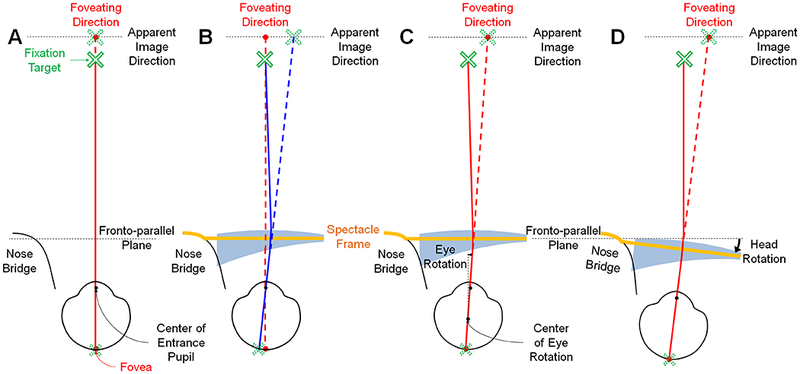
Purpose: Full-field prisms may shift a portion of the blind side to the residual seeing side. However, foveal fixation on an object of interest through a full-field prism requires head and/or eye rotation away from the blind side, thus negating the shift of the field toward the blind side.
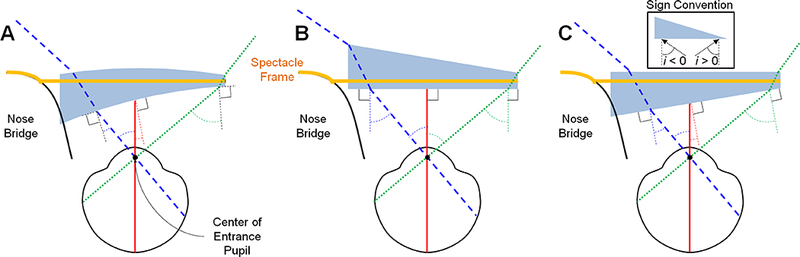
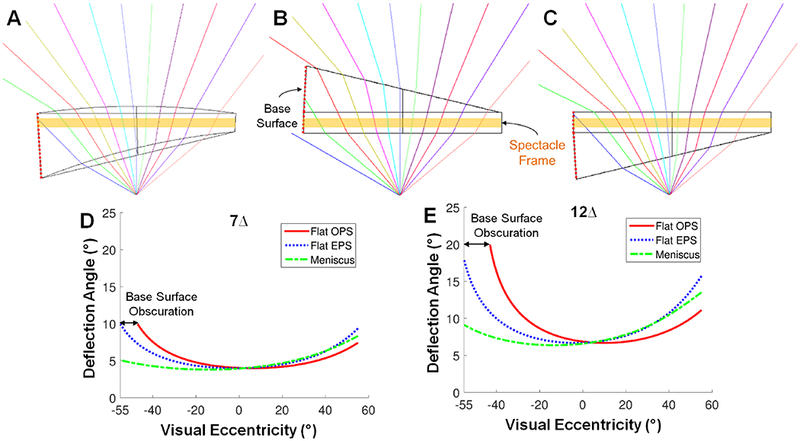
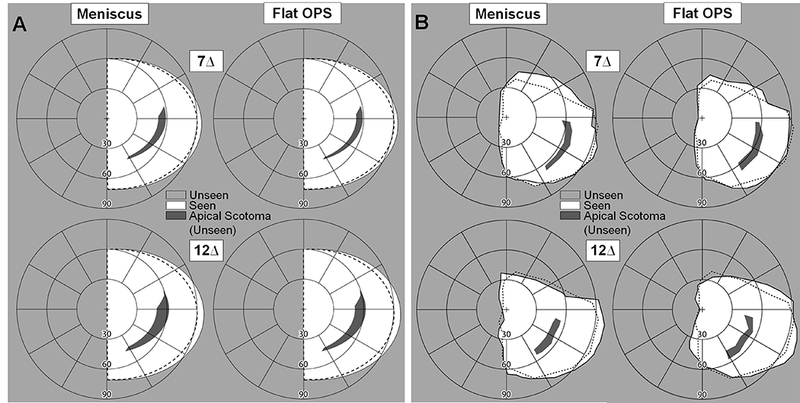
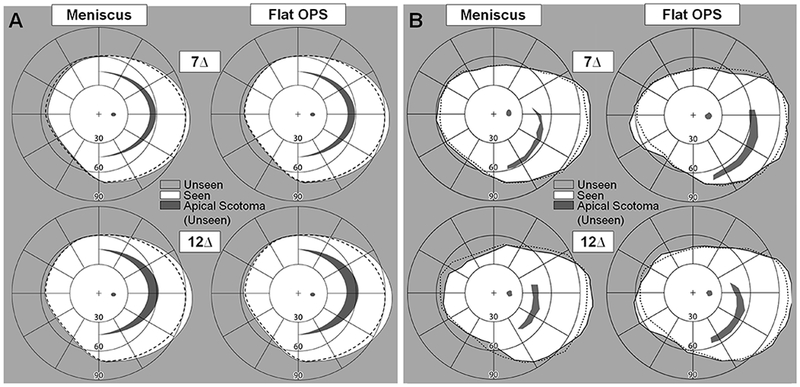
Methods: We fit meniscus and flat full-field 7Δ and 12Δ yoked prisms and conducted Goldmann perimetry in HH and AMV. We compared the perimetry results with ray tracing calculations.
Results: The rated prism power was in effect at the primary position of gaze for all prisms, and the meniscus prisms maintained almost constant power at all eccentricities. To fixate on the perimetry target, the subjects needed to turn their head and/or eyes away from the blind side, which negated the field shift into the blind side. In HH, there was no difference in the perimetry results on the blind side with any of the prisms. In AMV, the lower nasal field of view was slightly shifted into the blind side with the flat prisms, but not with the meniscus prisms.
Conclusions: Full-field prisms are not an effective field expansion device owing to the inevitable fixation shift. There is potential for a small field shift with the flat full-field prism in AMV, but such lenses cannot incorporate refractive correction. Furthermore, in considering the apical scotoma, the shift provides a mere field substitution at best.
Figures

References
-
- Cohen JM. An Overview of Enhancement Techniques for Peripheral Field Loss. J Am Optom Assoc 1993;64:60–70. - PubMed
-
- Cohen JM, Waiss B. Visual field remediation In: Cole RG, Rosenthal BP, eds. Remediation and Management of Low Vision. St. Louis: Mosby; 1996:1–25.
-
- Cotter SA. Uses of prism in low vision In: Weiss NJ, Brown WL, eds. Clinical Uses of Prism; a Spectrum of Applications. St. Louis: Mosby-Year Book, Inc.; 1995:279–300.
-
- Padula WV, Wu L, Vicci V, et al. Evaluating and treating visual dysfunction In: Zasler ND, Katz DI, Zafonte RD, eds. Brain Injury Medicine: Principles and Practice. New York: Demos; 2007:511–28.
-
- Rossetti Y, Rode G, Pisella L, et al. Prism Adaptation to a Rightward Optical Deviation Rehabilitates Left Hemispatial Neglect. Nature 1998;395:166–9. - PubMed
Publication types
MeSH terms
Grants and funding
LinkOut - more resources
Full Text Sources
Other Literature Sources
Medical
