


Long-term impact of evidence-based quality improvement for facilitating medical home implementation on primary care health professional morale
- PMID: 30170541
- PMCID: PMC6119243
- DOI: 10.1186/s12875-018-0824-4
Long-term impact of evidence-based quality improvement for facilitating medical home implementation on primary care health professional morale
Abstract
Background: Poor morale among primary care providers (PCPs) and staff can undermine the success of patient-centered care models such as the patient-centered medical home that rely on highly coordinated inter-professional care teams. Medical home literature hypothesizes that participation in quality improvement can ease medical home transformation. No studies, however, have assessed the impact of quality improvement participation on morale (e.g., burnout or dissatisfaction) during transformation. The objective of this study is to examine whether primary care practices participating in evidence-based quality improvement (EBQI) during medical home transformation reduced burnout and increased satisfaction over time compared to non-participating practices.
Methods: We used a longitudinal quasi-experimental design to examine the impact of EBQI (vs. no EBQI), a multi-level, interdisciplinary approach for engaging frontline primary care practices in developing evidence-based improvement innovations and tools for spread on PCP and staff morale following the 2010 national implementation of the medical home model in the Veterans Health Administration. The sample included 356 primary care employees (107 primary care providers and 249 staff) from 23 primary care practices (6 intervention and 17 comparison) within one Veterans Health Administration region. Three intervention practices began EBQI in 2011 (early) and three more began EBQI in 2012 (late). Three waves of surveys were administered across 42 months beginning in November 2011 and ending in January 2016 approximately 2 years 18 months apart. We used repeated measures analysis of the survey data on medical home teams. Main outcome measures were the emotional exhaustion subscale from the Maslach Burnout Inventory, and job satisfaction.
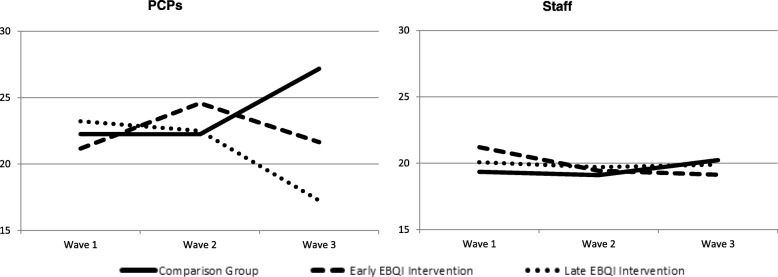
Results: Six of 26 approved EBQI innovations directly addressed provider and staff morale; all 26 addressed medical home implementation challenges. Survey rates were 63% for baseline and 48% for both follow-up waves. Age was associated with lower burnout among PCPs (p = .039) and male PCPs had higher satisfaction (p = .037). Controlling for practice and PCP/staff characteristics, burnout increased by 5 points for PCPs in comparison practices (p = .024) and decreased by 1.4 points for early and 6.8 points (p = .039) for the late EBQI practices.
Conclusions: Engaging PCPs and staff in EBQI reduced burnout over time during medical home transformation.
Keywords: Evidence-based quality improvement; Implementation; Patient-centered medical home; Primary care; Veterans.
Conflict of interest statement
Ethics approval and consent to participate
The study protocol, including ethics and consent to participate, was reviewed and approved by both the VA and RAND Institutional Review Boards (the Veterans Health Administration (VHA) Greater Los Angeles IRB and the Human Subjects Protection Committee, respectively). We informed potential participants in an initial email request for participation that included consent language which made it clear that clicking the button to start the survey indicated that they have consented.
Consent for publication
Not applicable.
Competing interests
The authors declare that they have no competing interests.
Publisher’s Note
Springer Nature remains neutral with regard to jurisdictional claims in published maps and institutional affiliations.
Figures

References
-
- Helfrich CD, Dolan ED, Simonetti J, Reid RJ, Joos S, Wakefield BJ, et al. Elements of team-based care in a patient-centered medical home are associated with lower burnout among VA primary care employees. J Gen Intern Med. 2014;29(Suppl 2):S659–S666. doi: 10.1007/s11606-013-2702-z. - DOI - PMC - PubMed
Publication types
MeSH terms
LinkOut - more resources
Full Text Sources
Other Literature Sources
