


A systematic review: the current status of carbapenem resistance in East Africa
- PMID: 30170613
- PMCID: PMC6119249
- DOI: 10.1186/s13104-018-3738-2
A systematic review: the current status of carbapenem resistance in East Africa
Abstract
Objective: In this systematic review, we present the molecular epidemiology and knowledge gaps of the carbapenem resistance in East Africa as well as the future probable research interventions that can be used to address the emergence of carbapenem resistance in the region.
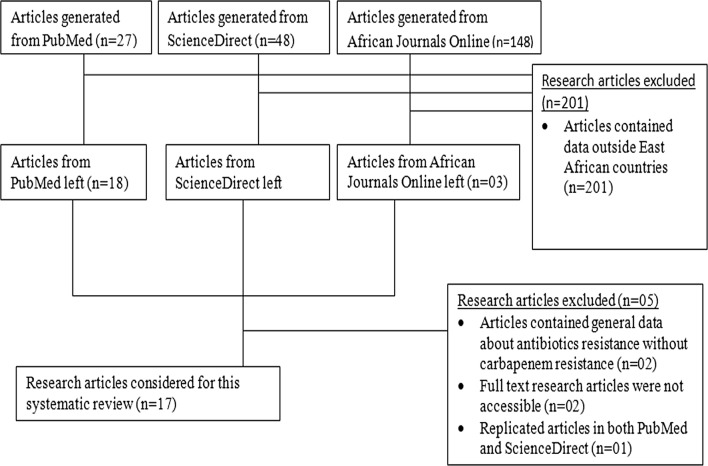
Results: The 17 articles which presented concrete information about the prevalence of carbapenem resistance in East Africa were reviewed. Tanzania exhibited the highest level of carbapenem resistance at 35% while DRC had the lowest level at 0.96%. Uganda was the only country with studies documenting CR obtained amongst hospital environment isolates with incidence ranging from 21% in Pseudomonas aeruginosa to 55% in Acinetobacter baumannii. Carbapenem resistance was more exhibited in A. baumannii (23%), followed by P. aeruginosa (17%), Klebsiella pneumoniae (15%), Proteus mirabilis (14%) and Escherichia coli (12%) mainly isolated from respiratory tract, blood, urine and wound/pus. The regional genetic determinants of carbapenem resistance detected were blaIMP, blaVIM-1 blaSPM-l, blaNDM-1, blaOXA-23 blaOXA-24, blaOXA-58 and blaKPC.
Keywords: Carbapenem resistance; East Africa; Molecular epidemiology.
Figures
References
-
- Livermore DM, Warner M, Mushtaq S, Doumith M, Zhang J, Woodford N. What remains against carbapenem resistant Enterobacteriaceae? Evaluation of chloramphenicol, ciprofloxacin, colistin, fosfomycin, minocycline, nitrofurantoin, temocillin and tigecycline. Int J Antimicrob Agents. 2011;37:415–424. doi: 10.1016/j.ijantimicag.2011.01.012. - DOI - PubMed
-
- CDC . Facility guidance for control of carbapenem-resistant Enterobacteriaceae (CRE) Atlanta: United States Department of Health and Human Services; 2015.
-
- European Centre for Disease Prevention and Control-ECDC . Rapid risk assessment-carbapenem-resistant Enterobacteriaceae. Stockholm: ECDC; 2016.
Publication types
MeSH terms
Substances
LinkOut - more resources
Full Text Sources
Other Literature Sources
Medical
