


Drug-Induced Glucocorticoids and Memory for Substance Use
- PMID: 30170822
- PMCID: PMC6204074
- DOI: 10.1016/j.tins.2018.08.005
Drug-Induced Glucocorticoids and Memory for Substance Use
Abstract
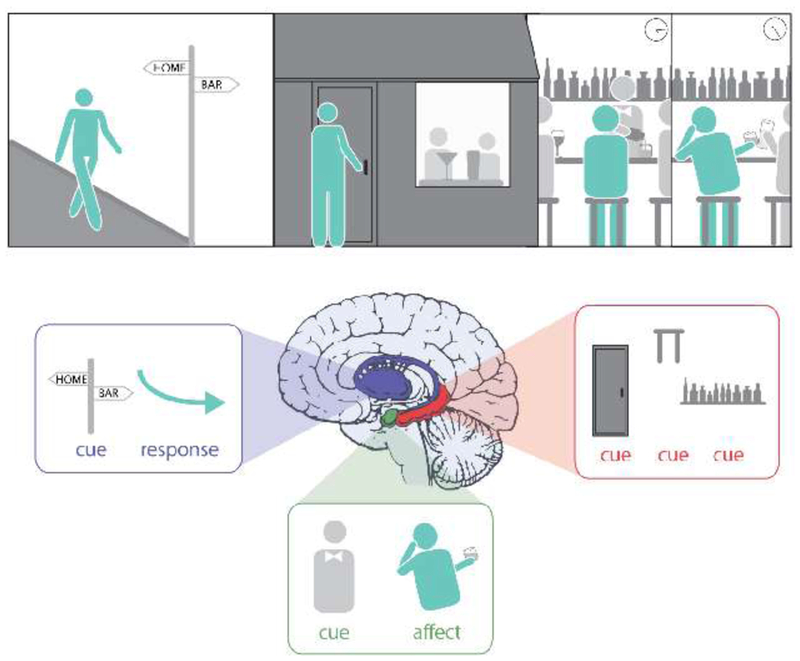
The biological stress response of the body forms one of the foundations of adaptive behavior, including promoting (and impairing) different forms of memory. This response transcends stressful experiences and underlies reactions to challenges and even reinforcers such as addictive substances. Nevertheless, drug-induced stress responses are rarely incorporated into models of addiction. We propose here that drug-induced stress responses (particularly glucocorticoids) play a crucial role in addictive behavior by modulating the formation of memories for substance-use experiences. We review the contributions of amygdala-, striatum-, and hippocampus-based memory systems to addiction, and reveal common effects of addictive drugs and acute stress on these different memories. We suggest that the contributions of drug-induced stress responses to memory may provide insights into the mechanisms driving addictive behavior.
Keywords: addiction; amygdala; hippocampus; memory; stress; striatum.
Copyright © 2018 Elsevier Ltd. All rights reserved.
Figures
References
-
- Shaham Y et al. (2003) The reinstatement model of drug relapse: history, methodology and major findings. Psychopharmacology (Berl) 168 (1–2), 3–20. - PubMed
-
- Hyman SE et al. (2006) Neural mechanisms of addiction: the role of reward-related learning and memory. Annu Rev Neurosci 29, 565–98. - PubMed
-
- White NM (1996) Addictive drugs as reinforcers: multiple partial actions on memory systems. Addiction 91 (7), 921–49; discussion 951–65. - PubMed
-
- Hogarth L et al. (2013) Associative learning mechanisms underpinning the transition from recreational drug use to addiction. Ann N Y Acad Sci 1282, 12–24. - PubMed
Publication types
MeSH terms
Substances
Grants and funding
LinkOut - more resources
Full Text Sources
Other Literature Sources
Medical
