. 2019 Jul;68(7):1180-1189.
doi: 10.1136/gutjnl-2018-316106. Epub 2018 Aug 31.

Population-level analysis of Blastocystis subtype prevalence and variation in the human gut microbiota

Affiliations

Population-level analysis of Blastocystis subtype prevalence and variation in the human gut microbiota

Raul Y Tito et al. Gut. 2019 Jul.

Abstract

Objective: Human gut microbiome studies are mainly bacteria- and archaea-oriented, overlooking the presence of single-cell eukaryotes such as Blastocystis, an enteric stramenopiles with worldwide distribution. Here, we surveyed the prevalence and subtype variation of Blastocystis in faecal samples collected as part of the Flemish Gut Flora Project (FGFP), a Western population cohort. We assessed potential links between Blastocystis subtypes and identified microbiota-host covariates and quantified microbiota differentiation relative to subtype abundances.

Design: We profiled stool samples from 616 healthy individuals from the FGFP cohort as well as 107 patients with IBD using amplicon sequencing targeting the V4 variable region of the 16S rRNA and 18S rRNA genes. We evaluated associations of Blastocystis, and their subtypes, with host parameters, diversity and composition of bacterial and archaeal communities.

Results: Blastocystis prevalence in the non-clinical population cohort was 30% compared with 4% among Flemish patients with IBD. Within the FGFP cohort, out of 69 previously identified gut microbiota covariates, only age was associated with Blastocystis subtype carrier status. In contrast, a strong association between microbiota community composition and Blastocystis subtypes was observed, with effect sizes larger than that of host covariates. Microbial richness and diversity were linked to both Blastocystis prevalence and subtype variation. All Blastocystis subtypes detected in this cohort were found to be less prevalent in Bacteroides enterotyped samples. Interestingly, Blastocystis subtypes 3 and 4 were inversely correlated with Akkermansia, suggesting differential associations of subtypes with host health.

Conclusions: These results emphasise the role of Blastocystis as a common constituent of the healthy gut microbiota. We show its prevalence is reduced in patients with active IBD and demonstrate that subtype characterisation is essential for assessing the relationship between Blastocystis, microbiota profile and host health. These findings have direct clinical applications, especially in donor selection for faecal transplantation.

Keywords: Blastocystis; FGFP; Microbiota.


Conflict of interest statement

Competing interests: None declared.

Figures
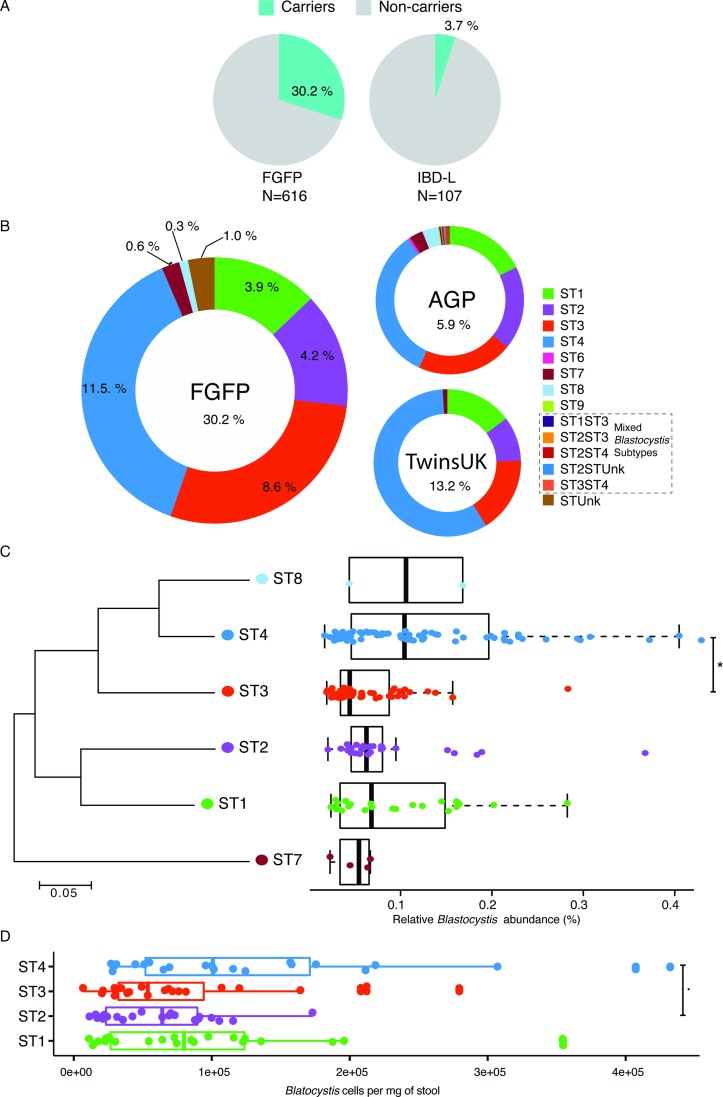
Figure 1
Figure 1
Prevalence, distribution and cell density of Blastocystis subtypes. (A) Prevalence of Blastocystis subtypes in the Flemish Gut Flora Project (FGFP) and IBD-L cohorts. IBD-affected individuals present lower prevalence of Blastocystis. (B) Prevalence of Blastocystis subtypes in the FGFP, TwinsUK (n=1045) and American gut project (AGP) (n=7567). (C) Neighbour-joining 18S rRNA gene phylogenetic tree of FGFP Blastocystis subtypes based on an alignment of 181 bases fragments from the most abundant sequence of each subtype and boxplot of their relative abundances in Blastocystis-positive individuals. Two extreme outliers were omitted from the visualisation. (D) Boxplot of Blastocystis cells per milligram of stool in the four more prevalent ST in the FGFP. The body of the boxplots represents the first and third quartiles of the distribution, and the median line. The whiskers extend from the quartiles to the last data point within 1.5×IQR, with outliers beyond. Dunn’s multiple-comparison test, false discovery rate (FDR): *FDR<0.01 and .FDR<0.05.
Figure 2
Figure 2
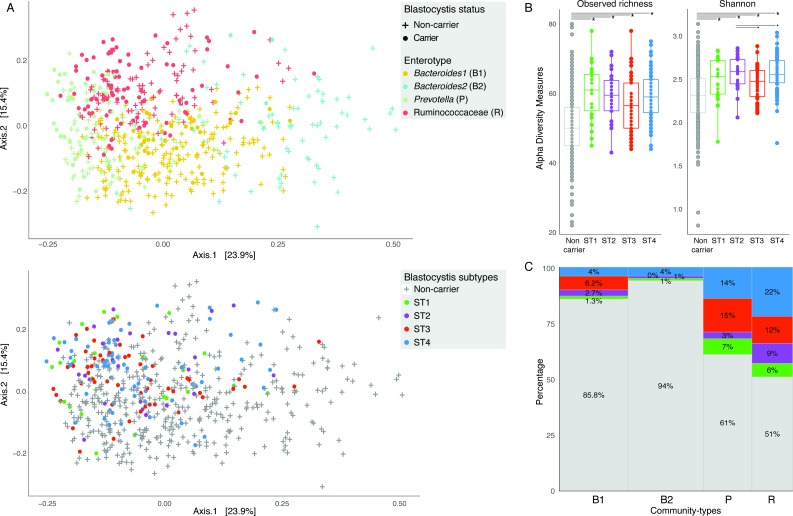
Microbial community variation associated to enterotypes and Blastocystis subtypes in the Flemish Gut Flora Project (FGFP) cohort. (A) Blastocystis carrier and non-carrier individuals (top panel) and subtype carriers (bottom panel) position in microbiota community space, represented by principal coordinates analysis (PCoA) of genus-level Bray-Curtis dissimilarity of the bacterial and archaeal fraction. The percentage of variation explained by the two first PCoA dimensions is reported on the axes. (B) Observed genus richness and Shannon diversity index (SDI) across Blastocystis non-carriers and carriers grouped by subtype. Presence of Blastocystis is associated to higher richness and SDI. Subtypes ST2 and ST4 have higher SDI compared with ST3. Wilcoxon test false discovery rate (FDR): *FDR<0.01; .FDR<0.05. (C) Distribution of Blastocystis non-carrier and subtypes carriers with respect to enterotypes, using Dirichlet Multinomial Mixtures community typing (Falony et al 2016). The Ruminococcaceae and Prevotella enterotypes have a higher proportion of Blastocystis carriers than Bacteroides1 and especially Bacteroides2. The body of the box plot represents the first and third quartiles of the distribution, and the median line. The whiskers extend from the quartiles to the last data point within 1.5×IQR, with outliers beyond.
Figure 3
Figure 3
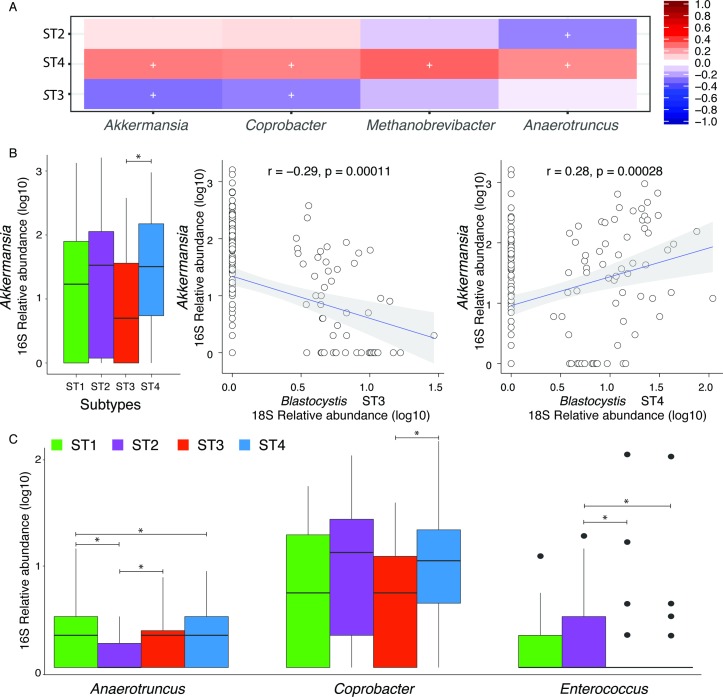
Blastocystis subtype carriers are strongly linked to microbial community composition. (A) Correlation between bacteria and archaea genera and Blastocystis subtypes. Heatmap of correlations between bacteria and archaea genera and Blastocystis subtypes is indicated by colours, positive (red) and negative (blue). The significant correlations (false discovery rate (FDR) <0.05) are indicated by ‘+’; only bacteria and archaea genera and Blastocystis subtypes with at least one significant correlation are shown. (B, C) The four genera with significant differences in relative abundances between the most prevalent Blastocystis subtypes carriers. (B) Akkermansia-relative abundances correlate negatively with abundances of Blastocystis ST3 and positively with ST4. (C) Differences in relative abundances of Anaerotruncus, Coprobacter and Enterococcus between the most prevalent Blastocystis subtypes carriers. Kruskal-Wallis with post hoc Wilcoxon test with multiple testing correction (FDR). *FDR<0.05 and Spearman correlation, FDR<0.05. The body of the boxplots represents the first and third quartiles of the distribution, and the median line. The whiskers extend from the quartiles to the last data point within 1.5×IQR, with outliers beyond.
Figure 4
Figure 4
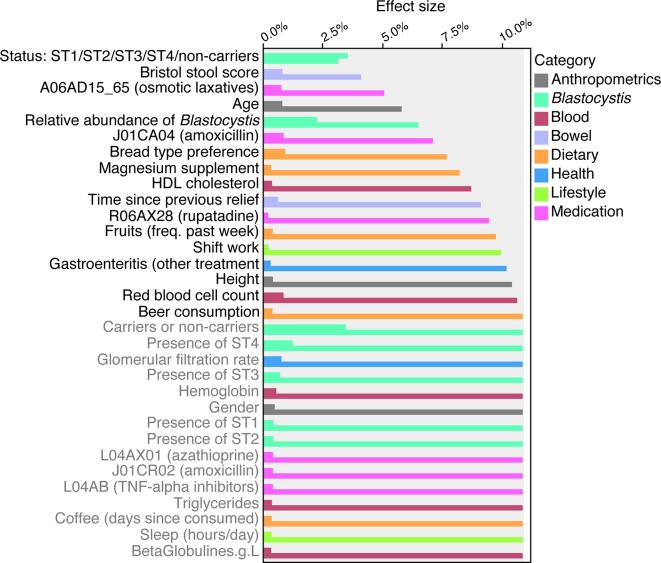
Explanatory power of Blastocystis carrier status and its total or subtypes relative abundances on microbiota community variation (bacterial and archaeal fraction), compared with the microbiota covariates reported in Falony et al. Variables are ordered according to the cumulative effect size of non-redundant covariates selected by stepwise redundancy analysis analysis (right bars) compared with individual effect sizes assuming independence (left bars) (false discovery rate<0.1). Variables labelled in grey did not contribute to additional explanatory power in the cumulative model. The full list is available in online supplementary table S11. Individuals carrying both Blastocystis and other single-cell eukaryotes were excluded from the analysis. HDL, high-density lipoprotein; TNF, tumour necrosis factor.

References

    1. Hugon P, Lagier JC, Colson P, et al. Repertoire of human gut microbes. Microb Pathog 2017;106:103–12. 10.1016/j.micpath.2016.06.020 - DOI - PubMed
    1. Mirzaei MK, Maurice CF. Ménage à trois in the human gut: interactions between host, bacteria and phages. Nat Rev Microbiol 2017;15:397–408. 10.1038/nrmicro.2017.30 - DOI - PubMed
    1. Manrique P, Dills M, Young MJ. The human gut phage community and its implications for health and disease. Viruses 2017;9:141 10.3390/v9060141 - DOI - PMC - PubMed
    1. Bedarf JR, Hildebrand F, Coelho LP, et al. Functional implications of microbial and viral gut metagenome changes in early stage L-DOPA-naïve Parkinson’s disease patients. Genome Med 2017;9:39 10.1186/s13073-017-0428-y - DOI - PMC - PubMed
    1. Stensvold CR, Clark CG. Current status of blastocystis: a personal view. Parasitol Int 2016;65:763–71. 10.1016/j.parint.2016.05.015 - DOI - PubMed

Publication types