. 2019 Jan;13(1):214-226.
doi: 10.1038/s41396-018-0264-0. Epub 2018 Aug 31.

Strong succession in arbuscular mycorrhizal fungal communities

Affiliations

Strong succession in arbuscular mycorrhizal fungal communities

Cheng Gao et al. ISME J. 2019 Jan.

Abstract

The ecology of fungi lags behind that of plants and animals because most fungi are microscopic and hidden in their substrates. Here, we address the basic ecological process of fungal succession in nature using the microscopic, arbuscular mycorrhizal fungi (AMF) that form essential mutualisms with 70-90% of plants. We find a signal for temporal change in AMF community similarity that is 40-fold stronger than seen in the most recent studies, likely due to weekly samplings of roots, rhizosphere and soil throughout the 17 weeks from seedling to fruit maturity and the use of the fungal DNA barcode to recognize species in a simple, agricultural environment. We demonstrate the patterns of nestedness and turnover and the microbial equivalents of the processes of immigration and extinction, that is, appearance and disappearance. We also provide the first evidence that AMF species co-exist rather than simply co-occur by demonstrating negative, density-dependent population growth for multiple species. Our study shows the advantages of using fungi to test basic ecological hypotheses (e.g., nestedness v. turnover, immigration v. extinction, and coexistence theory) over periods as short as one season.


Conflict of interest statement

The authors declare that they have no conflict of interest.

Figures
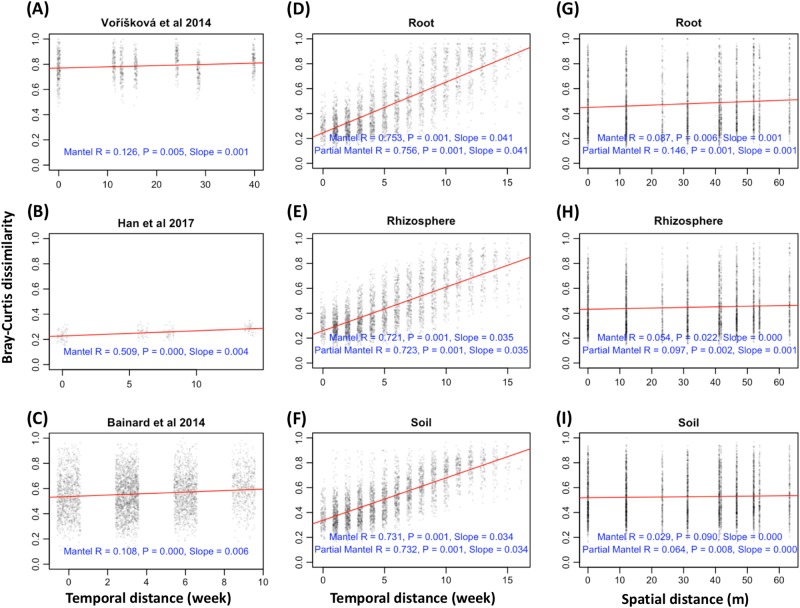
Fig. 1
Fig. 1
Arbuscular mycorrhizal fungal community change correlated over time (temporal distance af) and space (spatial distance, gi). Temporal distance (in weeks between sampling times) as correlated with Bray–Curtis community dissimilarity by Mantel testing in published data from (a) [28] [48 samples = 4 time points * 3 vertical layers * 4 plots (10 m2 with c. 100 m border)], b [29] (21 samples = 3 time points * 7 treatments), and c [30] [96 samples = 4 time points * 3 crops * 2 sample type * 4 plots (6 * 2 m2 plots with 6 m border)], and from new data presented in this study for (d) root (17 time points * 6 plots), e rhizosphere (17 time points * 6 plots) and f soil (18 time points*6 plots) with all plots having the dimensions 16 m * 8 m with at least a 3 m boarder. Spatial distance as correlated with Bray–Curtis community dissimilarity by Mantel testing from new data present in this study for (g) root, h rhizosphere, and i soil. Note the much stronger association of community dissimilarity and temporal distance reflected by R and slope for root, rhizosphere and soil in this study than [28, 29] and [30], and the near absence of association of community dissimilarity and spatial distance in this study. *The [29] result is based on a total fungal community dataset rather than AMF community, due to the low recovery of AMF in that study. Analyses in (df) treat sequence data as counts rarefied among AMF fungi and are nearly identical to analyses treating data as counts rarefied among all fungi or treating data as compositional (Fig. S5)
Fig. 2
Fig. 2
Change in composition of arbuscular mycorrhizal fungal communities in three compartments (root, rhizosphere, and soil) over 17 weekly time period (TP) samplings. a Principal coordinate (PCo) analysis by PERM ANOVA showing significant association of community composition with time period (TP) and compartment but not cultivar (***P < 0.001; ns: not significant). Note that TP accounts for nearly half the variance, which is far more than is accounted for by compartment (root, rhizosphere or soil) or plant genotype (sorghum cultivar RTx430 or BTx642). b Bar graph of AMF operational taxonomic unit (OTU) relative abundance at each TP and c Bar graph of AMF OTUs percentage in total fungal reads at each TP for the three compartments, root, rhizosphere and soil. Note the strong change in AMF community composition over time. Analysis in  a treats sequence data as counts rarefied among AMF fungi and is nearly identical to analyses treating data as counts rarefied among all fungi or treating data as compositional (Fig. S6)
Fig. 3
Fig. 3
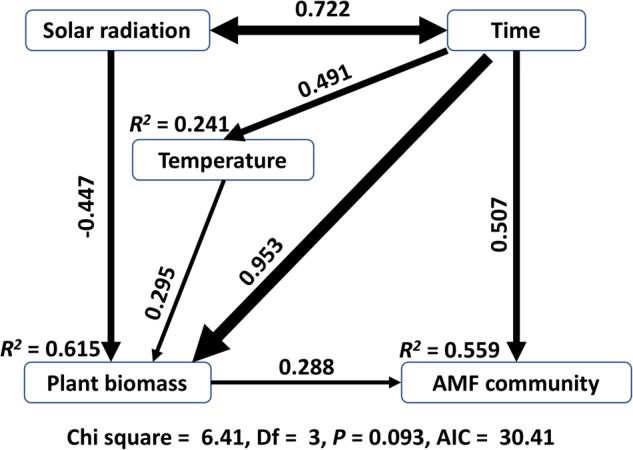
Structural equation model (SEM) demonstrates that the succession of arbuscular mycorrhizal fungal (AMF) communities was directly affected by time and aboveground biomass of sorghum, in addition to indirect (via plant biomass) effects of solar radiation and temperature. The numbers above the arrows indicate the magnitude of path coefficients (λ), and this magnitude is also depicted by the width of the lines. R2 values represent the proportion of variance explained for each variable
Fig. 4
Fig. 4
Temporal dynamics of (ac) richness and (df) phylogenetic relatedness of AMF communities on two sorghum cultivars. Richness shows a consistent increase over time for all three compartments (root, rhizosphere, and soil). Phylogenetic relatedness (net relatedness index, NRI) also increases over time, eventually showing significant underdispersion as it rises above the threshold of significance (horizontal, purple line). Note that the threshold is reached earlier inside roots than outside them in the rhizosphere and soil and that both cultivars (RTx430 and BTx642) behave similarly in terms of richness and NRI, consistent with the analyses in Fig. 2a
Fig. 5
Fig. 5
Role of two patterns, (a) turnover and (b) nestedness in the change in AMF community composition over time. The compositional variance of AMF community measured by Sorenson pair-wise dissimilarity was partitioned into a turnover component (Simpson pair-wise dissimilarity) and a nestedness component (Sorenson pair-wise dissimilarity minus Simpson pair-wise dissimilarity) following Baselga [52]. Subsequently, Mantel tests were carried out to explore the correlation of temporal distance and either the turnover or nestedness components of AMF compositional variance. Both AMF turnover and nestedness showed significant and biologically meaningful associations with temporal distance. Visualization of the superimposed points was enhanced by rendering them semi-transparent and adding a small amount of noise to the temporal distances
Fig. 6
Fig. 6
Steep (a) decline of initially dominant OTUs and (b) rise of at least 13 initially rare OTUs. Relationships between time and AMF OTU abundances were explored by linear mixed-effects models, including random effects of AMF identity. The conditional R2 calculated here can be interpreted as the variance explained by the mixed-effects models. Analyses in (a, b) treat sequence data as counts rarefied among AMF fungi and are nearly identical to analyses treating data as counts rarefied among all fungi or treating data as compositional (Fig. S7)
Fig. 7
Fig. 7
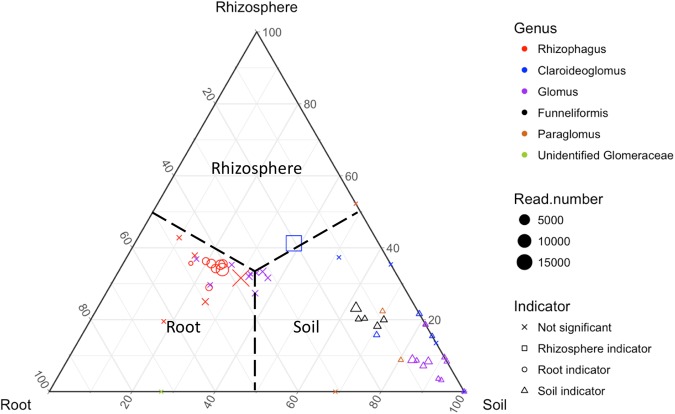
Ternary plot demonstrating the distribution of arbuscular mycorrhizal fungal (AMF) operational taxonomic units (OTUs) recovered from root, rhizosphere and soil. Note a bias toward roots for Rhizophagus OTUs, toward rhizosphere for a Clariodeoglomus OTU, and toward soil for Glomus, Claroideglomus, Funneliformis and Paraglomus OTUs

References

    1. Smith SE, Read DJ (2010). Mycorrhizal symbiosis, 3rd edn. Academic Press: London.
    1. Taylor JD, Helgason T, Öpik M (2017). Molecular Community Ecology of Arbuscular Mycorrhizal Fungi. Taylor JD, Helgason T, Öpik M (2017) Molecular community Ecology of Arbuscular Mycorrhizal Fungi. In: Dighton J, White JF, eds. The Fungal Community: its Organization and Role in the Ecosystem, 4th edn. CRC Press, pp 1–26.
    1. Horn S, Hempel S, Verbruggen E, Rillig MC, Caruso T. Linking the community structure of arbuscular mycorrhizal fungi and plants: a story of interdependence[quest] ISME J. 2017;11:1400–11. doi: 10.1038/ismej.2017.5. - DOI - PMC - PubMed
    1. Klironomos JN. Feedback with soil biota contributes to plant rarity and invasiveness in communities. Nature. 2002;417:67–70. doi: 10.1038/417067a. - DOI - PubMed
    1. Rillig MC. Arbuscular mycorrhizae and terrestrial ecosystem processes. Ecol Lett. 2004;7:740–54. doi: 10.1111/j.1461-0248.2004.00620.x. - DOI

Publication types