


Exercise without dietary changes alleviates nonalcoholic fatty liver disease without weight loss benefits
- PMID: 30172252
- PMCID: PMC6119590
- DOI: 10.1186/s12944-018-0852-z
Exercise without dietary changes alleviates nonalcoholic fatty liver disease without weight loss benefits
Abstract
Background: This study aimed to analyze the effect of exercise and/or dietary change on improvement of non-alcoholic fatty liver disease (NAFLD) in chronic high-fat diet (HFD)-induced obese mice.
Methods: Forty male C57BL/6 (8 weeks old) mice were divided into normal diet (CO, n = 8) and high-fat diet (HF, n = 32) groups. The HF group was fed with 60% fat chow for 16 weeks to induce obesity. After the obesity induction period, the HF group was subdivided into HFD + sedentary (n = 8), HFD + training (HFT, n = 8), dietary change to normal-diet + sedentary (HFND, n = 8), and dietary change to normal-diet + training (HFNDT, n = 8) groups, and the mice in the training groups underwent treadmill training for 8 weeks, 5 times per week, 40 min per day.
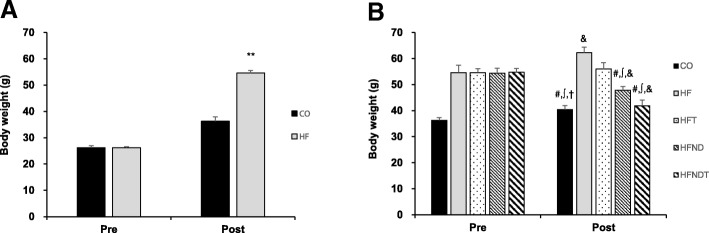
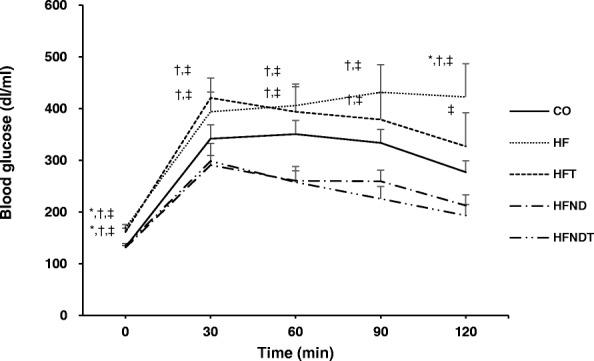
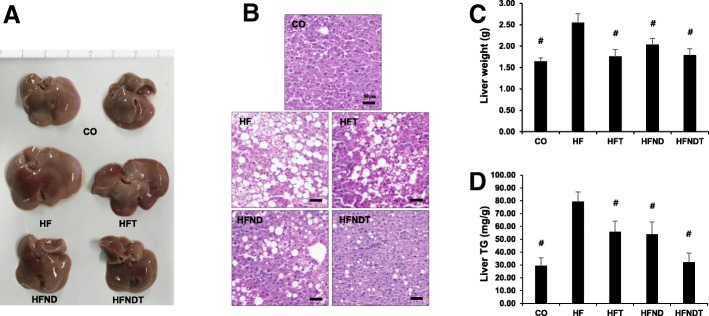
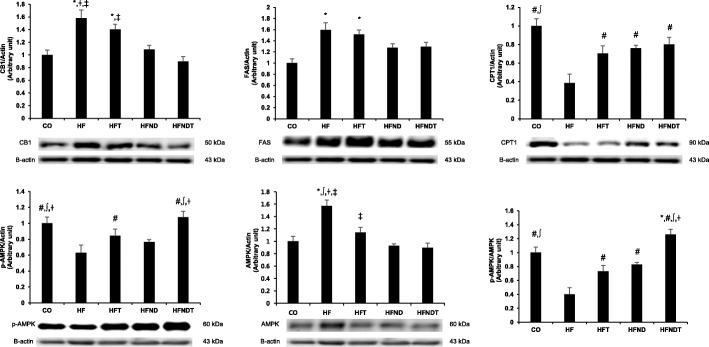
Results: A 24-week HFD induced increase of cannabinoid-1 receptor (CB1), fatty acid synthase (FAS), and AMP-activated protein kinase (AMPK) protein expressions (p < 0.05) and decrease of p-AMPK and carnitine palmitoyltransferase1 (CPT1) protein expressions (P < 0.05), resulting in increased liver fat accumulation. Treatment of exercise with dietary change and dietary change alone decreased CB1 and AMPK protein expressions with increased p-AMPK and CPT1 protein expressions (P < 0.05), leading to decreased body weight and liver fat (P < 0.05). The CB1 and FAS protein expressions in the HFT group were still higher than those in the CO group (P < 0.05), but the p-AMPK and CPT1 protein expressions were higher than those in the HF group (P < 0.05). Moreover, improved glucose tolerance and decreased liver fat were confirmed, although treatment of exercise alone had no effect on weight loss compared to pre-exercise.
Conclusions: Even in the case of obesity induced by chronic HFD, exercise and/or dietary interventions have preventive and therapeutic effects on fat accumulation in the liver, resulting from upregulations of lipolytic factors. Therefore, the results of this study suggested that treatment of exercise alone without dietary change also leads to improvement of NAFLD and glucose tolerance without weight loss benefits.
Keywords: AMPK; CB1 receptor; CPT1; FAS; NAFLD; Training.
Conflict of interest statement
Ethics approval
These animal experiments were approved by the Dong-A University Medical School Institutional Animal Care and Use Committee (DIACUC-approval-16-17).
Consent for publication
Not applicable.
Competing interests
The authors declare that they have no competing interests.
Publisher’s Note
Springer Nature remains neutral with regard to jurisdictional claims in published maps and institutional affiliations.
Figures
References
-
- Fischer M, You M, Matsumoto M, Crabb DW. Peroxisome proliferator-activated receptor alpha (PPARalpha) agonist treatment reverses PPARalpha dysfunction and abnormalities in hepatic lipid metabolism in ethanol-fed mice. J Biol Chem. 2003;278(30):27997–27004. doi: 10.1074/jbc.M302140200. - DOI - PubMed
MeSH terms
Grants and funding
LinkOut - more resources
Full Text Sources
Other Literature Sources
Medical
Research Materials
Miscellaneous
