


Load-bearing capacity of lithium disilicate and ultra-translucent zirconias
- PMID: 30173069
- PMCID: PMC6179910
- DOI: 10.1016/j.jmbbm.2018.08.023
Load-bearing capacity of lithium disilicate and ultra-translucent zirconias
Abstract
Objective: The aim of this study was to evaluate the load-bearing capacity of monolithic lithium disilicate (LiDi - IPS e.max CAD) and novel ultra-translucent zirconia restorative systems of various compositions: 5Y-PSZ (5 mol% yttria-partially-stabilized zirconia) and 4Y-PSZ (4 mol% yttria-partially-stabilized zirconia); relative to a 3Y-TZP (3 mol% yttria-stabilized zirconia) control.
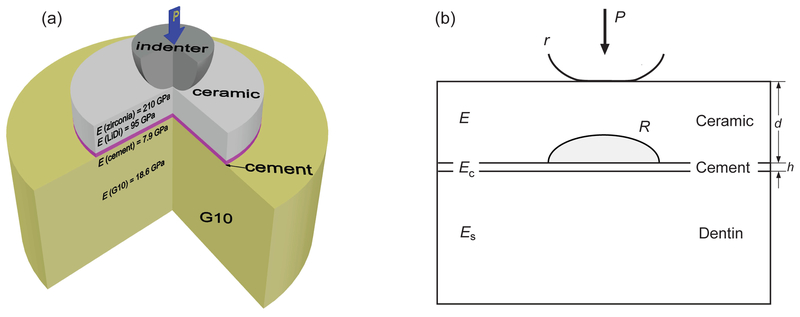
Materials and methods: Experiments were carried out with 10 disc specimens (Ø12 ×1 mm) per ceramic material. The zirconia intaglio surface (as machined) was sandblasted (50 µm Al2O3 at 2 bar), while LiDi was etched with 5% HF for 20 s. The ceramic discs were then adhesively bonded onto a dentin-like substrate (G10, a high-pressure fiberglass material) using Multilink Automix cement and Monobond Plus primer, producing a ceramic/cement/dentin-like substrate trilayer structure. The bonded specimens were stored in water for 3 days at 37 °C prior to a Hertzian indentation flexural radial fracture test. The plate-on-foundation theory was used to validate the load-bearing capacity of the trilayer systems based on the flexural tensile stress at the ceramic intaglio (cementation) surface-a cause for bulk fracture of ceramic onlays.
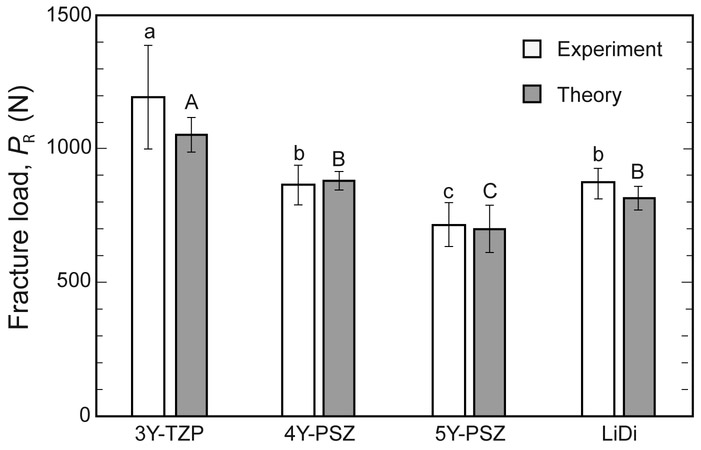
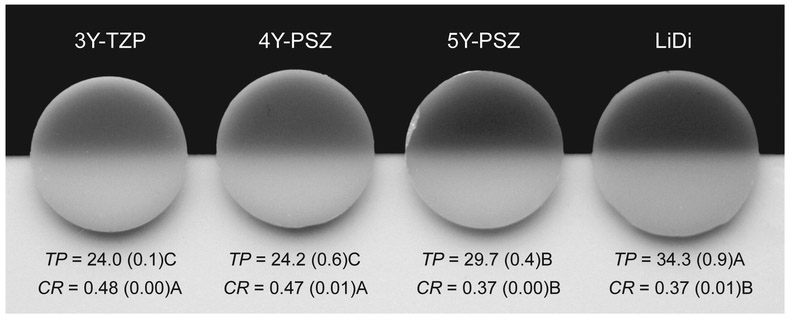
Results: The experiment data showed that, when bonded to and supported by a dentin-like substrate, the load-bearing capacity of LiDi (872 N) is superior to the 5Y-PSZ (715 N) and can even reach that of 4Y-PSZ (864 N), while 3Y-TZP still holds the highest load-bearing capacity (1195 N). Theoretical analyses agree with experimental observations. The translucency of 5Y-PSZ approaches that of LiDi, which are superior to both 4Y-PSZ and 3Y-TZP.
Conclusions: When adhesively bonded to and supported by dentin, lithium disilicate exhibits similar load-bearing properties to 4Y-PSZ but much better than 5Y-PSZ.
Keywords: Elastic modulus; Flexural strength; Layer thickness; Lithium disilicate; Load-bearing capacity; Ultra-translucent zirconia.
Copyright © 2018 Elsevier Ltd. All rights reserved.
Conflict of interest statement
Figures
References
-
- ASTM Standard E112, 2013. Standard Test Methods for Determining Average Grain Size ASTM International, West Conshohocken, PA, 2013, DOI: 10.1520/E0112. - DOI
-
- Belli R, Wendler M, de Ligny D, Cicconi MR, Petschelt A, Peterlik H, Lohbauer U, 2017. Chairside CAD/CAM materials. Part 1: Measurement of elastic constants and microstructural characterization. Dent Mater 33, 84–98. - PubMed
-
- Bhowmick S, Zhang Y, Lawn BR, 2005. Competing fracture modes in brittle materials subject to concentrated cyclic loading in liquid environments: Bilayer structures. J Mater Res 20, 2792–2800.
-
- Christensen RP, Ploeger BJ, 2010. A clinical comparison of zirconia, metal and alumina fixed-prosthesis frameworks veneered with layered or pressed ceramic: a three-year report. J Am Dent Assoc 141, 1317–1329. - PubMed
-
- CIE, 2004. Technical Committee: Colorimetry. CIE pub no 15.3. Vienna, Austria: CIE Central Bureau.
Publication types
MeSH terms
Substances
Grants and funding
LinkOut - more resources
Full Text Sources
Other Literature Sources
Research Materials
Miscellaneous
