


Progress in voluntary medical male circumcision for HIV prevention supported by the US President's Emergency Plan for AIDS Relief through 2017: longitudinal and recent cross-sectional programme data
- PMID: 30173159
- PMCID: PMC6120649
- DOI: 10.1136/bmjopen-2018-021835
Progress in voluntary medical male circumcision for HIV prevention supported by the US President's Emergency Plan for AIDS Relief through 2017: longitudinal and recent cross-sectional programme data
Abstract
Objective: This article provides an overview and interpretation of the performance of the US President's Emergency Plan for AIDS Relief's (PEPFAR's) male circumcision programme which has supported the majority of voluntary medical male circumcisions (VMMCs) performed for HIV prevention, from its 2007 inception to 2017, and client characteristics in 2017.
Design: Longitudinal collection of routine programme data and disaggregations.
Setting: 14 countries in sub-Saharan Africa with low baseline male circumcision coverage, high HIV prevalence and PEPFAR-supported VMMC programmes.
Participants: Clients of PEPFAR-supported VMMC programmes directed at males aged 10 years and above.
Main outcome measures: Numbers of circumcisions performed and disaggregations by age band, result of HIV test offer, procedure technique and follow-up visit attendance.
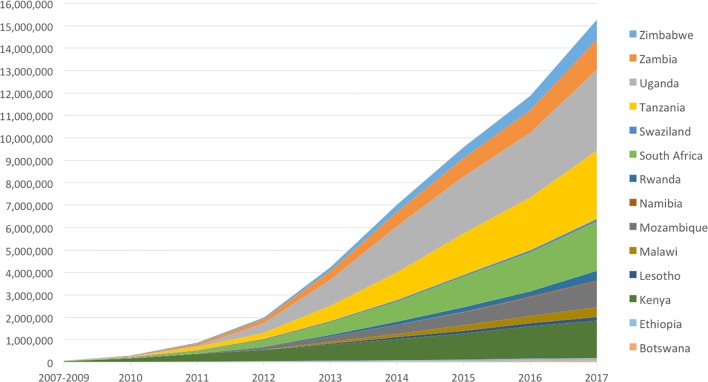
Results: PEPFAR supported a total of 15 269 720 circumcisions in 14 countries in Southern and Eastern Africa. In 2017, 45% of clients were under 15 years of age, 8% had unknown HIV status, 1% of those tested were HIV+ and 84% returned for a follow-up visit within 14 days of circumcision.
Conclusions: Over 15 million VMMCs have been supported by PEPFAR since 2007. VMMC continues to attract primarily young clients. The non-trivial proportion of clients not testing for HIV is expected, and may be reassuring that testing is not being presented as mandatory for access to circumcision, or in some cases reflect test kit stockouts or recent testing elsewhere. While VMMC is extremely safe, achieving the highest possible follow-up rates for early diagnosis and intervention on complications is crucial, and programmes continue to work to raise follow-up rates. The VMMC programme has achieved rapid scale-up but continues to face challenges, and new approaches may be needed to achieve the new Joint United Nations Programme on HIV/AIDS goal of 27 million additional circumcisions through 2020.
Keywords: preventive medicine; public health.
© Author(s) (or their employer(s)) 2018. Re-use permitted under CC BY-NC. No commercial re-use. See rights and permissions. Published by BMJ.
Conflict of interest statement
Competing interests: None declared.
Figures
References
-
- WHO/UNAIDS Technical Consultation on Male Circumcision and HIV Prevention: Research Implications for Policy and Programming. New Data on Male Circumcision and HIV Prevention: Policy and Programme Implications. Montreux, 6 – 8 March 2007. 2007. http://www.unaids.org/sites/default/files/media_asset/mc_recommendations... (accessed 3 Apr 2018). - PubMed
Publication types
MeSH terms
Grants and funding
LinkOut - more resources
Full Text Sources
Other Literature Sources
Medical
