. 2019 May;39(4):503-522.
doi: 10.1007/s10571-018-0614-5. Epub 2018 Sep 1.

Resetting the Stress System with a Mifepristone Challenge

Affiliations

Resetting the Stress System with a Mifepristone Challenge

Sergiu Dalm et al. Cell Mol Neurobiol. 2019 May.

Abstract

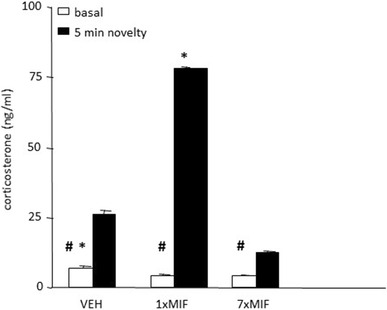
Psychotic depression is characterized by elevated circulating cortisol, and high daily doses of the glucocorticoid/progesterone antagonist mifepristone for 1 week are required for significant improvement. Using a rodent model, we find that such high doses of mifepristone are needed because the antagonist is rapidly degraded and poorly penetrates the blood-brain barrier, but seems to facilitate the entry of cortisol. We also report that in male C57BL/6J mice, after a 7-day treatment with a high dose of mifepristone, basal blood corticosterone levels were similar to that of vehicle controls. This is surprising because after the first mifepristone challenge, corticosterone remained elevated for about 16 h, and then decreased towards vehicle control levels at 24 h. At that time, stress-induced corticosterone levels of the 1xMIF were sevenfold higher than the 7xMIF group, the latter response being twofold lower than controls. The 1xMIF mice showed behavioral hyperactivity during exploration of the circular hole board, while the 7xMIF mice rather engaged in serial search patterns. To explain this rapid reset of corticosterone secretion upon recurrent mifepristone administration, we suggest the following: (i) A rebound glucocorticoid feedback after cessation of mifepristone treatment. (ii) Glucocorticoid agonism in transrepression and recruitment of cell-specific coregulator cocktails. (iii) A more prominent role of brain MR function in control of stress circuit activity. An overview table of neuroendocrine MIF effects is provided. The data are of interest for understanding the mechanistic underpinning of stress system reset as treatment strategy for stress-related diseases.

Keywords: Behavior; Brain; Glucocorticoid receptor; Mineralocorticoid receptor; RU38486; Stress.


Conflict of interest statement

SD and AMK report no conflict of interest. ERdK is on the Scientific Advisory Board of the DynaCorts Group and owns stock of Corcept Therapeutics. OCM receives funding from Corcept Therapeutics. JKB is an employee of Corcept Therapeutics, which develops novel GR ligands.

Figures
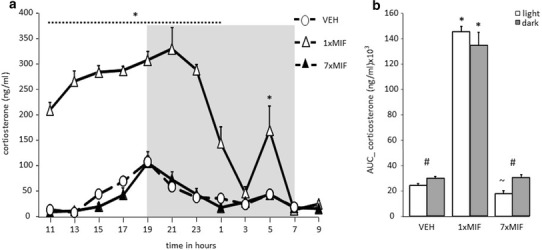
Fig. 1
Fig. 1
a Circadian secretion of corticosterone in ng/ml measured every 2 h in blood plasma of male mice C57BL/6J that received RU38486 (MIF) once (1xMIF) or for seven days (7xMIF). Mice were entrained in a 12–12-h light–dark cycle (dark phase from 1900 to 0700 h represented by the gray-shaded area). b Total corticosterone secretion in ng/ml during the light and dark period of the day, determined as area under the curve (AUC); ng/ml. Data are presented as mean ± SEM; p < .05 * versus other groups, # within groups, ~ 7xMIF versus VEH
Fig. 2
Fig. 2
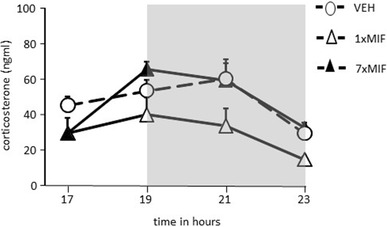
Corticosterone (ng/ml) secretion during the circadian peak in mice, 32 h after last administration of RU38486 (MIF), 1xMIF, 7xMIF, or VEH (dark phase from 1900 to 2300 h represented by the gray-shaded area). Data are presented as mean ± SEM
Fig. 3
Fig. 3
Basal and novelty (5 min exposure to the circular hole board)-induced corticosterone (ng/ml) were determined in mice, 24 h after last administration of VEH, 1xMIF, or 7xMIF. Data are presented as mean ± SEM; p < .05 * versus other groups, # within groups
Fig. 4
Fig. 4
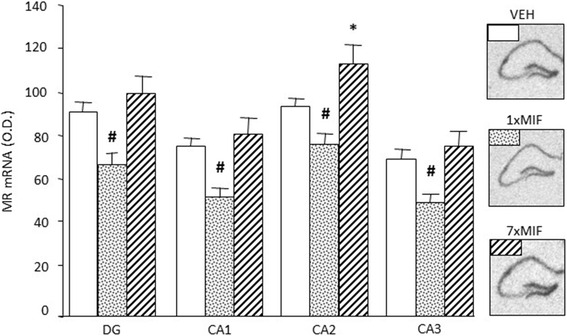
Expression of MR mRNA, measured as optical density (OD) in the hippocampal subfields dentate gyrus (DG), CA1, CA2, and CA3, 24 h after last administration of VEH, 1xMIF, or 7xMIF. Data are presented as mean ± SEM; p < .05 * versus other groups, # within groups
Fig. 5
Fig. 5
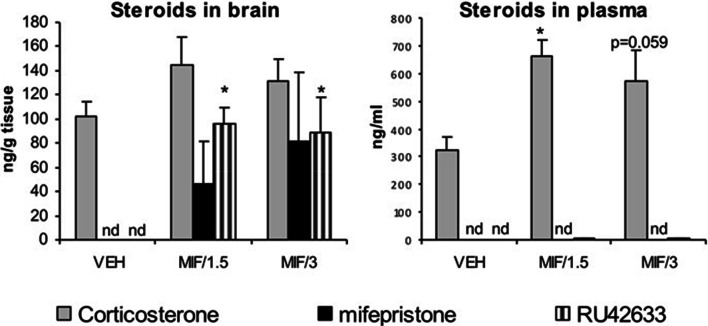
Steroid levels at 1.5 or 3 h after the last oral administration of 50 mg/kg mifepristone; levels of mifepristone were undetectable in plasma, but clearly detectable in brain although with high variability. Brain RU42633 levels were significantly higher in MIF-treated animals compared to vehicle treated rats (F(2,15) = 13.12, p < .01). Corticosterone levels were significantly higher in plasma but not in brain of rats treated with MIF (F(2,15) = 7.94, p < .01) compared to vehicle -treated rats. The concentrations of RU42848 and RU42698 were below the detection limit in both plasma and brain. N = 4–6, shown is mean + sem, *p < .05, Tukey post hoc test. Note the difference in scale
Fig. 6
Fig. 6
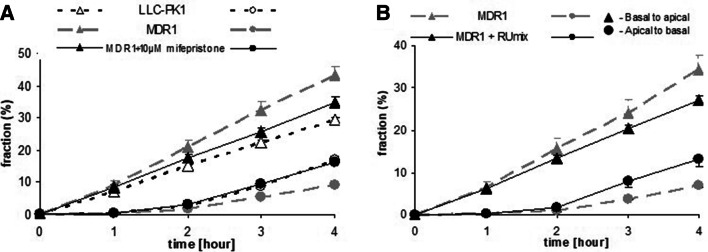
a Fraction of activity of 3H-cortisol present in medium at different time points after adding 15 nM 3H-cortisol to the opposite compartment at t = 0 in absence or presence of MIF. Transepithelial transport from basal to apical compartment and vice versa was measured in MDR1-transfected LLC-PK1 monolayers. Repeated measures ANOVA showed a significant time * cell type * MIF * direction of transport interaction (p < .01). In the presence of 10 µM MIF, transport of 3H-cortisol in monolayers of MDR1-transfected cells is inhibited and not different from transport of cortisol in monolayers of hosts cells. Data are presented as mean ± sem of three wells. MIF did not affect cortisol transport in untransfected monolayers (data not shown). b A mix of MIF and its three main metabolites at therapeutically relevant concentrations(see text) inhibits the transport of 3H-cortisol in MDR1-transfected monolayers
Fig. 7
Fig. 7
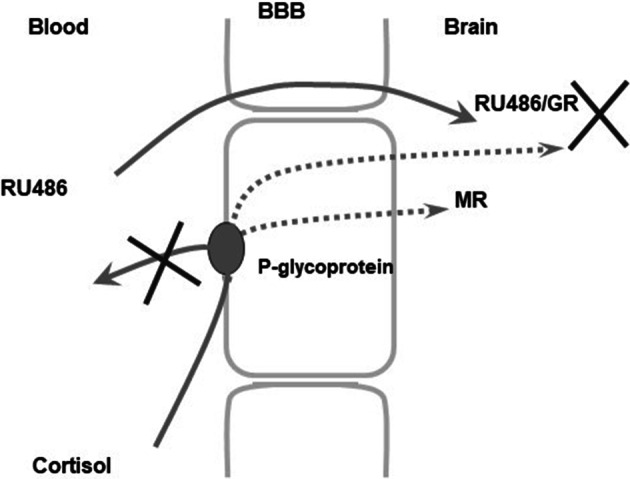
Hypothesized MIF-induced facilitation of cortisol brain uptake through inhibition of the efflux transporter P-glycoprotein at the blood–brain barrier. Under normal conditions, cortisol is hampered to enter the brain due to active outwards directed transport at the blood–brain barrier mediated by P-glycoprotein (Karssen et al. 2001). In the presence of MIF, this efflux is blocked facilitating the uptake of cortisol into the brain. The ensuing increased cortisol concentration will not lead to increased activation of GR, since this receptor is blocked by the high concentrations of MIF. However, increased activation of the MR is predicted to affect cognitive performance and neuroendocrine regulation. X indicates blockade of Pgp by MIF, which facilitates cortisol penetration through the blood–brain barrier and blockade of cortisol binding to GR. Dotted line is preferred cortisol route after Pgp blockade by MIF

References

    1. Arp JM, ter Horst JP, Loi M et al (2016) Blocking glucocorticoid receptors at adolescent age prevents enhanced freezing between repeated cue-exposures after conditioned fear in adult mice raised under chronic early life stress. Neurobiol Learn Mem 133:30–38. 10.1016/j.nlm.2016.05.009 - PubMed
    1. Atucha E, Zalachoras I, van den Heuvel JK et al (2015) A mixed glucocorticoid/mineralocorticoid selective modulator with dominant antagonism in the male rat brain. Endocrinology 156:4105–4114. 10.1210/en.2015-1390 - PubMed
    1. Bachmann CG, Linthorst ACE, Holsboer F, Reul JMHM (2003) Effect of chronic administration of selective glucocorticoid receptor antagonists on the rat hypothalamic-pituitary-adrenocortical axis. Neuropsychopharmacology 28:1056–1067. 10.1038/sj.npp.1300158 - PubMed
    1. Beaudry JL, Dunford EC, Teich T et al (2014) Effects of selective and non-selective glucocorticoid receptor II antagonists on rapid-onset diabetes in young rats. PLoS ONE 9:e91248. 10.1371/journal.pone.0091248 - PMC - PubMed
    1. Belanoff JK, Flores BH, Kalezhan M et al (2001) Rapid reversal of psychotic depression using mifepristone. J Clin Psychopharmacol 21:516–521. 10.1097/00004714-200110000-00009 - PubMed

MeSH terms

LinkOut - more resources