


Detection of foot-and-mouth disease virus in milk samples by real-time reverse transcription polymerase chain reaction: Optimisation and evaluation of a high-throughput screening method with potential for disease surveillance
- PMID: 30173746
- PMCID: PMC6127443
- DOI: 10.1016/j.vetmic.2018.07.024
Detection of foot-and-mouth disease virus in milk samples by real-time reverse transcription polymerase chain reaction: Optimisation and evaluation of a high-throughput screening method with potential for disease surveillance
Abstract
This study aimed to evaluate the utility of milk as a non-invasive sample type for the surveillance of foot-and-mouth disease (FMD), a highly contagious viral disease of cloven-hooved animals. Four milking Jersey cows were infected via direct-contact with two non-milking Jersey cows that had been previously inoculated with FMD virus (FMDV: isolate O/UKG/34/2001). Milk and blood were collected throughout the course of infection to compare two high-throughput real-time reverse transcription polymerase chain reaction (rRT-PCR) protocols with different RT-PCR chemistries. Using both methods, FMDV was detected in milk by rRT-PCR one to two days before the presentation of characteristic foot lesions, similar to detection by virus isolation. Furthermore, rRT-PCR detection from milk was extended, up to 28 days post contact (dpc), compared to detection by virus isolation (up to 14 dpc). Additionally, the detection of FMDV in milk by rRT-PCR was possible for 18 days longer than detection by the same method in serum samples. FMDV was also detected with both rRT-PCR methods in milk samples collected during the UK 2007 outbreak. Dilution studies were undertaken using milk from the field and experimentally-infected animals, where for one sample it was possible to detect FMDV at 10-7. Based on the peak CT values detected in this study, these findings indicate that it could be possible to identify one acutely-infected milking cow in a typical-sized dairy herd (100-1000 individuals) using milk from bulk tanks or milk tankers. These results motivate further studies using milk in FMD-endemic countries for FMD surveillance.
Keywords: Foot-and-mouth disease virus; Milk; Real-time RT-PCR; Surveillance.
Copyright © 2018 The Authors. Published by Elsevier B.V. All rights reserved.
Figures

 : Method A,
  : Method B.
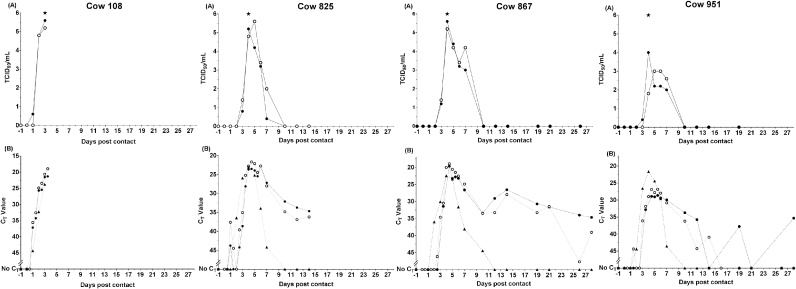
 : Onset of clinical signs,
  : whole milk,
  : skimmed milk,
  : serum.
 : 867 (4.5 dpc),
  : c27.
References
-
- Alexandersen S., Zhang Z., Donaldson A., Garland A.J. The pathogenesis and diagnosis of foot-and-mouth disease. J. Comp. Pathol. 2003;129:1–36. - PubMed
-
- Ansari-Lari M., Mohebbi-Fani M., Lyons N.A., Azizi N. Impact of FMD outbreak on milk production and heifers’ growth on a dairy herd in southern Iran. Prev. Vet. Med. 2017;144:117–122. - PubMed
-
- Armstrong R.M. Development of tests for antibodies against food-and-mouth disease virus in cattle milk. J. Virol. Methods. 1997;63:175–180. - PubMed
-
- Beaudeau F., Belloc C., Seegers H., Assié S., Sellal E., Joly A. Evaluation of a blocking ELISA for the detection of bovine viral diarrhoea virus (BVDV) antibodies in serum and milk. Vet. Microbiol. 2001;80:329–337. - PubMed
MeSH terms
LinkOut - more resources
Full Text Sources
Other Literature Sources
