


Tofacitinib for induction of remission in ulcerative colitis: systematic review and meta-analysis
- PMID: 30174394
- PMCID: PMC6102462
- DOI: 10.20524/aog.2018.0276
Tofacitinib for induction of remission in ulcerative colitis: systematic review and meta-analysis
Abstract
Background: The aim of the study was to assess the efficacy and safety of tofacitinib and its impact on quality of life in patients with moderate-to-severe ulcerative colitis.
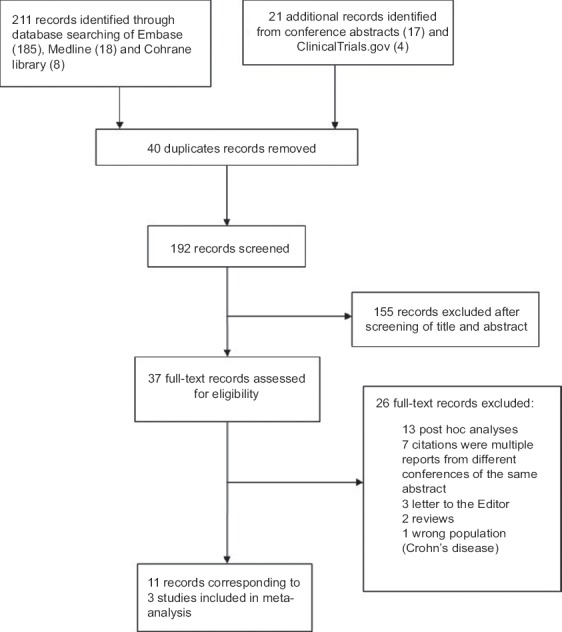
Methods: We conducted a systematic review and meta-analysis of randomized controlled trials comparing tofacitinib with placebo or any active comparator. We searched Medline, Embase, the Cochrane Library and gray literature for articles published up to May 2017. We synthesized data using a fixed-effect model. We conducted subgroup analysis based on prior exposure to anti-tumor necrosis factor (TNF). We summarized the strength of evidence using the Grading of Recommendations Assessment, Development and Evaluation (GRADE) approach.
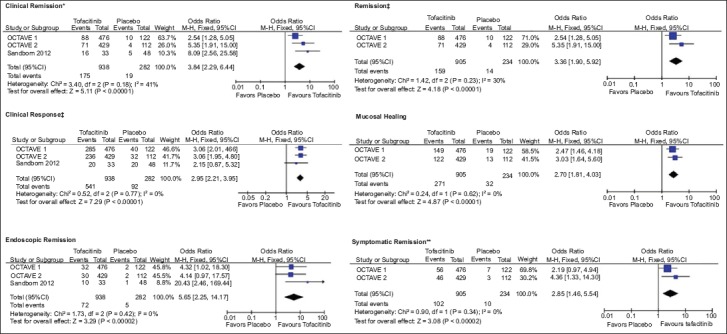
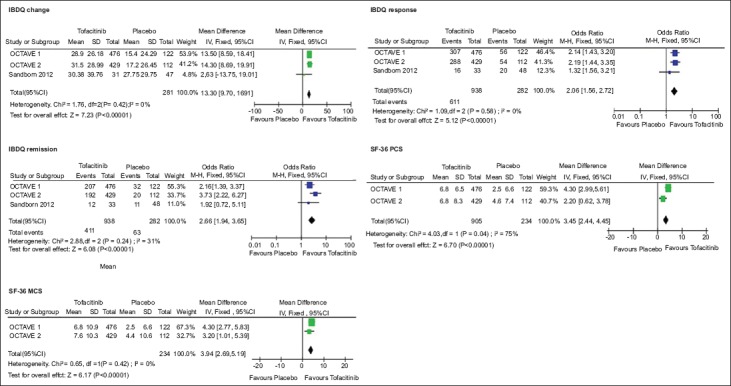
Results: We included three trials with 1220 participants. Compared with placebo, tofacitinib was effective in inducing clinical remission (odds ratio [OR] 3.84, 95% confidence interval [CI] 2.29-6.44, I2: 41%, GRADE: moderate), clinical response (OR 2.95, 95%CI 2.21-3.95, I2: 0%, GRADE: high), mucosal healing (OR 2.70, 95%CI 1.81-4.03, I2: 0%, GRADE: high). Tofacitinib was effective in both anti-TNF-naïve and -experienced patients. Tofacitinib had a favorable effect on quality of life. There were no significant differences in the safety profile in terms of the incidence of any or serious adverse events compared to placebo. The risk for infections was increased (OR 1.51, 95%CI 1.05-2.19, I2: 0%, GRADE: moderate), but the incidence of serious infections did not differ between tofacitinib and placebo.
Conclusion: In patients with moderate-to-severe ulcerative colitis, short-term treatment with tofacitinib is effective for induction of remission and improvement of quality of life.
Keywords: Tofacitinib; meta-analysis; ulcerative colitis.
Conflict of interest statement
Conflict of Interest: None
Figures
References
-
- Dignass A, Eliakim R, Magro F, et al. Second European evidence-based consensus on the diagnosis and management of ulcerative colitis part 1: definitions and diagnosis. J Crohns Colitis. 2012;6:965–990. - PubMed
-
- Magro F, Gionchetti P, Eliakim R, et al. European Crohn's and Colitis Organisation [ECCO] Third European evidence-based consensus on diagnosis and management of ulcerative colitis. part 1: definitions, diagnosis, extra-intestinal manifestations, pregnancy, cancer surveillance, surgery, and ileo-anal pouch disorders. J Crohns Colitis. 2017;11:649–670. - PubMed
-
- Dignass A, Lindsay JO, Sturm A, et al. Second European evidence-based consensus on the diagnosis and management of ulcerative colitis part 2: current management. J Crohns Colitis. 2012;6:991–1030. - PubMed
-
- Mehta SJ, Silver AR, Lindsay JO. Review article: strategies for the management of chronic unremitting ulcerative colitis. Aliment Pharmacol Ther. 2013;38:77–97. - PubMed
LinkOut - more resources
Full Text Sources
Other Literature Sources
Molecular Biology Databases