Review
. 2018 Aug 21:10:229-242.
doi: 10.2147/NSS.S148543. eCollection 2018.

Blood-pressure variability in patients with obstructive sleep apnea: current perspectives

Affiliations
Review

Blood-pressure variability in patients with obstructive sleep apnea: current perspectives

Oreste Marrone et al. Nat Sci Sleep. .

Abstract

Obstructive sleep apnea (OSA) is often associated with hypertension and other cardiovascular diseases. Blood pressure (BP) variability is part of the assessment of cardiovascular risk. In OSA, BP variability has been studied mainly as very short-term (beat-by-beat) and short-term (24-hour BP profile) variability. BP measured on consecutive heartbeats has been demonstrated to be highly variable, due to repeated peaks during sleep, so that an accurate assessment of nocturnal BP levels in OSA may require peculiar methodologies. In 24-hour recordings, BP frequently features a "nondipping" profile, ie, <10% fall from day to night, which may increase cardiovascular risk and occurrence of major cardiovascular events in the nocturnal hours. Also, BP tends to show a large "morning BP surge", a still controversial negative prognostic sign. Increased very short-term BP variability, high morning BP, and nondipping BP profile appear related to the severity of OSA. Treatment of OSA slightly reduces mean 24-hour BP levels and nocturnal beat-by-beat BP variability by abolishing nocturnal BP peaks. In some patients OSA treatment turns a nondipping into a dipping BP profile. Treatment of arterial hypertension in OSA usually requires both antihypertensive pharmacological therapy and treatment of apnea. Addressing BP variability could help improve the management of OSA and reduce cardiovascular risk. Possibly, drug administration at an appropriate time would ensure a dipping-BP profile.

Keywords: ambulatory blood-pressure monitoring; beat-by-beat measurements; blood-pressure dipping; morning blood-pressure surge; sleep apnea.


Conflict of interest statement

Disclosure The authors report no conflicts of interest in this work.

Figures
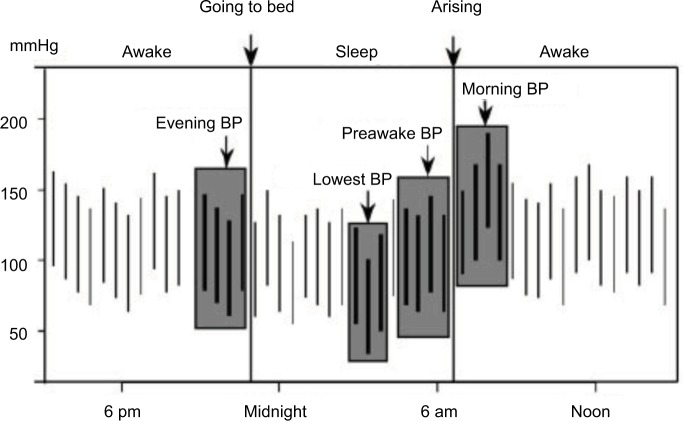
Figure 1
Figure 1
Measurements of morning blood pressure surge (MBPS). Notes: Sleep-trough MBPS definition: mean blood pressure in the 2 hours following morning awakening – lowest nocturnal blood pressure (measured as the mean of three measurements centered on the lowest nocturnal value). Prewaking MBPS definition: mean blood pressure in the 2 hours following morning awakening – mean blood pressure in the 2 hours preceding morning awakening. Copyright ©2003. American Heart Association, Inc. Reproduced from Kario K, Pickering TG, Umeda Y, et al. Morning surge in blood pressure as a predictor of silent and clinical cerebrovascular disease in elderly hypertensives: a prospective study. Circulation. 2003;107(10):1401–1406 (https://www.ahajournals.org/doi/10.1161/01.cir.0000056521.67546.aa).
Figure 2
Figure 2
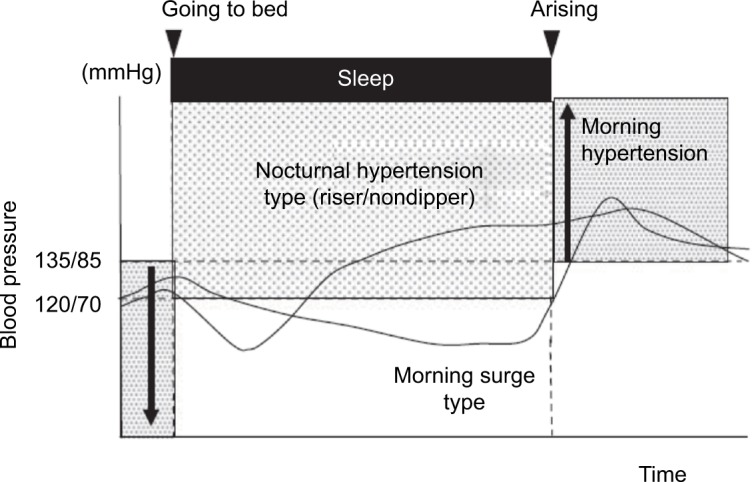
Different blood-pressure profiles in two subjects with high sleep-trough morning blood pressure surge (MBPS). Notes: High MBPS may or may not be associated with low nocturnal blood pressure. Copyright ©2005. American Journal of Hypertension, Ltd. Reproduced from Kario K. Time for focus on morning hypertension: pitfall of current antihypertensive medication. Am J Hypertens. 2005;18(2 Pt 1):149–151, by permission of Oxford University Press.
Figure 3
Figure 3
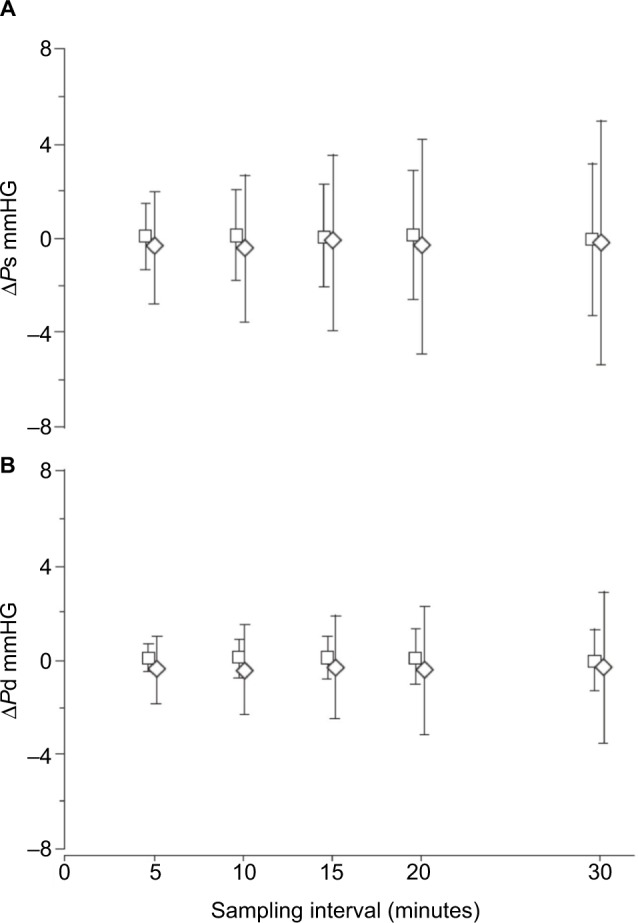
Means ± SD of (A) ΔPs and (B) ΔPd values in control (□) and obstructive sleep apnea (◊) subjects for each sampling interval. Notes: ΔPs and ΔPd: differences in mmHg between the mean nocturnal blood pressure values, respectively systolic and diastolic, obtained from sampled single heart beats and from all heart beats. Copyright ©2000. ERS Journals Ltd. Reproduced from Marrone O, Romano S, Insalaco G, Bonsignore MR, Salvaggio A, Bonsignore G. Influence of sampling interval on the evaluation of nocturnal blood pressure in subjects with and without obstructive sleep apnoea. Eur Respir J. 2000;16(4):653–658.
Figure 4
Figure 4
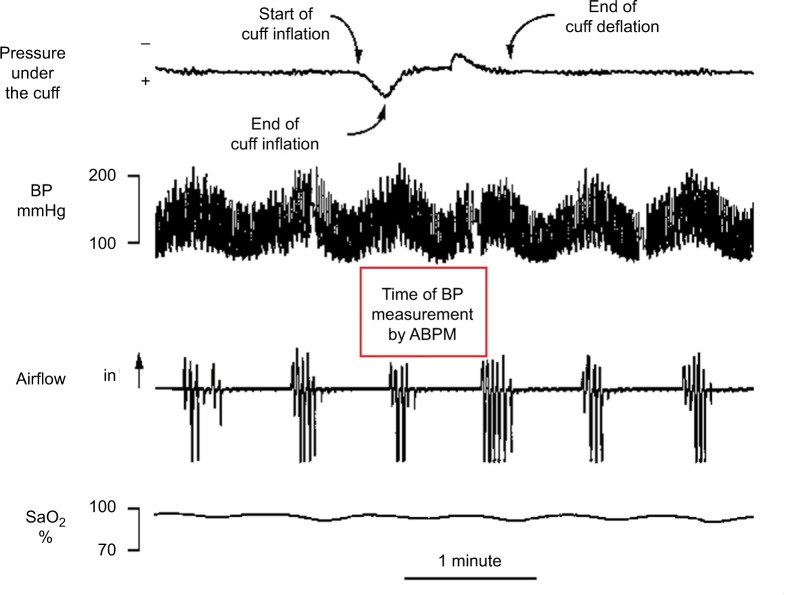
Fragment of a polygraph recording in a representative sleepy patient with severe obstructive sleep apnea. Notes: Patient undergoing simultaneous continuous finger blood pressure monitoring and ambulatory blood pressure monitoring (ABPM). Top to bottom: pressure detected by an open hose placed under the cuff for ABPM measurements; beat-by-beat blood pressure (BP); nasal airflow; oxyhemoglobin saturation (SaO2). A flat airflow signal identifies apnea time. In this patient, apnea duration was similar before and during ABPM measurement, which indicates that the cuff inflation did not cause any arousal shortening habitual apnea duration. ABPM measurement required a time exceeding the duration of an apnea cycle, ie, of an apnea and following ventilation. During that period, BP values largely varied, but only one systolic and one diastolic value were obtained by ABPM.

References

    1. Javaheri S, Barbe F, Campos-Rodriguez F, et al. Sleep apnea: types, mechanisms, and clinical cardiovascular consequences. J Am Coll Cardiol. 2017;69(7):841–858. - PMC - PubMed
    1. Parati G, Ochoa JE, Lombardi C, Bilo G. Assessment and management of blood-pressure variability. Nat Rev Cardiol. 2013;10(3):143–155. - PubMed
    1. Stevens SL, Wood S, Koshiaris C, et al. Blood pressure variability and cardiovascular disease: systematic review and meta-analysis. BMJ. 2016;354:i4098. - PMC - PubMed
    1. Stergiou GS, Parati G. How to best assess blood pressure? The ongoing debate on the clinical value of blood pressure average and variability. Hypertension. 2011;57(6):1041–1042. - PubMed
    1. Taylor KS, Heneghan CJ, Stevens RJ, Adams EC, Nunan D, Ward A. Heterogeneity of prognostic studies of 24-hour blood pressure variability: systematic review and meta-analysis. PLoS One. 2015;10(5):e0126375. - PMC - PubMed

LinkOut - more resources