Interatrial block predicts atrial fibrillation in patients with carotid and coronary artery disease
- PMID: 30174880
- PMCID: PMC6106028
- DOI: 10.21037/jtd.2018.06.53
Interatrial block predicts atrial fibrillation in patients with carotid and coronary artery disease
Abstract
Background: Interatrial block (IAB) has been previously shown to predict atrial fibrillation (AF) in cardiac populations. This study sought to evaluate the relationship between IAB and new-onset AF in a population of patients undergoing clinically indicated coronary angiography who received carotid ultrasonography.
Methods: A population of 355 subjects undergoing coronary angiography and carotid ultrasound were retrospectively studied. Common carotid artery (CCA) far-wall intima-media thickness (CIMT), and total carotid plaque area were measured. Coronary artery disease was measured by angiography and IAB by electrocardiograph (ECG).
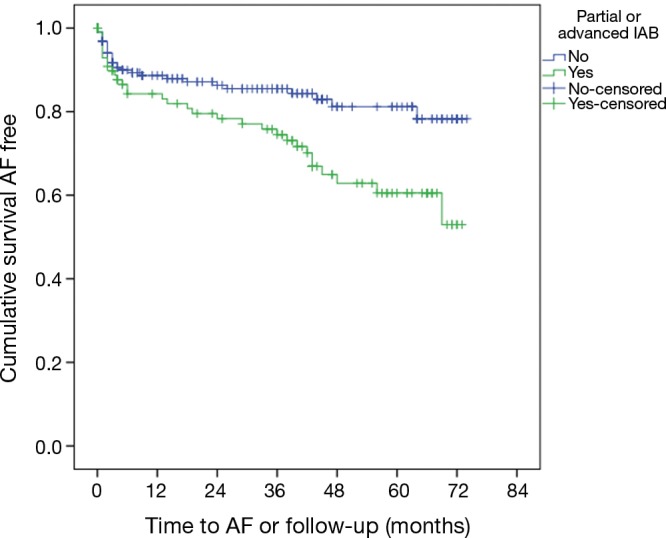
Results: The mean population age was 64.4 years, 70.4% male, mean BMI 29.9 kg/m2. IAB was a predictor of new-onset AF (OR =2.40, 95% CI: 1.33-4.29; P=0.003). There was a significant difference in AF free survival time between patients with IAB and without IAB via Cox proportional hazard analysis [52.9 months (95% CI: 47.1-58.7 months) vs. 62.6 months (95% CI: 58.8-66.5 months); P=0.006]. Patients with IAB had a significantly greater CIMT (0.883±0.193 vs. 0.829±0.192 mm; P=0.013) and a higher prevalence of significant (>70%) right coronary artery lesions than patients without (45.8% vs. 34.4%; P=0.026). Significant predictors of IAB on multivariate analysis were BMI ≥30 kg/m2 (OR =3.14, 95% CI: 1.14-6.71, P=0.003), male sex (OR =1.78, 95% CI: 1.05-3.03, P=0.034), increased mean CIMT (per 0.1 mm increase) (OR =1.75, 95% CI: 1.00-3.07, P=0.050) and increased age (per 10-year increase) (OR =1.46, 95% CI: 1.14-1.88, P=0.003).
Conclusions: IAB is a predictor of new-onset AF in patients with carotid and coronary artery disease. Both carotid and coronary artery disease are associated with a higher prevalence of IAB.
Keywords: Interatrial block (IAB); atherosclerosis; atrial fibrillation (AF); carotid Doppler.
Conflict of interest statement
Conflicts of Interest: The authors have no conflicts of interest to declare.
Figures
References
LinkOut - more resources
Full Text Sources
Other Literature Sources