What information could the main actors of liquid biopsy provide? -a representative case of non-small cell lung cancer (NSCLC)
- PMID: 30174936
- PMCID: PMC6105979
- DOI: 10.21037/jtd.2018.06.38
What information could the main actors of liquid biopsy provide? -a representative case of non-small cell lung cancer (NSCLC)
Abstract
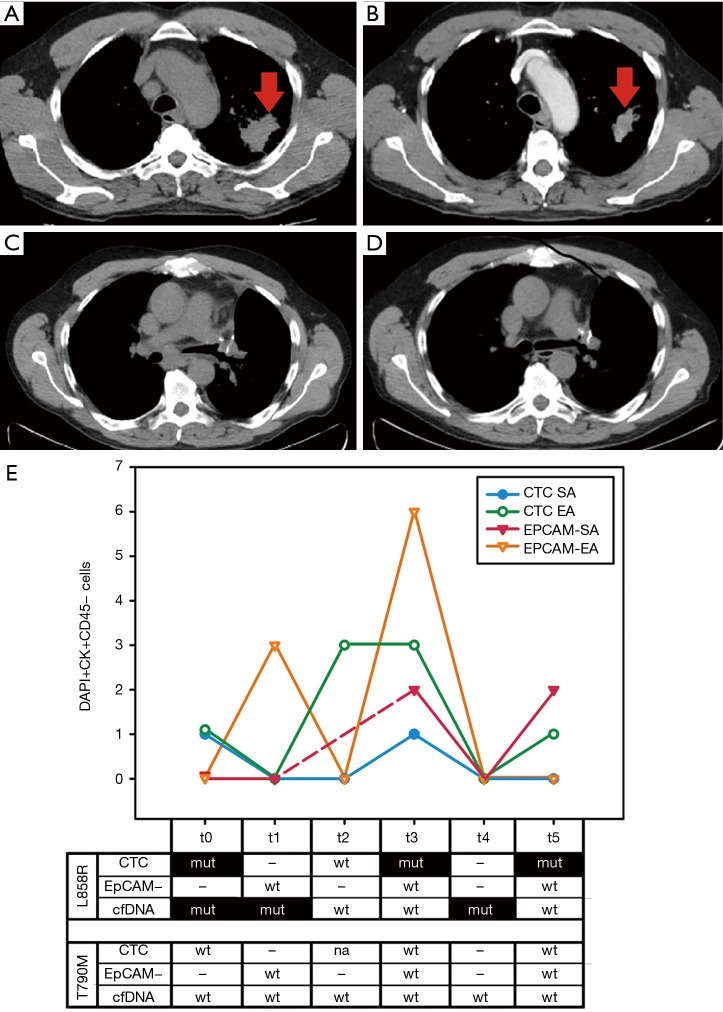
In non-small cell lung cancer (NSCLC), there is a consensus regarding the use of liquid biopsy, generally, to detect "druggable" mutations and, in particular, to monitor tyrosine kinase inhibitor (TKI) treatments. However, whether circulating tumor cells (CTCs) are better tools than cell-free DNA (cfDNA), is still a matter of debate, mainly concerning which antigen(s) we should use to investigating simultaneously both epithelial and epithelial-to-mesenchymal transient (EMT) phenotype in the same sample of CTCs. To address this item, we exploited here a single-tube liquid biopsy, to detect both epithelial cell adhesion molecule (EpCAM)-positive CTCs and EpCAM-low/negative CTCs, because down-modulation of EpCAM is considered the first step in EMT. Furthermore, we analyzed the DNA from CTCs of four different phenotypes (ctcDNA), according to their EpCAM expression and cytokeratin pattern, and circulating tumor DNA (ctDNA) by droplet digital PCR (ddPCR), in order to disclose activating and resistance-driving mutations. Liquid biopsy reflected spatial and temporal heterogeneity of the tumor under treatment pressure. We provide the proof-of-concept that the complementary use of ctDNA and ctcDNA represents a reliable, minimally invasive and dynamic tool for a more comprehensive view of tumor evolution.
Keywords: Non-small cell lung cancer (NSCLC); circulating tumor DNA (ctDNA); circulating tumor cells (CTCs); epidermal growth factor receptor (EGFR); epithelial cell adhesion molecule-positive and epithelial cell adhesion molecule-low/negative (EpCAM pos and EpCAM low/neg); liquid biopsy.
Conflict of interest statement
Conflicts of Interest: The authors have no conflicts of interest to declare.
Figures
References
-
- Mitsudomi T, Morita S, Yatabe Y, et al. Gefitinib versus cisplatin plus docetaxel in patients with non-small-cell lung cancer harbouring mutations of the epidermal growth factor receptor (WJTOG3405): an open label, randomised phase 3 trial. Lancet Oncol 2010;11:121-8. 10.1016/S1470-2045(09)70364-X - DOI - PubMed
Publication types
LinkOut - more resources
Full Text Sources
Other Literature Sources
Research Materials
Miscellaneous