


It's the journey, not the destination: Locomotor exploration in infants
- PMID: 30176103
- PMCID: PMC6391171
- DOI: 10.1111/desc.12740
It's the journey, not the destination: Locomotor exploration in infants
Abstract
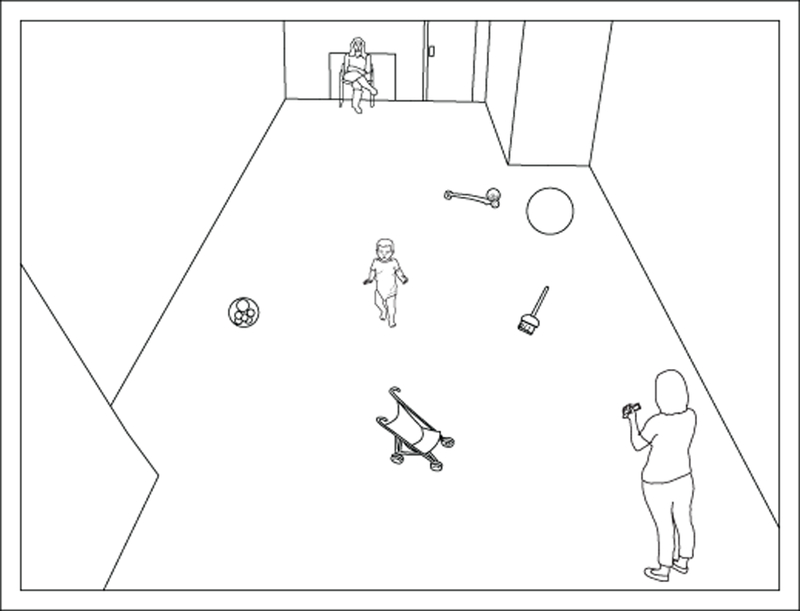
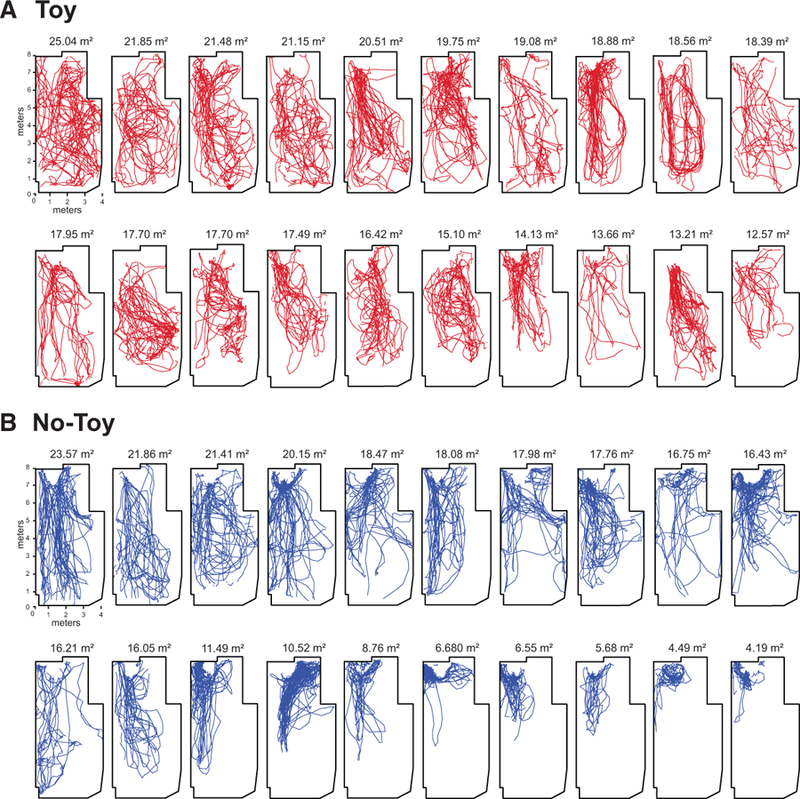
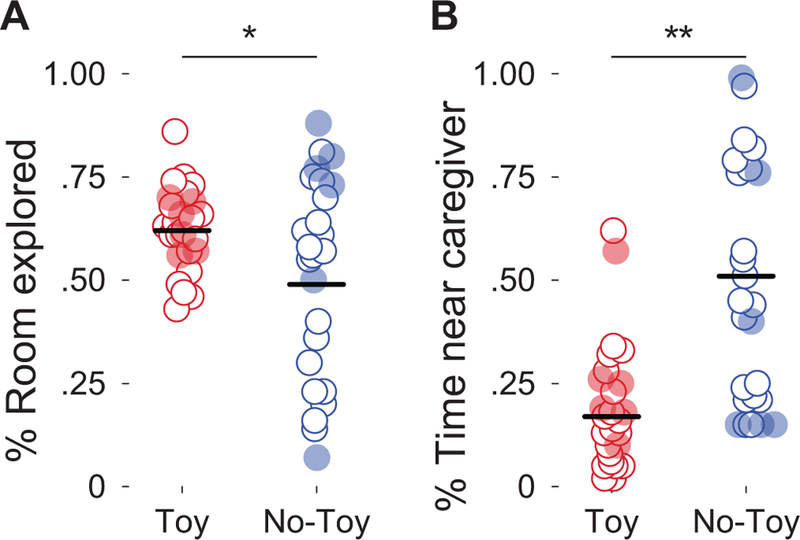
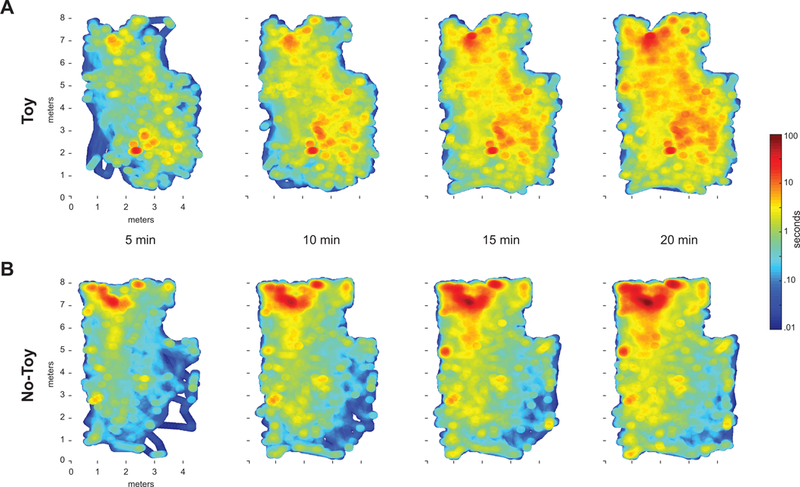
What incites infant locomotion? Recent research suggests that locomotor exploration is not primarily directed toward distant people, places, or things. However, this question has not been addressed experimentally. In the current study, we asked whether a room filled with toys designed to encourage locomotion (stroller, ball, etc.) elicits different quantities or patterns of exploration than a room with no toys. Caregivers were present but did not interact with infants. Although most walking bouts in the toy-filled room involved toys, to our surprise, 15-month-olds in both rooms produced the same quantity of locomotion. This finding suggests that mere space to move is sufficient to elicit locomotion. However, infants' patterns of locomotor exploration differed: Infants in the toy-filled room spent a smaller percent of the session within arms' reach of their caregiver and explored more locations in the room. Real-time analyses show that infants in the toy-filled room took an increasing number of steps per bout and covered more area as the session continued, whereas infants in the no-toy room took fewer and fewer steps per bout and traveled repeatedly over the same ground. Although not required to elicit locomotion, moving with toys encouraged infants to travel farther from their caregivers and to explore new areas.
Keywords: exploration; gross motor play; infant locomotion; peragration; walking.
© 2018 John Wiley & Sons Ltd.
Figures

References
-
- Adolph KE, & Robinson SR (2013). The road to walking: What learning to walk tells us about development. In Zelazo P (Ed.), Oxford handbook of developmental psychology (pp. 403–443). New York: Oxford University Press.
-
- Adolph KE, & Robinson SR (2015). Motor development. In Liben L & Muller U (Eds.), Handbook of child psychology and developmental science (7th ed., Vol. 2 Cognitive Processes, pp. 114–157). New York: Wiley.
Publication types
MeSH terms
Grants and funding
LinkOut - more resources
Full Text Sources
Other Literature Sources
Medical
