


Drug Reaction with Eosinophilia and Systemic Symptoms (DRESS) Syndrome Identified in the Electronic Health Record Allergy Module
- PMID: 30176295
- PMCID: PMC6363826
- DOI: 10.1016/j.jaip.2018.08.013
Drug Reaction with Eosinophilia and Systemic Symptoms (DRESS) Syndrome Identified in the Electronic Health Record Allergy Module
Abstract
Background: Drug reaction with eosinophilia and systemic symptoms (DRESS) syndrome is a rare but severe hypersensitivity reaction that remains poorly characterized in the United States.
Objective: To identify and describe DRESS syndrome cases in an integrated health care system using electronic health record (EHR) allergy module free-text searches.
Methods: We identified DRESS syndrome cases with rash, absolute eosinophil count of 500/L or more, organ involvement, and a European Registry of Severe Cutaneous Adverse Reactions to Drugs and Collection of Biological Samples score of 2 or more by reviewing those patients from 1980 to 2016 whose EHR allergic reaction matched DRESS-related key words. Liver injury required alanine aminotransferase level of 100 U/L or more, and renal injury required creatinine increase by 0.5 mg/dL (or 50%) or more. Patient and DRESS characteristics were described, resource use was determined, and cost was estimated.
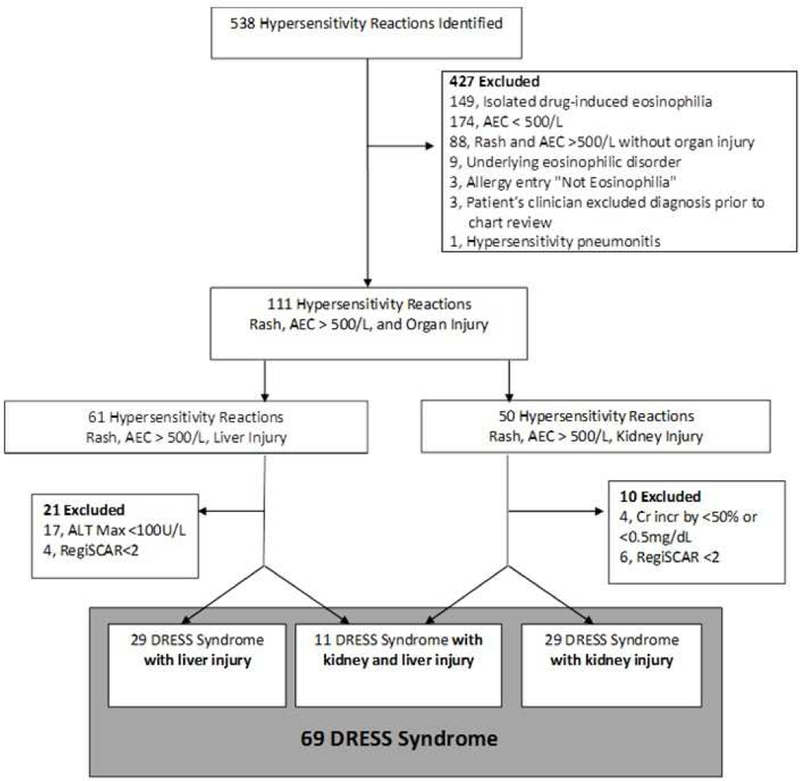
Results: Among 3,162,562 patients with 3,319,387 million allergy entries, 538 reactions matched key words, and 69 were DRESS syndrome cases (prevalence 2.18 per 100,000). Patients with DRESS had liver (42%) or renal (42%) injury; 11 (16%) had both liver and renal injury. Primary drug culprits were antibiotics (74%) (vancomycin [39%], β-lactams [23%], fluoroquinolones [4%], tetracyclines [4%], and sulfonamides [3%]) and anticonvulsants (20%). Of 65 (94%) hospitalized patients with DRESS, 43 (66%) were hospitalized for DRESS syndrome management with median length of stay of 9 days (interquartile range, 6-17 days) and cost approximately $17,101 per patient.
Conclusions: Using free-text search of the EHR allergy module identified a large US DRESS syndrome cohort. DRESS prevalence was 2.18 per 100,000 patients. Both liver and kidney injury were frequent, and vancomycin was the most common drug culprit. DRESS cases were morbid and resource-intensive.
Keywords: Anticonvulsant hypersensitivity syndrome; Cost; Drug-induced hypersensitivity syndrome; Hypersensitivity; Resource; Severe cutaneous adverse reaction.
Copyright © 2018 American Academy of Allergy, Asthma & Immunology. Published by Elsevier Inc. All rights reserved.
Conflict of interest statement
Conflict of Interest:
NAP discloses spousal employment by Chiesi Farmaceutici; this is unrelated to the submitted manuscript.
The other authors (ARW, LZ, YL, OAC, KGB) declare no conflict of interest.
Figures
References
-
- Myers GB, Heide EV, Balcerski M. Exfoliative dermatitis following sulfanilamide. JAMA 1937;109:1983–1984.
-
- Saltzstein SL, Ackerman LV. Lymphadenopathy induced by anticonvulsant drugs and mimicking clinically and pathologically malignant lymphomas. Cancer 1959;12:164–182. - PubMed
-
- Chen YC, Chiu HC, Chu CY. Drug reaction with eosinophilia and systemic symptoms: a retrospective study of 60 cases. Arch Dermatol 2010;146:1373–1379. - PubMed
-
- Um SJ, Lee SK, Kim YH, Kim KH, Son CH, Roh MS, et al. Clinical features of drug-induced hypersensitivity syndrome in 38 patients. J Investig Allergol Clin Immunol 2010;20:556–562. - PubMed
Publication types
MeSH terms
Substances
Grants and funding
LinkOut - more resources
Full Text Sources
Other Literature Sources
