


Self-monitoring and personalized feedback based on the experiencing sampling method as a tool to boost depression treatment: a protocol of a pragmatic randomized controlled trial (ZELF-i)
- PMID: 30176845
- PMCID: PMC6122175
- DOI: 10.1186/s12888-018-1847-z
Self-monitoring and personalized feedback based on the experiencing sampling method as a tool to boost depression treatment: a protocol of a pragmatic randomized controlled trial (ZELF-i)
Abstract
Background: Depression is a leading cause of disability worldwide. To reduce the societal burden and improve quality of life for individual patients, treatments for depression need to be optimized. There is a particular need for person-tailored interventions that reinforce self-management of patients. Systematic self-monitoring and personalized feedback through the Experience Sampling Method (ESM) could provide such a person-tailored, empowering intervention that enhances treatment outcomes. The primary aim of this study is to investigate the efficacy of self-monitoring and personalized feedback as an add-on tool in the treatment of depressive complaints in a natural setting.
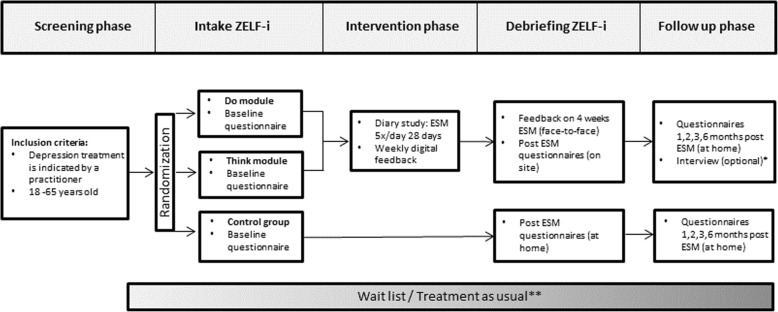
Methods: The ZELF-i study is a pragmatic multi-site randomized controlled trial (RCT). We aim to recruit 150 individuals with depressive symptoms aged between 18 and 65 years, who have an intake for outpatient basic or specialized treatment at a mental health care organization in the North of the Netherlands. After the intake, participants will be randomly allocated to one of three study arms: two experimental groups engaging in 28 days of systematic self-monitoring (5 times per day) and receiving weekly personalized feedback on positive affect and activities ("Do"-module) or on negative affect and thinking patterns ("Think"-module), and a control group receiving no additional intervention. Self-report inventories of depressive symptoms, psychosocial functioning and feelings of empowerment will be administered before and after the intervention period, and at follow-up measurements at 1, 2, 3 and 6 months. The patient-experienced utility of the intervention will be investigated by a combination of quantitative and qualitative research methods.
Discussion: The present study is the first to examine the effects of add-on self-monitoring and personalized feedback on depressive complaints in clinical practice. It is also the first to evaluate two different ESM modules targeted at both of depression's core symptoms. Lastly, it is the first study that uses a combination of qualitative and quantitative methods to evaluate the patient-experienced utility of ESM with personalized feedback as an intervention for depression. Results of the present study may improve treatment for depression, if the intervention is found to be effective.
Trial registration: Dutch Trial Register, NTR5707 , registered prospectively 1 February 2016.
Keywords: Depression; E-health; Experience sampling; Intervention; Personalized medicine; Randomized Controlled trial; Self-monitoring.
Conflict of interest statement
Ethics approval and consent to participate
The current study was approved by the Medical Ethical Committee from the University Medical Center Groningen (no. 2015/530). All participants will provide written informed consent before enrollment in the study.
Consent for publication
Not applicable.
Competing interests
The authors declare that they have no competing interests.
Publisher’s Note
Springer Nature remains neutral with regard to jurisdictional claims in published maps and institutional affiliations.
Figures

References
-
- World Health Organization: The global burden of disease 2004 update. http://www.who.int/healthinfo/global_burden_disease/2004_report_update/en (2008). Accessed 20 Feb 2018.
-
- American Psychiatric Association . Diagnostic and statistical manual of mental disorders. 4th ed., text revision. Washington, DC: American Psychiatric Association; 2000.
-
- Ministry of Health, Welfare and Sport: Voorhangbrief POH-GGZ en generalistische basis GGZ. https://www.rijksoverheid.nl/onderwerpen/geestelijke-gezondheidszorg/doc... (2013). Accessed 20 Feb 2018.
-
- Elfeddali I, van der Feltz-Cornelis CM, van Os J, Knappe S, Vieta E, Wittchen HU, et al. Horizon 2020 priorities in clinical mental health research: results of a consensus-based ROAMER expert survey. Int J Environ Res Public Health. 2014;11(10):10915–10939. doi: 10.3390/ijerph111010915. - DOI - PMC - PubMed
Publication types
MeSH terms
Associated data
LinkOut - more resources
Full Text Sources
Other Literature Sources
Medical
