


Adjustment of refugee children and adolescents in Australia: outcomes from wave three of the Building a New Life in Australia study
- PMID: 30176864
- PMCID: PMC6122776
- DOI: 10.1186/s12916-018-1124-5
Adjustment of refugee children and adolescents in Australia: outcomes from wave three of the Building a New Life in Australia study
Abstract
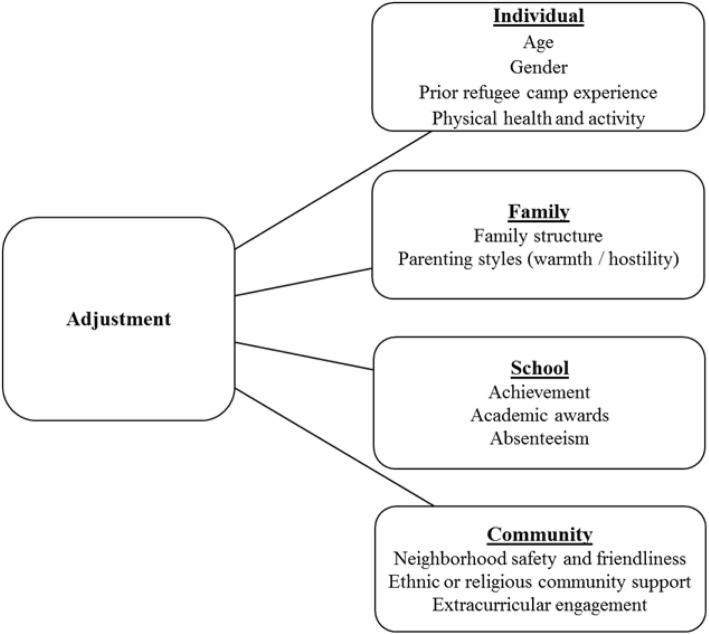
Background: High-income countries like Australia play a vital role in resettling refugees from around the world, half of whom are children and adolescents. Informed by an ecological framework, this study examined the post-migration adjustment of refugee children and adolescents 2-3 years after arrival to Australia. We aimed to estimate the overall rate of adjustment among young refugees and explore associations with adjustment and factors across individual, family, school, and community domains, using a large and broadly representative sample.
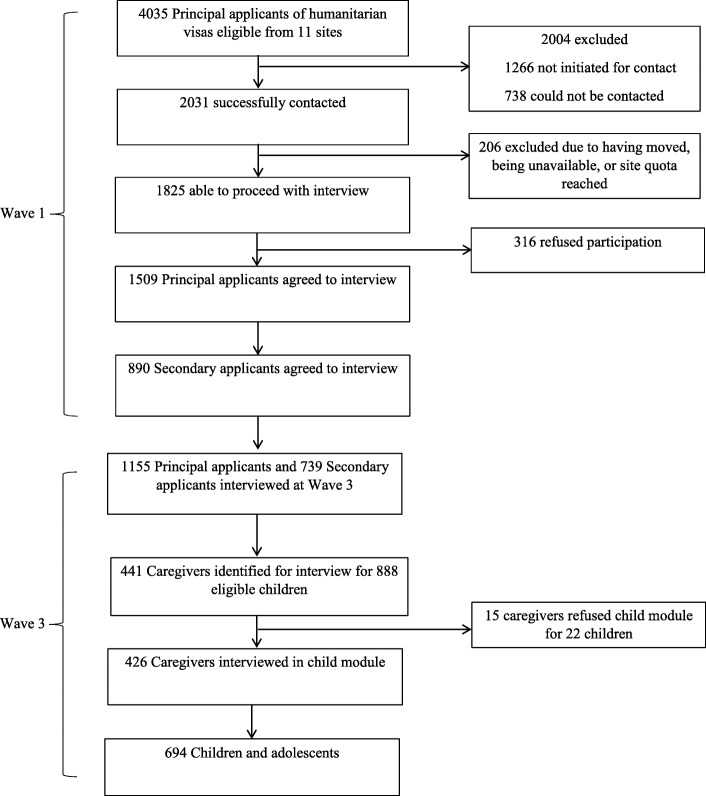
Methods: Data were drawn from Wave 3 of the Building a New Life in Australia (BNLA) study, a nationally representative, longitudinal study of settlement among humanitarian migrants in Australia. Caregivers of refugee children aged 5-17 (N = 694 children and adolescents) were interviewed about their children's physical health and activity, school absenteeism and achievement, family structure and parenting style, and community and neighbourhood environment. Parent and child forms of the Strengths and Difficulties Questionnaire (SDQ) were completed by caregivers and older children to assess social and emotional adjustment.
Results: Sound adjustment according to the SDQ was observed regularly among young refugees, with 76-94% (across gender and age) falling within normative ranges. Comparison with community data for young people showed that young refugees had comparable or higher adjustment levels than generally seen in the community. However, young refugees as a group did report greater peer difficulties. Bivariate and multivariate linear regression analyses showed that better reported physical health and school achievement were associated with higher adjustment. Furthermore, higher school absenteeism and endorsement of a hostile parenting style were associated with lower adjustment.
Conclusions: This is the first study to report on child psychosocial outcomes from the large, representative longitudinal BNLA study. Our findings indicate sound adjustment for the majority of young refugees resettled in Australia. Further research should examine the nature of associations between variables identified in this study. Overall, treating mental health problems early remains a priority in resettlement. Initiatives to enhance parental capability, physical health, school achievement and participation could assist to improve settlement outcomes for young refugees.
Keywords: Adjustment; Adolescents; Children; Ecological; Mental health; Psychosocial; Refugee; Resettlement; Strengths and Difficulties Questionnaire.
Conflict of interest statement
Ethics approval and consent to participate
Ethics approval was granted by the Australian Institute of Family Studies Human Research Ethics Committee (LSHM 13/03).
Consent for publication
Not applicable.
Competing interests
The authors declare that they have no competing interests.
Publisher’s Note
Springer Nature remains neutral with regard to jurisdictional claims in published maps and institutional affiliations.
Figures
Comment in
-
Refugees and the post-migration environment.BMC Med. 2018 Sep 4;16(1):164. doi: 10.1186/s12916-018-1155-y. BMC Med. 2018. PMID: 30176858 Free PMC article.
References
-
- Jenkinson R, Silbert M, De Maio J, Edwards B. Building a New Life in Australia: Settlement experiences of recently arrived humanitarian migrants. J Home Econ Inst Aust. 2015;22(3):22–8.
Publication types
MeSH terms
Grants and funding
LinkOut - more resources
Full Text Sources
Other Literature Sources
