


Restructuring physical micro-environments to reduce the demand for meat: a systematic review and qualitative comparative analysis
- PMID: 30177007
- PMCID: PMC6120131
- DOI: 10.1016/S2542-5196(18)30188-8
Restructuring physical micro-environments to reduce the demand for meat: a systematic review and qualitative comparative analysis
Abstract
Background: Reducing meat consumption could help to protect the natural environment and promote population health. Interventions restructuring physical micro-environments might help to change habitual behaviour. We synthesised the scientific evidence pertaining to whether, and which, interventions restructuring physical micro-environments effectively reduce the demand for meat.
Methods: We did a systematic review of quantitative studies evaluating the effectiveness of interventions restructuring physical micro-environments to reduce the demand for meat. We identified relevant records by searching six electronic databases (CAB Abstracts, Embase, PsycINFO, Science Citation Index, MEDLINE, and Dissertations & Theses) on Aug 31, 2017, contacting experts, screening publicly accessible online resources, and searching references. We included studies that evaluated the effectiveness of interventions restructuring physical micro-environments to reduce the demand for meat, defined as the actual or intended consumption, purchase, or selection of meat in real or virtual environments. We extracted data pertaining to the study samples, the interventions, and meat demand at the follow-up closest to intervention completion and at the longest follow-up, with the former representing our primary outcome. We synthesised data narratively and did a qualitative comparative analysis to identify configurations of intervention characteristics associated with, and those not found to be associated with, significant reductions in meat demand. Our Systematic Review is registered with PROSPERO, number CRD42017081532.
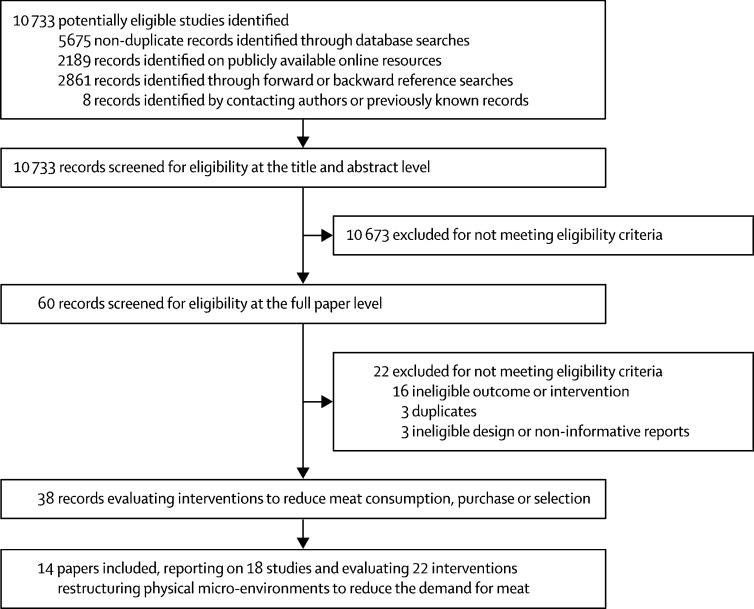
Results: Of 10 733 titles and abstracts screened for eligibility, we assessed 60 full papers and included 14 papers reporting on 18 studies with 22 intervention conditions. Three interventions reducing the portion size of meat servings reduced meat consumption in randomised trials. Three interventions providing meat alternatives with supporting educational material were associated with reduced meat demand in pre-post design studies. Three of four interventions altering the sensory properties (eg, visual presentation) of meat or meat alternatives at point of purchase reduced meat demand in randomised trials. Four interventions repositioning meat products to be less prominent at point of purchase were associated with lower meat demand, but only two such interventions reached statistical significance in a randomised trial and a multiple treatment reversal design. Only one of five interventions manipulating the description of meat or meat alternatives at point of purchase was associated with lower meat demand in a multiple treatment reversal design. Evidence from randomised trials evaluating a pricing intervention or interventions restructuring several aspects of micro-environments was too scarce or inconsistent to be conclusive. The results from our qualitative comparative analysis supported the findings of this narrative synthesis.
Interpretation: Some interventions restructuring physical micro-environments could help to promote lower demand for meat. Interventions reducing portion sizes of meat servings, providing meat alternatives, or changing the sensory properties of meat and meat alternatives at point of purchase offered the most promise in the context of experimental studies.
Funding: None.
Copyright © 2018 The Author(s). Published by Elsevier Ltd. This is an Open Access article under the CC BY 4.0 license. Published by Elsevier Ltd.. All rights reserved.
Comment in
-
Environmental nudges to reduce meat demand.Lancet Planet Health. 2018 Sep;2(9):e374-e375. doi: 10.1016/S2542-5196(18)30185-2. Lancet Planet Health. 2018. PMID: 30177002 No abstract available.
References
-
- Steinfeld H, Gerber P, Wassenaar T, Castel V, Rosales M, de Hann C. Food and Agriculture Organization of the United Nations; Rome: 2006. Livestock's long shadow: environmental issues and opinions.
-
- Tilman D, Clark M. Global diets link environmental sustainability and human health. Nature. 2014;515:518–522. - PubMed
-
- Pimentel D, Pimentel M. Sustainability of meat-based and plant-based diets and the environment. Am J Clin Nutr. 2003;78(3 suppl):660S–663S. - PubMed
-
- Gerber P, Steinfeld H, Henderson B. Food and Agriculture Organization of the United Nations; Rome: 2013. Tackling climate change through livestock—a global assessment of emissions and mitigation opportunities.
-
- Watts N, Amann M, Ayeb-Karlsson S. The Lancet Countdown on health and climate change: from 25 years of inaction to a global transformation for public health. Lancet. 2018;391:581–630. - PubMed
Publication types
MeSH terms
Grants and funding
LinkOut - more resources
Full Text Sources
Other Literature Sources
