Review
. 2018 Nov:71:177-182.
doi: 10.1016/j.dnarep.2018.08.022. Epub 2018 Aug 23.

The comings and goings of PARP-1 in response to DNA damage

Affiliations
Review

The comings and goings of PARP-1 in response to DNA damage

John M Pascal. DNA Repair (Amst). 2018 Nov.

Abstract

Poly(ADP-ribose) polymerase (PARP) enzymes are broadly involved in the cellular response to DNA damage. PARP-1 is the chief human PARP enzyme involved in the DNA damage response, acting as a first responder that detects DNA strand breaks, and contributes to repair pathway choice and the efficiency of repair through modulation of chromatin structure and through interaction with and modification of a multitude of DNA repair factors. This perspective summarizes our knowledge of PARP-1 involvement in DNA repair pathways, and highlights recent structural and functional data regarding the activation of PARP-1 upon detecting DNA damage, and the release and trapping of PARP-1 at sites of DNA damage.

Keywords: DNA damage response; PARP; Poly(ADP-ribose).


Conflict of interest statement

Conflict of Interest Statement

The author claims no conflict of interest.

Figures
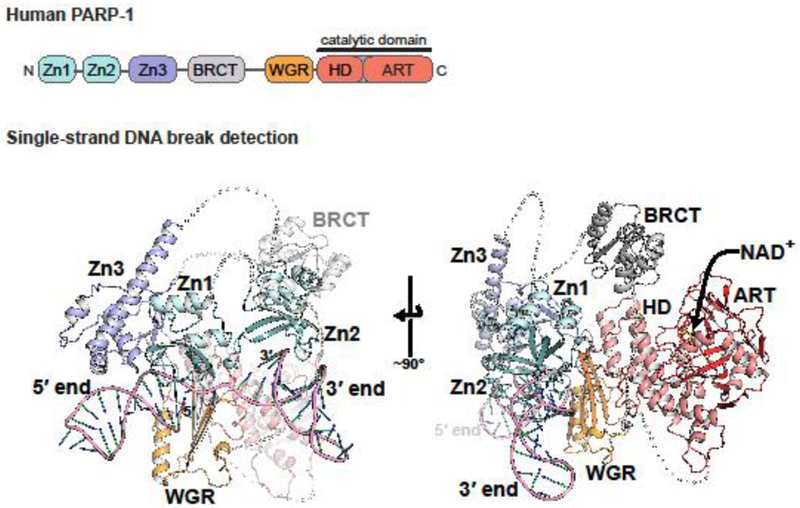
Figure 1.
Figure 1.. PARP-1 detecting DNA damage and primed for poly(ADP-ribose) production
Human PARP-1 domain names and organization, and a structural model for PARP-1 interaction with single-strand break DNA damage. PARP-1 binding to the ends of DNA strand break damage is achieved through coordinated action of two zinc finger domains, Zn1 and Zn2, located at the N-terminus of the protein. The Zn1 domain binds to the side of the DNA break with a terminal 5’ strand (5’ end), and the Zn2 domain binds to the side of the DNA break with a terminal 3’ strand (3’ end). A structurally unrelated third zinc binding domain, Zn3, and the WGR (Trp-Gly-Arg) domain also make contacts with DNA. The catalytic domain (CAT) is composed of an ADP-ribosyl transferase (ART) fold and a helical subdomain (HD). The linker residues (each residue represented by an individual sphere) and the BRCT (BRCA1 C-terminus) domain were manually positioned based on linker lengths and the domain termini. The NAD+ binding site is noted. The combined crystallographic and NMR model is shown in two orientations that are related by an approximately 90-degree rotation about a vertical axis in the plane of the page. The left view highlights the structure of the DNA break and PARP-1/DNA contacts, with the CAT domain and the BRCT in the background. The right view highlights the HD contacts with the domains that are assembled on DNA.

References

    1. Gibson BA, Kraus WL, New insights into the molecular and cellular functions of poly(ADP-ribose) and PARPs, Nat. Rev. Mol. Cell Biol. 13 (2012) 411–424. doi:10.1038/nrm3376. - DOI - PubMed
    1. Hassa PO, Hottiger MO, The diverse biological roles of mammalian PARPS, a small but powerful family of poly-ADP-ribose polymerases., Front. Biosci. 13 (2008) 3046–82. http://www.ncbi.nlm.nih.gov/pubmed/17981777 (accessed March 22, 2018). - PubMed
    1. Karlberg T, Langelier M-F, Pascal JM, Schüler H, Structural biology of the writers, readers, and erasers in mono- and poly(ADP-ribose) mediated signaling., Mol. Aspects Med. 34 (2013) 1088–108. doi:10.1016/j.mam.2013.02.002. - DOI - PMC - PubMed
    1. Hottiger MO, Hassa PO, Lüscher B, Schüler H, Koch-Nolte F, Toward a unified nomenclature for mammalian ADP-ribosyltransferases, Trends Biochem. Sci. 35 (2010) 208–219. doi:10.1016/j.tibs.2009.12.003. - DOI - PubMed
    1. Ray Chaudhuri A, Nussenzweig A, The multifaceted roles of PARP1 in DNA repair and chromatin remodelling, Nat. Rev. Mol. Cell Biol. 18 (2017) 610–621. doi:10.1038/nrm.2017.53. - DOI - PMC - PubMed

Publication types

LinkOut - more resources
