. 2018 Sep 3;9(1):3561.
doi: 10.1038/s41467-018-06008-4.

A systems-level framework for drug discovery identifies Csf1R as an anti-epileptic drug target

Affiliations

A systems-level framework for drug discovery identifies Csf1R as an anti-epileptic drug target

Prashant K Srivastava et al. Nat Commun. .

Abstract

The identification of drug targets is highly challenging, particularly for diseases of the brain. To address this problem, we developed and experimentally validated a general computational framework for drug target discovery that combines gene regulatory information with causal reasoning ("Causal Reasoning Analytical Framework for Target discovery"-CRAFT). Using a systems genetics approach and starting from gene expression data from the target tissue, CRAFT provides a predictive framework for identifying cell membrane receptors with a direction-specified influence over disease-related gene expression profiles. As proof of concept, we applied CRAFT to epilepsy and predicted the tyrosine kinase receptor Csf1R as a potential therapeutic target. The predicted effect of Csf1R blockade in attenuating epilepsy seizures was validated in three pre-clinical models of epilepsy. These results highlight CRAFT as a systems-level framework for target discovery and suggest Csf1R blockade as a novel therapeutic strategy in epilepsy. CRAFT is applicable to disease settings other than epilepsy.


Conflict of interest statement

J.v.E., P.G., M.M., J.V.S., B.D., C.V., P.F., K.L., G.M.-C., A.C., F.V., I.N., J.K., J.G., G.G., S.-A.C., I.K., and R.M.K. are employees of UCB Pharma. M.R.J. and E.P. have received research funding from UCB Pharma. The authors declare no other competing interests.

Figures

Fig. 1
Fig. 1
Experimental plan and study overview. We studied 100 mice with epilepsy (pilocarpine post status epilepticus model of temporal lobe epilepsy) and 100 control (pilocarpine-naïve) matched littermate mice. At 4 weeks post status epilepticus, each mouse was continuously monitored using 3D accelerometry and video monitoring for 14 days to record seizure frequency and severity. High-throughput mRNA sequencing (RNA-seq) was generated using RNA from snap-frozen whole hippocampus samples from the mice and gene expression profiles were used to generate co-expression modules. Co-expression modules with a potential relationship to epilepsy were prioritized using the following criteria: (i) differential co-expression between epileptic and healthy hippocampus (mouse and human TLE), (ii) correlation of module expression with seizure frequency (mouse), and (iii) conservation in the human epileptic hippocampus. Modules meeting these criteria were considered candidate modules for epilepsy, and subjected to CRAFT analysis to identify membrane receptors predicted to restore disease module expression toward health
Fig. 2
Fig. 2
Correlation of module expression with seizures. a For each co-expression module from the epileptic mouse hippocampus, we plotted the significance (−Log10 FDR) of the Spearman’s correlation between the module’s eigengene and seizure frequency (bar plot), and the percentage of variance in seizure frequency explained by the module’s eigengene (R2, dotted line). Modules marked with a blue arrow are the modules differentially co-expressed between the epileptic mouse hippocampus and the control mouse hippocampus. Modules highlighted in gray (bar plot) are significantly (FDR <0.05) correlated with seizure frequency. b Volcano plot of average (Spearman’s) correlation of a module’s genes with seizure frequency (X-axis) versus the significance of the module’s enrichment for genes individually correlated with seizure frequency (QTT genes) (Y-axis) for the nine modules differentially co-expressed in epilepsy and correlated with seizures by module eigenegene
Fig. 3
Fig. 3
Causal reasoning framework. A knowledge-based “interactome” (or "regulome") connecting membrane receptors to module gene expression was constructed based on experimentally validated connections between membrane receptors and transcription factors (TFs) in linear pathways, and between TFs and their target genes (genome-wide). This “regulome” is then integrated with information about whether the genes in a candidate module are over-expressed (“O”) or under-expressed (“U”) in the disease state, allowing receptors to be classified as either disease “Activators” or “Repressors,” which in turn permits the therapeutic directionality of receptor blockade or activation to be inferred. In the upper part of the figure, we show the positive activation of the TFs by the receptor “Receptor A,” whereas in the lower part of the figure we show the opposite scenario of inactivation of the TFs by Receptor A. An illustrative example of the framework is shown in Supplementary Figure 6
Fig. 4
Fig. 4
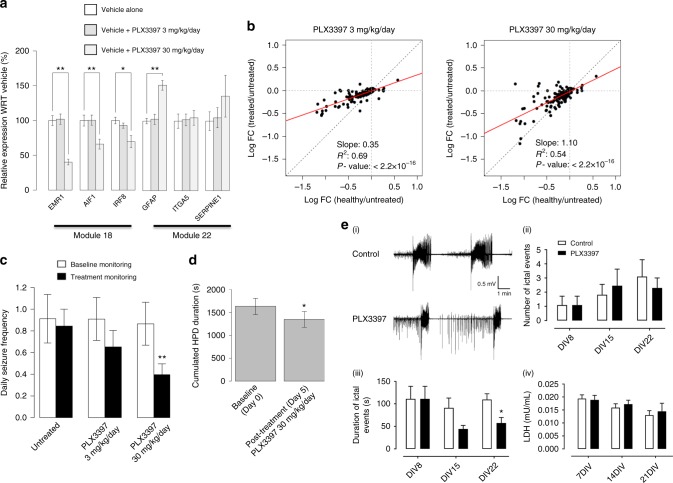
Effect of PLX3397 on module 18 expression and seizures. a PLX3397 regulates module 18 genes. Epileptic mice were treated daily for 7 days with vehicle or PLX3397 at 3 or 30 mg/kg per day (n = 8 mice in each group). At the end of the treatment, hippocampal RNA was extracted and the expression of marker genes in modules 18 and 22 was assayed by rt-qPCR. Module 18 marker genes were significantly down-regulated by PLX3397 at 30 mg/kg per day (*P < 0.05, **P < 0.01—one-tailed Welch’s t test). b Restoration of module 18 expression in epilepsy toward health by PLX3397. Epileptic mice were treated with PLX3397 at 3 or 30 mg/kg per day or vehicle alone (n = 8 mice in each group). Hippocampal mRNA was extracted on day 14 of treatment and module 18 expression assayed by microarray. Red line indicates the linear negative correlation between the two conditions compared to a theoretical complete restoration of expression toward the healthy state (dotted black line). Treatment with PLX3397 resulted in a significant and dose-dependent (P = 3.6 × 10−14) restoration of expression of module 18 toward health (i.e., toward the dotted black diagonal). c Efficacy of PLX3397 on seizures—pilocarpine model. Epileptic mice were baseline monitored for a week (white) before daily administration with vehicle or PLX3397 at 3 or 30 mg/kg per day (n = 20 mice in each group) and monitored for a second week (black). PLX3397 treatment induced a significant decrease in daily seizure frequency (**P < 0.01—Wilcoxon's signed-rank test) at 30 mg/kg per day. d Efficacy of PLX3397 on paroxysmal hippocampal discharges—kainate model. Epileptic mice (n = 8) were EEG monitored at baseline (day 0) for 2 h prior to daily administration of PLX3397 at 30 mg/kg per day for 4 days and then EEG monitored on day 5 for 2 h to assess drug efficacy. Treatment with PLX3397 led to a significant (*P < 0.05) reduction in the duration of HPDs. e Efficacy of PLX3397 in organotypic hippocampal slice cultures. (i) Representative field potential traces of ictal epileptiform activity in dentate gyrus (DG) granular cell layer following 2 weeks of vehicle alone or 1 µM PLX3397, (ii) mean and (iii) duration of ictal events (±S.E.M.) at baseline (DIV 8) and following PLX3397 (DIV 15 and DIV 22). (iv) supernatant concentrations (mean ± S.E.M.) of lactate dehydrogenase at baseline (DIV 7) and following PLX3397 (DIV 14 and DIV 21). In total, 60 hippocampal slices from six rats were analyzed consisting of 36 slices for control and 24 for PLX3397 treatment groups, respectively. *P < 0.05

Comment in

References

    1. Paul SM, et al. How to improve R&D productivity: the pharmaceutical industry’s grand challenge. Nat. Rev. Drug Discov. 2010;9:203–214. - PubMed
    1. Kola I, Landis J. Can the pharmaceutical industry reduce attrition rates? Nat. Rev. Drug Discov. 2004;3:1–5. - PubMed
    1. Johnson MR, et al. Systems genetics identifies a convergent gene network for cognition and neurodevelopmental disease. Nat. Neurosci. 2016;19:223–232. - PubMed
    1. Schadt EE. Molecular networks as sensors and drivers of common human diseases. Nature. 2009;461:218–223. - PubMed
    1. Civelek M, Lusis AJ. Systems genetics approaches to understand complex traits. Nat. Rev. Genet. 2014;15:34–48. - PMC - PubMed

Publication types

MeSH terms