


Clinical epidemiology of infectious disease among patients with chronic kidney disease
- PMID: 30178234
- PMCID: PMC6435626
- DOI: 10.1007/s10157-018-1641-8
Clinical epidemiology of infectious disease among patients with chronic kidney disease
Erratum in
-
Correction to: Clinical epidemiology of infectious disease among patients with chronic kidney disease.Clin Exp Nephrol. 2019 May;23(5):723. doi: 10.1007/s10157-019-01708-7. Clin Exp Nephrol. 2019. PMID: 30826978 Free PMC article.
Abstract
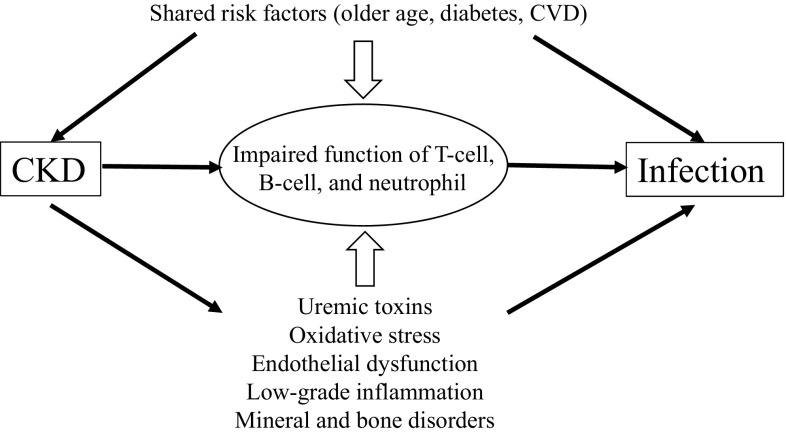
Infectious disease is recognized as an important complication among patients with end-stage renal disease, contributing to excess morbidity and health care costs. However, recent epidemiological studies have revealed that even mild to moderate stages of chronic kidney disease (CKD) substantially increase risk of infection. Regarding underlying mechanisms, evidence suggests various aspects of altered immune response in patients with CKD including impaired function of T cells, B cells and neutrophil. Multiple conditions surrounding CKD, such as older age, diabetes, and cardiovascular disease are important contributors in the increased susceptibility to infection in this population. In addition, several mechanisms impairing immune function have been hypothesized including accumulated uremic toxins, increased oxidative stress, endothelial dysfunction, low-grade inflammation, and mineral and bone disorders. In terms of prevention strategies, influenza and pneumococcal vaccines are most feasible and important. Nevertheless, the extent of vaccine utilization in CKD has not been well documented. In addition, antibody response to vaccination may be reduced in CKD patients, and thus a vaccine delivery strategy (e.g., dose and frequency) may need to be optimized among patients with CKD. Through this review, we demonstrate that infection is a major but underrecognized complication of CKD. As CKD is recognized as a serious public health issue, dedicated research is needed to better characterize the burden of infectious disease associated with CKD, understand the pathophysiology of infection in patients with CKD, and develop effective strategies to prevent infection and its sequela in this high risk population.
Keywords: Bloodstream infections; Chronic kidney disease; Infections; Influenza vaccination; Pneumococcal vaccination; Pneumonia; Renal failure.
Conflict of interest statement
Conflict of interest
The author reports no conflicts of interest in this work.
Human and animal rights statement
This work does not include any analysis involving human or animal subjects.
Informed consent
There is no involvement of human subjects in this work.
Figures
References
-
- Jha V, Garcia-Garcia G, Iseki K, Li Z, Naicker S, Plattner B, et al. Chronic kidney disease: global dimension and perspectives. Lancet. 2013;382(9888):260–272. - PubMed
-
- United States Renal Data System . 2015 USRDS annual data report: Epidemiology of kidney disease in the United States. Bethesda: National Institutes of Health, National Institute of Diabetes and Digestive and Kidney Diseases; 2015.
Publication types
MeSH terms
Grants and funding
LinkOut - more resources
Full Text Sources
Other Literature Sources
Medical
Research Materials
