


doi: 10.1007/978-3-319-91287-5_56.
Long-Term In Vivo Oxygen Sensors for Peripheral Artery Disease Monitoring
Affiliations
- PMID: 30178370
- PMCID: PMC6367927
- DOI: 10.1007/978-3-319-91287-5_56
Item in Clipboard
Long-Term In Vivo Oxygen Sensors for Peripheral Artery Disease Monitoring
Adv Exp Med Biol.
2018.
Abstract
Tracking of tissue oxygenation around chronic foot wounds may help direct therapy decisions in patients with peripheral artery disease (PAD). Novel sensing technology to enable such monitoring was tested over 9 months in a Sinclair mini-pig model. No adverse events were observed over the entire study period. Systemic and acute hypoxia challenges were detected during each measurement period by the microsensors. The median time to locate the sensor signal was 13 s. Lumee Oxygen microsensors appear safe for long-term repeated oxygen measurements over 9 months.
Figures
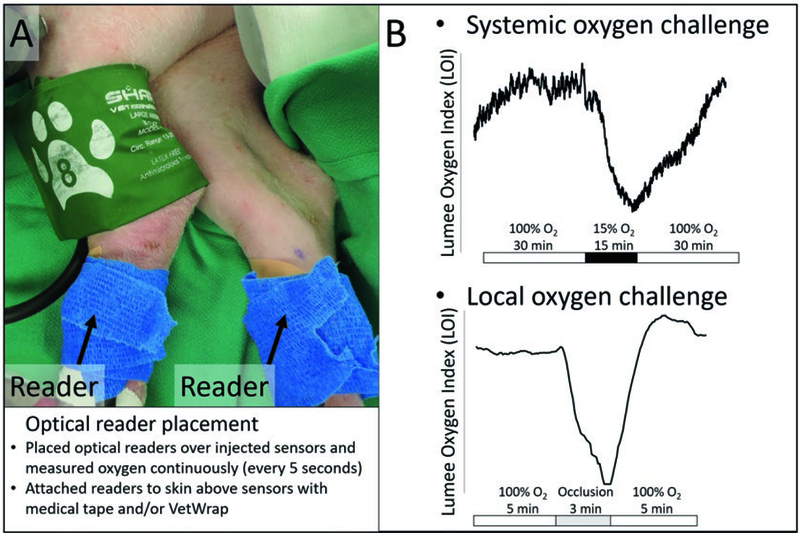
(a) Image of optical readers attached over sensors secured with wrap (blue) in the hind limbs of a pig and a pressure cuff (green). Optical readers non-invasively measured microsensors continuously during systemic and local oxygen challenges. (b) Example results of tissue oxygen measurements (LOI) versus time and description of protocol for systemic and local oxygen challenges
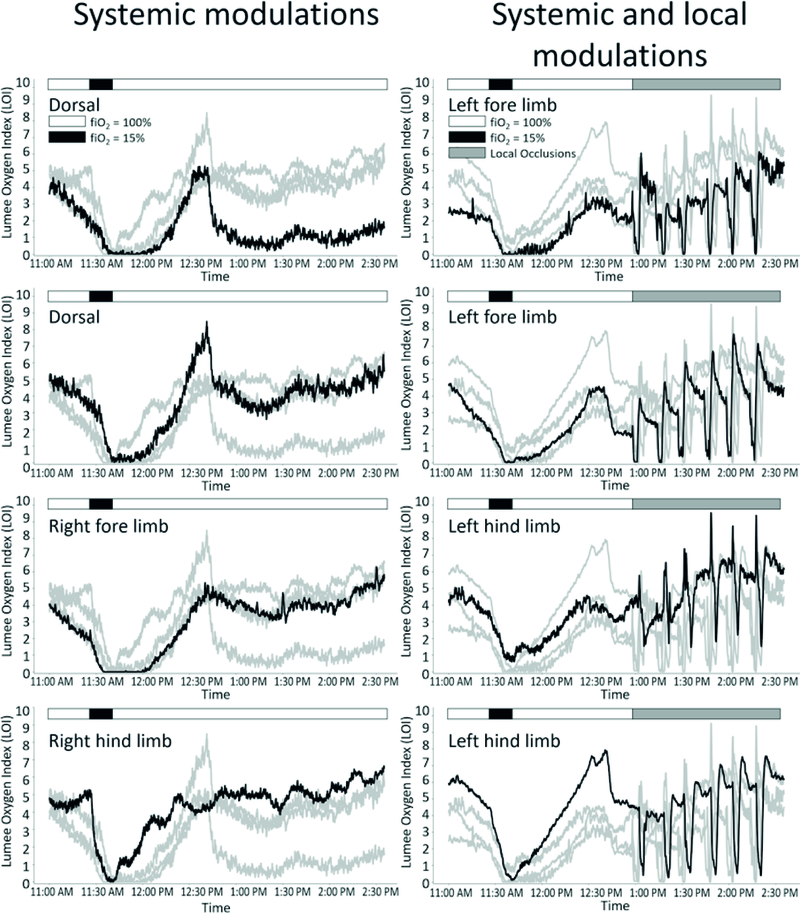
Individual microsensor traces from eight separate sensors during systemic and local oxygen challenges 6 months post-injection. Graphs in the left column were tested with systemic oxygen challenges. Graphs in the right column were tested with systemic and local oxygen challenges. Anatomical location of black sensor trace is indicated on each graph. Grey traces are the other sensors with the same modulation types (systemic only or systemic and local oxygen challenges). Displayed are the LOI measurements versus time. Microsensors detected tissue oxygen reductions in response to systemic and local hypoxic events
References
-
- Hirsch A, Criqui M, Treat-Jacobson D et al. (2001) Peripheral arterial disease detection, awareness, and treatment in primary care. JAMA 286:1317–1324 - PubMed
-
- Nowygrod R, Egorova N, Greco G et al. (2006) Trends, complications, and mortality in peripheral vascular surgery. J Vasc Surg 43:417–418 - PubMed
-
- Stanley J, Veith F, Wakefield T (2014) Current therapy in vascular and endovascular surgery Elsevier Health Sciences, Philadelphia
-
- Wolfram R, Budinsky A, Pokrajac B et al. (2006) Endovascular brachytherapy for prophylaxis of restenosis after femoropopliteal angioplasty: five-year follow-up: prospective randomized study. Radiology 240:878–884 - PubMed
-
- Laird J, Jaff M, Biamino G et al. (2005) Cryoplasty for the treatment of femoropopliteal arterial disease: results of a prospective, multicenter registry. J Vasc Inerv Radiol 16:1067–1073 - PubMed
Publication types
MeSH terms
Substances
Grants and funding
LinkOut - more resources
Full Text Sources
Other Literature Sources
Medical
