


Combining Bulk Temperature and Nanoheating Enables Advanced Magnetic Fluid Hyperthermia Efficacy on Pancreatic Tumor Cells
- PMID: 30181576
- PMCID: PMC6123461
- DOI: 10.1038/s41598-018-31553-9
Combining Bulk Temperature and Nanoheating Enables Advanced Magnetic Fluid Hyperthermia Efficacy on Pancreatic Tumor Cells
Abstract
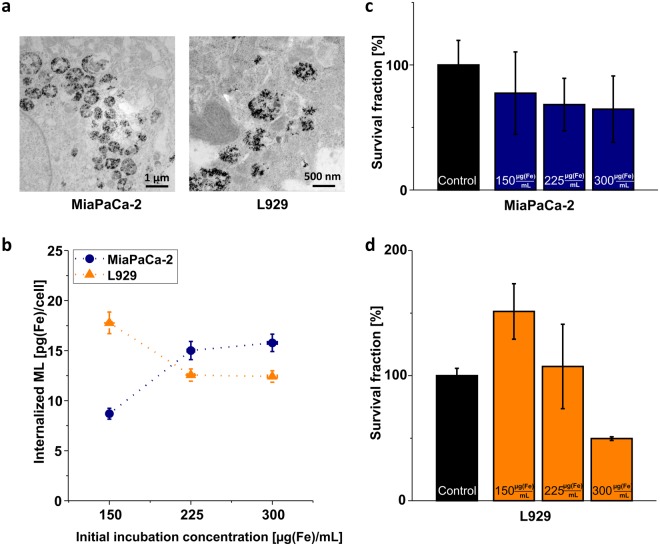
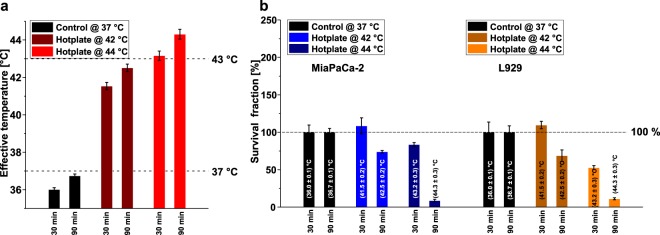
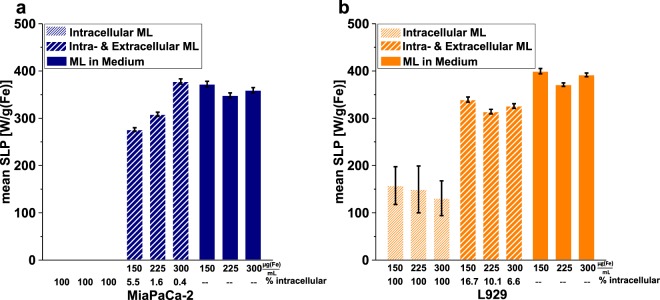
Many efforts are made worldwide to establish magnetic fluid hyperthermia (MFH) as a treatment for organ-confined tumors. However, translation to clinical application hardly succeeds as it still lacks of understanding the mechanisms determining MFH cytotoxic effects. Here, we investigate the intracellular MFH efficacy with respect to different parameters and assess the intracellular cytotoxic effects in detail. For this, MiaPaCa-2 human pancreatic tumor cells and L929 murine fibroblasts were loaded with iron-oxide magnetic nanoparticles (MNP) and exposed to MFH for either 30 min or 90 min. The resulting cytotoxic effects were assessed via clonogenic assay. Our results demonstrate that cell damage depends not only on the obvious parameters bulk temperature and duration of treatment, but most importantly on cell type and thermal energy deposited per cell during MFH treatment. Tumor cell death of 95% was achieved by depositing an intracellular total thermal energy with about 50% margin to damage of healthy cells. This is attributed to combined intracellular nanoheating and extracellular bulk heating. Tumor cell damage of up to 86% was observed for MFH treatment without perceptible bulk temperature rise. Effective heating decreased by up to 65% after MNP were internalized inside cells.
Conflict of interest statement
The authors declare no competing interests.
Figures



References
-
- Ferlay, J., Ervik, M., Dikshit, R., Eser, S. & Mathers, C. Cancer Incidence and Mortality Worldwide. GLOBOCAN IARC CancerBase 11 (2012). - PubMed
-
- Stewart B., Wild C. World Cancer Report 2014. IARC Sci. Publ. (2014).
-
- Statistisches-Bundesamt-Deutschland. Todesursachen in Deutschland. Fachserie 124, https://www.destatis.de/DE/Publikationen/Thematisch/Gesundheit/Todesursa... (2017).
-
- Brus C, Saif MW. Second Line Therapy for Advanced Pancreatic Adenocarcinoma: Where Are We and Where Are We Going? Journal of the Pancreas. 2010;11:321–323. - PubMed
Publication types
MeSH terms
Substances
LinkOut - more resources
Full Text Sources
Other Literature Sources
Medical
