. 2018 Sep 4;8(1):13183.
doi: 10.1038/s41598-018-31429-y.

Experimental Limits of Ghost Diffraction: Popper's Thought Experiment

Affiliations

Experimental Limits of Ghost Diffraction: Popper's Thought Experiment

Paul-Antoine Moreau et al. Sci Rep. .

Abstract

Quantum ghost diffraction harnesses quantum correlations to record diffraction or interference features using photons that have never interacted with the diffractive element. By designing an optical system in which the diffraction pattern can be produced by double slits of variable width either through a conventional diffraction scheme or a ghost diffraction scheme, we can explore the transition between the case where ghost diffraction behaves as conventional diffraction and the case where it does not. For conventional diffraction the angular extent increases as the scale of the diffracting object is reduced. By contrast, we show that no matter how small the scale of the diffracting object, the angular extent of the ghost diffraction is limited (by the transverse extent of the spatial correlations between beams). Our study is an experimental realisation of Popper's thought experiment on the validity of the Copenhagen interpretation of quantum mechanics. We discuss the implication of our results in this context and explain that it is compatible with, but not proof of, the Copenhagen interpretation.


Conflict of interest statement

The authors declare no competing interests.

Figures
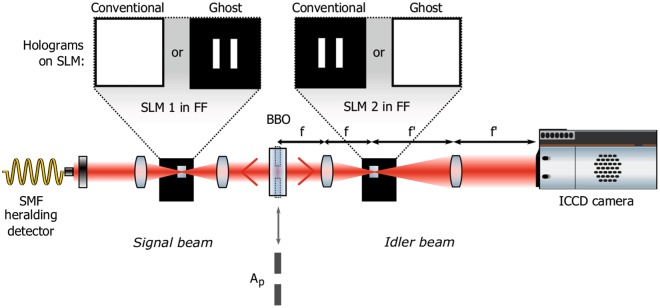
Figure 1
Figure 1
Experimental setup for quantum ghost diffraction and conventional diffraction. A non-linear BBO crystal pumped with a laser at 355 nm generates spontaneous parametric down-converted photon pairs. The two photons are separated and travel in 2 different arms. One of them, the herald, is first collected into a single-mode fibre and is detected by an avalanche photodiode (APD) and the second one is detected by an ICCD camera triggered by the APD. The two photons are reflected from two independent SLMs before being detected. As shown in the figure, the pattern used on each SLM determines if the system is used in conventional or ghost diffraction configuration. Importantly the pump beam size at the crystal can be controlled by introducing an aperture Ap before the crystal, thereby controlling the transverse extent of the spatial correlations between the two generated photons in the far-field of the crystal plane (FF).
Figure 2
Figure 2
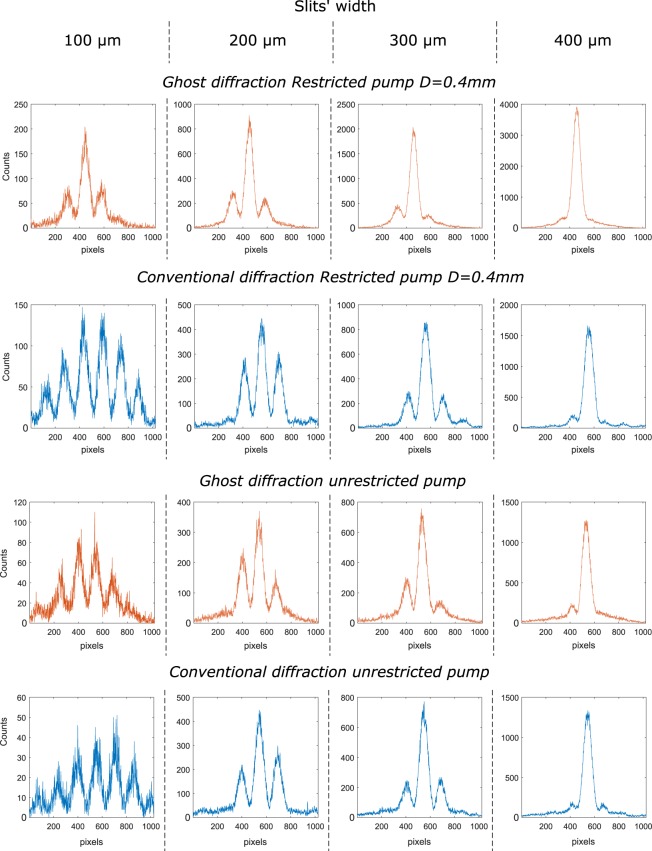
Ghost and conventional diffraction for different slit widths (respectively in orange and blue). The slit separation is in all cases 500 μm and the pump aperture is restricted to a diameter of D = 0.4 mm in the first two rows. The pump has a diameter of D = 2wp = 0.9 mm in the two last rows, where wp is the pump beam’s beam waist.
Figure 3
Figure 3
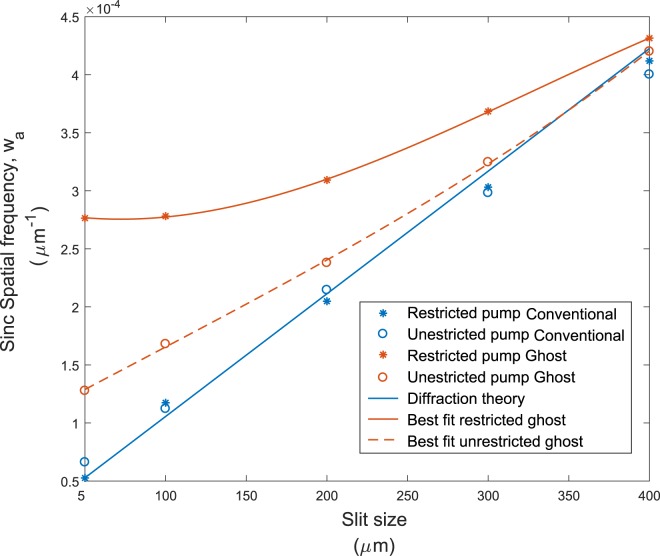
Spatial frequency of the sinc envelope of the diffraction patterns as function of the slits’ width. The orange asterisks correspond to the measured ghost diffraction using a pump beam with a restricted aperture. The orange circles correspond to measured ghost diffraction but with an unrestricted pump. The solid blue line corresponds to the theoretical prediction for an unrestricted diffraction. The blue asterisks and circles correspond to the measured conventional diffraction measurements, with both restricted and unrestricted pump. Error bars not shown here for clarity are estimated to be ±0.1 × 10−4μm−1 along the y axis.

References

    1. Pittman T, Shih Y, Strekalov D, Sergienko A. Optical imaging by means of two-photon quantum entanglement. Phys. Rev. A. 1995;52:R3429. doi: 10.1103/PhysRevA.52.R3429. - DOI - PubMed
    1. Strekalov D, Sergienko A, Klyshko D, Shih Y. Observation of two-photon “ghost” interference and diffraction. Phys. Rev. Lett. 1995;74:3600. doi: 10.1103/PhysRevLett.74.3600. - DOI - PubMed
    1. Shapiro JH, Boyd RW. The physics of ghost imaging. Quantum Inf. Process. 2012;11:949–993. doi: 10.1007/s11128-011-0356-5. - DOI
    1. Bennink RS, Bentley SJ, Boyd RW. “two-photon” coincidence imaging with a classical source. Phys. Rev. Lett. 2002;89:113601. doi: 10.1103/PhysRevLett.89.113601. - DOI - PubMed
    1. Cai Y, Zhu S-Y. Ghost interference with partially coherent radiation. Opt. letters. 2004;29:2716–2718. doi: 10.1364/OL.29.002716. - DOI - PubMed

LinkOut - more resources