


Review
doi: 10.1186/s13068-018-1230-9.
eCollection 2018.
Bio-production of gaseous alkenes: ethylene, isoprene, isobutene
Affiliations
- PMID: 30181774
- PMCID: PMC6114056
- DOI: 10.1186/s13068-018-1230-9
Item in Clipboard
Review
Bio-production of gaseous alkenes: ethylene, isoprene, isobutene
Biotechnol Biofuels.
.
Abstract
To reduce emissions from petrochemical refinement, bio-production has been heralded as a way to create economically valuable compounds with fewer harmful effects. For example, gaseous alkenes are precursor molecules that can be polymerized into a variety of industrially significant compounds and have biological production pathways. Production levels, however, remain low, thus enhancing bio-production of gaseous petrochemicals for chemical precursors is critical. This review covers the metabolic pathways and production levels of the gaseous alkenes ethylene, isoprene, and isobutene. Techniques needed to drive production to higher levels are also discussed.
Figures

Petrochemical process of converting natural gas and crude oil into industrial building blocks using steam cracking, which is highly energy intensive
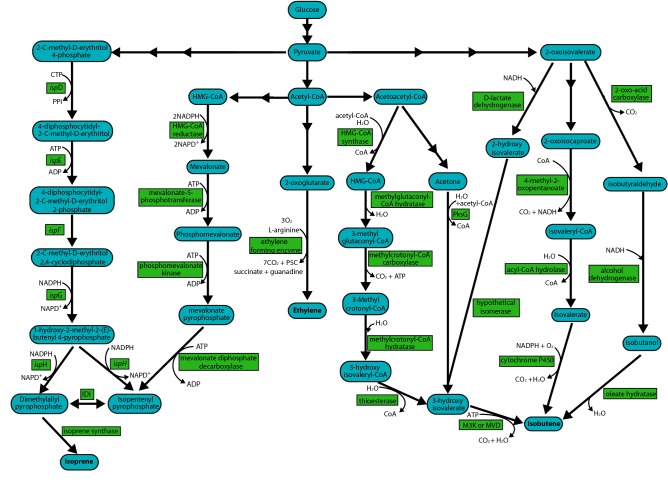
Pathways from glycolytic and citric acid cycle products to isoprene, ethylene, and isobutene. HMG-CoA, 3-hydroxy-3-methylglutaryl-CoA; P5C, l -delta 1-pyrroline-5-carboxylate; ispD, 4-diphosphocytidyl-2-C-methylerythritol synthetase; ispE, 4-diphosphocytidyl- 2-C-methyl-d -erythritol kinase; ispF, 2-C-methyl-d -erythritol-2,4-cyclodiphosphate synthase; ispG, (E)-4-hydroxy-3-methylbut-2-methyl-d -erythritol-2,4-cyclodiphosphate synthase; ispH, HMBPP reductase; IDI, IPP isomerase; PKSG, 3-hydroxy-3-methylglutaryl-ACP synthase
References
-
- Centi G, Quadrelli EA, Perathoner S. Catalysis for CO2 conversion: a key technology for rapid introduction of renewable energy in the value chain of chemical industries. Energy Environ Sci. 2013;6(6):1711–1731. doi: 10.1039/c3ee00056g. - DOI
-
- Schietekat CM, Van Cauwenberge DJ, Van Geem KM, Marin GB. Computational fluid dynamics-based design of finned steam cracking reactors. AIChE J. 2014;60(2):794–808. doi: 10.1002/aic.14326. - DOI
-
- Guo M, Song W, Buhain J. Bioenergy and biofuels: history, status, and perspective. Renew Sustain Energy Rev. 2015;42:712–725. doi: 10.1016/j.rser.2014.10.013. - DOI
Publication types
LinkOut - more resources
Full Text Sources
Other Literature Sources
