. 2018 Sep 3:4:31.
doi: 10.1038/s41540-018-0069-9. eCollection 2018.

Prevalence and patterns of higher-order drug interactions in Escherichia coli

Affiliations

Prevalence and patterns of higher-order drug interactions in Escherichia coli

Elif Tekin et al. NPJ Syst Biol Appl. .

Abstract

Interactions and emergent processes are essential for research on complex systems involving many components. Most studies focus solely on pairwise interactions and ignore higher-order interactions among three or more components. To gain deeper insights into higher-order interactions and complex environments, we study antibiotic combinations applied to pathogenic Escherichia coli and obtain unprecedented amounts of detailed data (251 two-drug combinations, 1512 three-drug combinations, 5670 four-drug combinations, and 13608 five-drug combinations). Directly opposite to previous assumptions and reports, we find higher-order interactions increase in frequency with the number of drugs in the bacteria's environment. Specifically, as more drugs are added, we observe an elevated frequency of net synergy (effect greater than expected based on independent individual effects) and also increased instances of emergent antagonism (effect less than expected based on lower-order interaction effects). These findings have implications for the potential efficacy of drug combinations and are crucial for better navigating problems associated with the combinatorial complexity of multi-component systems.


Conflict of interest statement

The authors declare no competing interests.

Figures
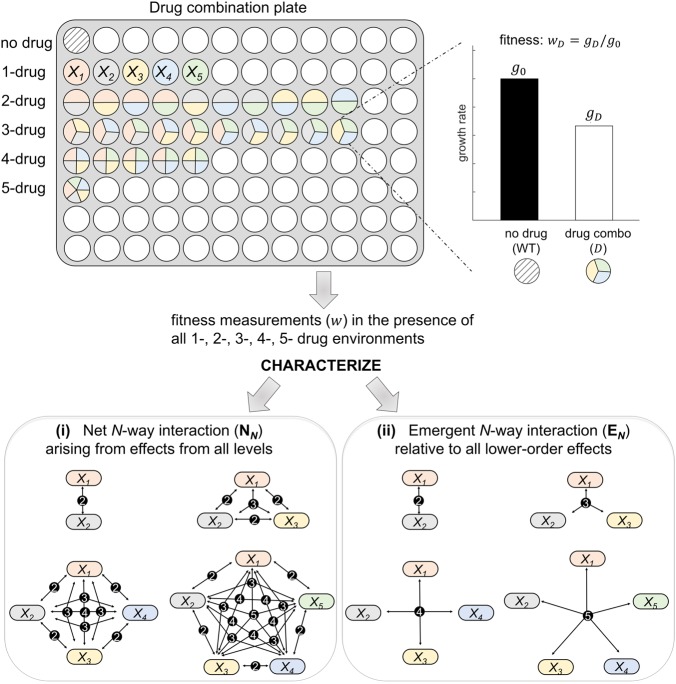
Fig. 1
Fig. 1
Experimental and theoretical setup for the characterization of higher-order interactions. Schematic representation of a drug combination plate, where the shaded well in the first row represents the control strain with no drug added and colored wells correspond to single or N-way (up to five-way) combinations from a set of drugs denoted by Xi. The N-way combinations of drugs are represented by wells divided into N identical slices with the colors signifying the drugs in the combination (see 1-drug row for each color). The concentration of each drug is kept the same across single, two-, three-, four-, and five-drug combination experiments. Here, the experimental setup is simplified for illustration, but in actuality, (1) we filled all wells with bacteria and drug combinations to obtain replicate measurements (see “Experimental details”), and (2) we used multiple 96-well plates for each five-drug combination. From these experiments, fitness of bacteria (w) in the presence of drug combination (D) is assessed by the relative growth rate with respect to the no-drug control (WT). In the figure, schematics for the net N-way interaction include all possible lower-order connections, whereas an emergent interaction schematic connects all N drugs (such as dyad and triad for two- and three-drug combinations, respectively)
Fig. 2
Fig. 2
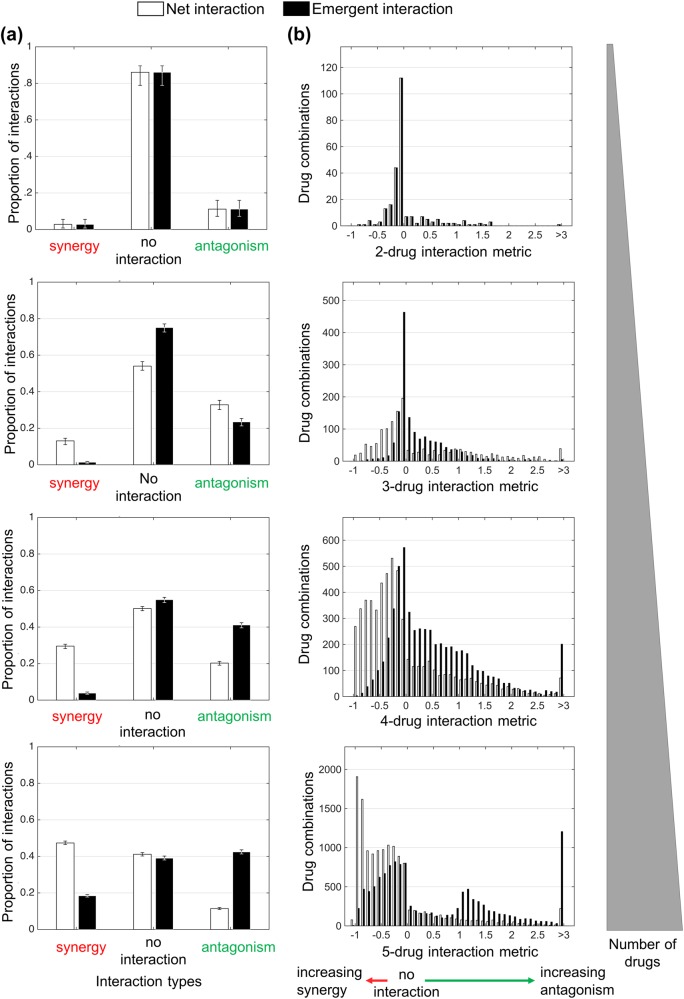
Overall behavior of interaction metric results and categorization of interactions. For each N-way interaction, a bar plots for interaction classifications (synergy, no-interaction, antagonism) of net (white) and emergent (black) interactions with 95% confidence intervals resulting from bootstrapping experiments via sampling with replacement over all measured drug combinations and b histograms of net (white) and emergent (black) interaction metric results with a bin size of 0.1 are plotted. A diagram is shown that displays the direction in which the strength of specific interaction class enlarges. Note here that the definitions of net two-way and emergent two-way interactions are identical. Hence, plots corresponding to the distribution of interaction metrics and the proportion of interactions are indistinguishable for two-drug combinations
Fig. 3
Fig. 3
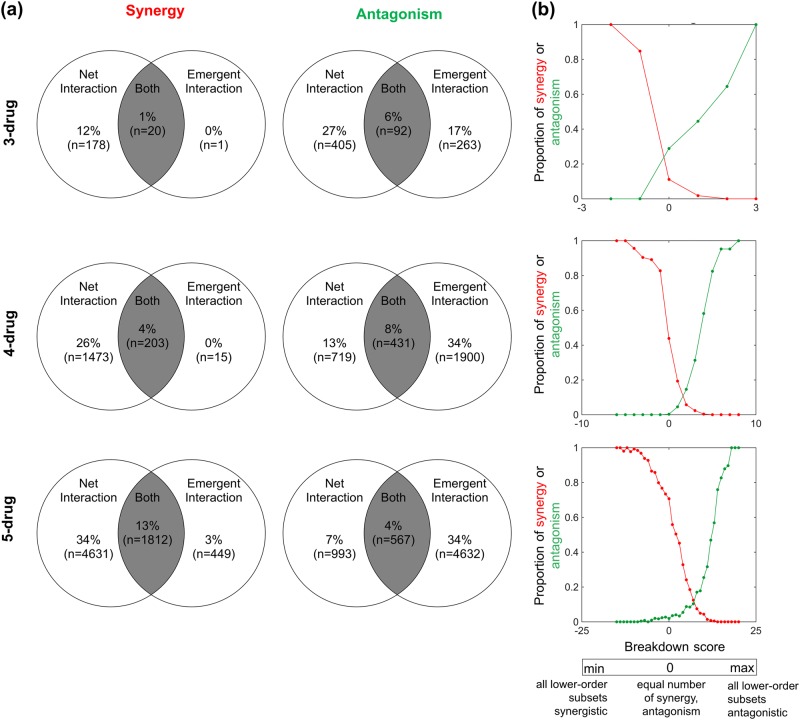
Comparison of net and emergent interactions by synergy and antagonism. a Venn diagrams comparing an overlap for different interaction categorizations (synergy: left column, antagonism: right column) according to net and emergent interaction measures of three-, four-, and five-drug combinations. For each N-drug Venn diagram, the percentages are calculated relative to the number of N-drug combinations. b The proportion of net synergies and net antagonisms are plotted versus the total breakdown score. Breakdown scores represent the dominant form of interaction types at the lower-order combinations calculated by the summation of −1 and 1 over each lower-order synergy and lower-order antagonism, respectively (see S1 Table). The minimum and maximum values of breakdown score differ across each plot as the total number of lower-order combinations of an N-drug combination depends on the value of N

References

    1. Bialek W, et al. Statistical mechanics for natural flocks of birds. Proc. Natl. Acad. Sci. 2012;109:4786–4791. doi: 10.1073/pnas.1118633109. - DOI - PMC - PubMed
    1. Shi S. Customer relationship and sales. J. Econ. Theory. 2016;166:483–516. doi: 10.1016/j.jet.2016.09.012. - DOI
    1. Hamilton LC. Education, politics and opinions about climate change evidence for interaction effects. Clim. Change. 2011;104:231–242. doi: 10.1007/s10584-010-9957-8. - DOI
    1. Nishikawa T, Motter AE. Symmetric states requiring system asymmetry. Phys. Rev. Lett. 2016;117:114101. doi: 10.1103/PhysRevLett.117.114101. - DOI - PubMed
    1. van Vliet S, Ackermann M. Bacterial ventures into multicellularity: collectivism through individuality. PLoS Biol. 2015;13:e1002162. doi: 10.1371/journal.pbio.1002162. - DOI - PMC - PubMed