


Study of factors related to the attitudes toward studying abroad among preclinical/clinical undergraduate dental students at three dental schools in Japan
- PMID: 30181908
- PMCID: PMC6115873
- DOI: 10.1002/cre2.114
Study of factors related to the attitudes toward studying abroad among preclinical/clinical undergraduate dental students at three dental schools in Japan
Abstract
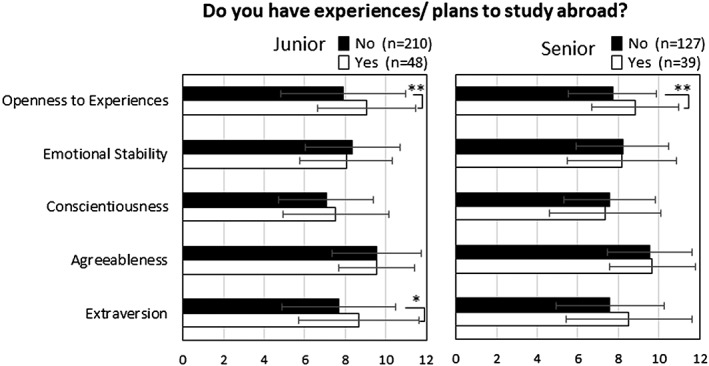
Despite of their general interests in studying abroad, there are two types of dental student in Japan. They are those who decide to go studying abroad and those who do not. The aim of this study was to clarify the factors related to the attitudes toward studying abroad among preclinical/clinical undergraduate dental students who attended three dental schools in Japan. A questionnaire was used to assess undergraduate dental students' attitudes toward studying abroad. We analyzed the differences between junior (preclinical) students and senior (clinical) students on concerns, and relationships between personality traits based on the Big Five and experiences related to studying abroad. Four hundred and thirty-nine undergraduate students completed the questionnaire. The senior dental students were more worried, more than the junior students, about "lack of language ability in daily life," "higher quality facilities and environment," and valued "dental/medical knowledges and skills" and "advantage for getting a job" through studying abroad. Both junior and senior students with experience of/plans for studying abroad reported significantly higher levels of openness to experience than those without such experiences or plans. The less-open group was more concerned with "lack of language ability in daily life/academic fields," "higher quality facilities and environment," "life in a foreign country," "interpersonal relationships in foreign countries," and "no friends in foreign countries" than the open-group. Although the preclinical and clinical dental students at the three dental schools in Japan had different views of concern for studying abroad, "openness to experience" might be a common key factor related to their studying abroad. However, apart from any personality factor, alleviating students' concerns regarding daily life adjustments might be effective in promoting a willingness to go studying abroad.
Keywords: personality; studying abroad; undergraduate dental education; undergraduate dental students.
Figures
References
-
- Allik, J. , & McCrae, R. R. (2004). Toward a geography of personality traits: Patterns of profiles across 36 cultures. Journal of Cross‐Cultural Psychology, 35, 13–28.
-
- Benet‐Martínez, V. , & John, O. P. (1998). ‘Los Cinco Grandes’ Across cultures and ethnic groups: Multitrait‐multimethod analyses of the Big Five in Spanish and English. Journal of Personality and Social Psychology, 75, 729–750. - PubMed
-
- Bornstein, M. H. , Hahn, C.‐S. , Haynes, O. M. , Belsky, J. , Azuma, H. , Kwak, K. , … de Galperín, C. Z. (2007). Maternal personality and parenting cognitions in cross‐cultural perspective. International Journal of Behavioral Development, 31, 193–209.
-
- Costa, P. T. Jr. , & McCrae, R. R. (1992). Revised NEO Personality Inventory (NEO‐PI‐R) and NEO Five‐Factor Inventory (NEO‐FFI) professional manual. Odessa, FL: Psychological Assessment Resources.
LinkOut - more resources
Full Text Sources
Other Literature Sources
