The Hippo Signaling Network and Its Biological Functions
- PMID: 30183404
- PMCID: PMC6322405
- DOI: 10.1146/annurev-genet-120417-031621
The Hippo Signaling Network and Its Biological Functions
Abstract
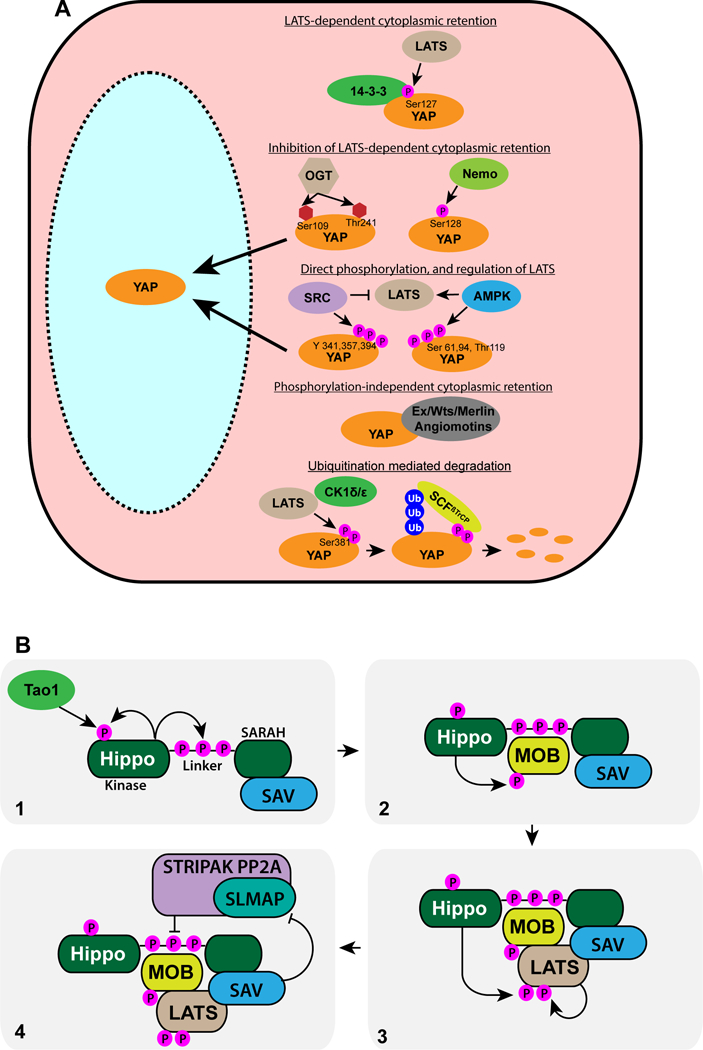
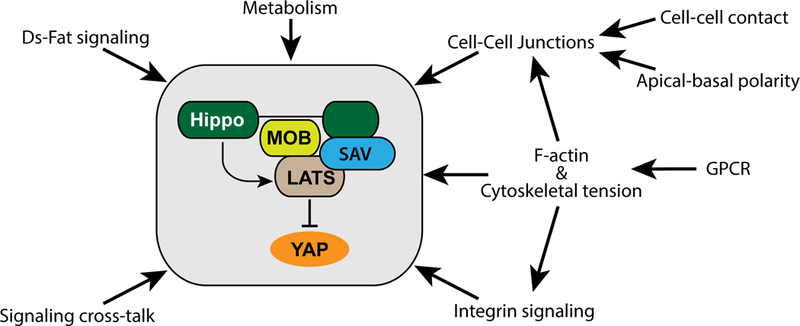
Hippo signaling is an evolutionarily conserved network that has a central role in regulating cell proliferation and cell fate to control organ growth and regeneration. It promotes activation of the LATS kinases, which control gene expression by inhibiting the activity of the transcriptional coactivator proteins YAP and TAZ in mammals and Yorkie in Drosophila. Diverse upstream inputs, including both biochemical cues and biomechanical cues, regulate Hippo signaling and enable it to have a key role as a sensor of cells' physical environment and an integrator of growth control signals. Several components of this pathway localize to cell-cell junctions and contribute to regulation of Hippo signaling by cell polarity, cell contacts, and the cytoskeleton. Downregulation of Hippo signaling promotes uncontrolled cell proliferation, impairs differentiation, and is associated with cancer. We review the current understanding of Hippo signaling and highlight progress in the elucidation of its regulatory mechanisms and biological functions.
Keywords: Hippo; YAP; Yorkie; cancer; growth.
Figures

References
-
- Adler JJ, Johnson DE, Heller BL, Bringman LR, Ranahan WP, et al. 2013. Serum deprivation inhibits the transcriptional co-activator YAP and cell growth via phosphorylation of the 130-kDa isoform of Angiomotin by the LATS1/2 protein kinases. Proceedings of the National Academy of Sciences of the United States of America 110:17368–73 - PMC - PubMed
-
- Aragona M, Panciera T, Manfrin A, Giulitti S, Michielin F, et al. 2013. A Mechanical Checkpoint Controls Multicellular Growth through YAP/TAZ Regulation by Actin-Processing Factors. Cell 154:1047–59 - PubMed
-
- Baumgartner R, Pörnbacher I, Buser N, Hafen E, Stocker H. 2010. The WW domain protein Kibra acts upstream of Hippo in Drosophila. Dev Cell 18:309–16 - PubMed
Publication types
MeSH terms
Substances
Grants and funding
LinkOut - more resources
Full Text Sources
Other Literature Sources
Molecular Biology Databases