


Comparison of Six Sample-to-Answer Influenza A/B and Respiratory Syncytial Virus Nucleic Acid Amplification Assays Using Respiratory Specimens from Children
- PMID: 30185508
- PMCID: PMC6204686
- DOI: 10.1128/JCM.00930-18
Comparison of Six Sample-to-Answer Influenza A/B and Respiratory Syncytial Virus Nucleic Acid Amplification Assays Using Respiratory Specimens from Children
Abstract
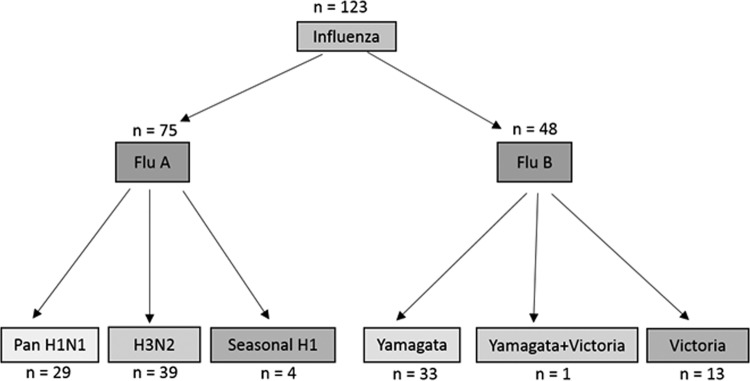
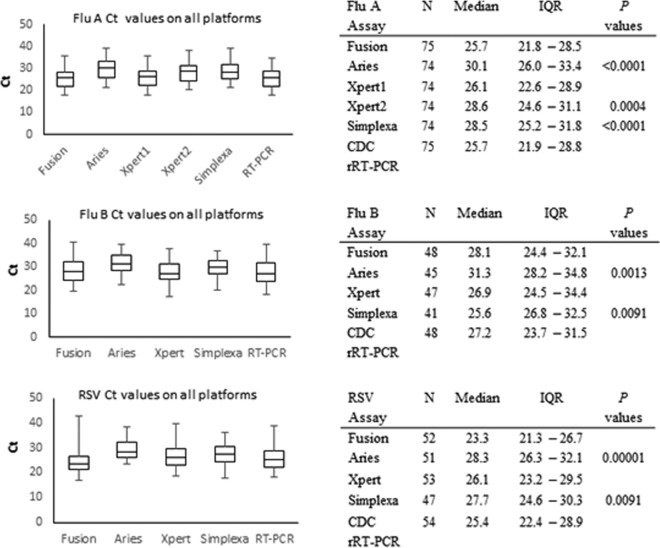
The rapid and accurate detection of influenza A virus (FluA), influenza B virus (FluB), and respiratory syncytial virus (RSV) improves patient care. Sample-to-answer (STA) platforms based on nucleic acid amplification and detection of these viruses are simple, automated, and accurate. We compared six such platforms for the detection of FluA, FluB, and RSV: Cepheid GeneXpert Xpress Flu/RSV (Xpert), Hologic Panther Fusion Flu A/B/RSV (Fusion), Cobas influenza A/B & RSV (Liat), Luminex Aries Flu A/B & RSV (Aries), BioFire FilmArray respiratory panel (RP), and Diasorin Simplexa Flu A/B & RSV (Simplexa). Nasopharyngeal (NP) swab specimens (n = 225) from children previously tested by RP were assessed on these platforms. The results were compared to those of the Centers for Disease Control and Prevention (CDC)-developed real-time reverse transcription-PCR (rRT-PCR) assay for influenza A/B viruses and RSV. Subtyping for FluA and FluB was performed for discrepant analysis where applicable. The percent sensitivities/specificities for FluA detection were 100/100 (Fusion), 98.6/99.3 (Xpert), 100/100 (Liat), 98.6/100 (Aries), 98.6/100 (Simplexa), and 100/100 (RP). The percent sensitivities/specificities for FluB detection were 100/100 (Fusion), 97.9/99.4 (Xpert), 97.9/98.3 (Liat), 93.7/99.4 (Aries), 85.4/99.4 (Simplexa), and 95.8/97.7 (RP); and those for RSV detection were 98.1/99.4 (Xpert), 98.1/99.4 (Liat), 96.3/100 (Fusion), 94.4/100 (Aries), 87/94.4 (Simplexa), and 94.4/100 (RP). The 75 strains confirmed to be FluA included 29 pH1N1, 39 H3N2, 4 sH1N1, and 3 untyped strains. The 48 strains confirmed to be FluB included 33 strains of the Yamagata lineage, 13 of the Victoria lineage, 1 of both the Yamagata and Victoria lineages, and 1 of an unknown lineage. All six STA platforms demonstrated >95% sensitivity for FluA detection, while three platforms (Fusion, Xpert, and Liat) demonstrated >95% sensitivity for FluB and RSV detection.
Keywords: FluA/B and RSV; clinical microbiology; sample to answer.
Copyright © 2018 American Society for Microbiology.
Figures
References
-
- Monto AS. 2002. Epidemiology of viral respiratory infections. Am J Med 112(Suppl 6A):4S–12S. - PubMed
-
- Nair H, Brooks WA, Katz M, Roca A, Berkley JA, Madhi SA, Simmerman JM, Gordon A, Sato M, Howie S, Krishnan A, Ope M, Lindblade KA, Carosone-Link P, Lucero M, Ochieng W, Kamimoto L, Dueger E, Bhat N, Vong S, Theodoratou E, Chittaganpitch M, Chimah O, Balmaseda A, Buchy P, Harris E, Evans V, Katayose M, Gaur B, O'Callaghan-Gordo C, Goswami D, Arvelo W, Venter M, Briese T, Tokarz R, Widdowson MA, Mounts AW, Breiman RF, Feikin DR, Klugman KP, Olsen SJ, Gessner BD, Wright PF, Rudan I, Broor S, Simoes EA, Campbell H. 2011. Global burden of respiratory infections due to seasonal influenza in young children: a systematic review and meta-analysis. Lancet 378:1917–1930. doi: 10.1016/S0140-6736(11)61051-9. - DOI - PubMed
-
- Nair H, Nokes DJ, Gessner BD, Dherani M, Madhi SA, Singleton RJ, O'Brien KL, Roca A, Wright PF, Bruce N, Chandran A, Theodoratou E, Sutanto A, Sedyaningsih ER, Ngama M, Munywoki PK, Kartasasmita C, Simoes EA, Rudan I, Weber MW, Campbell H. 2010. Global burden of acute lower respiratory infections due to respiratory syncytial virus in young children: a systematic review and meta-analysis. Lancet 375:1545–1555. doi: 10.1016/S0140-6736(10)60206-1. - DOI - PMC - PubMed
Publication types
MeSH terms
LinkOut - more resources
Full Text Sources
Other Literature Sources
Medical
Miscellaneous
