


What factors influence older people's intention to enrol in nursing homes? A cross-sectional observational study in Shanghai, China
- PMID: 30185570
- PMCID: PMC6129045
- DOI: 10.1136/bmjopen-2018-021741
What factors influence older people's intention to enrol in nursing homes? A cross-sectional observational study in Shanghai, China
Abstract
Objectives: Given the increasing need of long-term care and the low occupancy rate of nursing homes in Shanghai, this study attempts to explore what factors influence older people's intention to enrol in nursing homes.
Design: A cross-sectional observational study based on the theory of reasoned action was conducted. Survey data were collected from subjects during face-to-face interviews. Structural equation modelling was employed for data analysis.
Setting: This study was conducted in six community health service centres in Shanghai, China. Two service centres were selected in urban, suburban and rural areas, respectively.
Participants: A total of 641 Shanghai residents aged over 60 were surveyed.
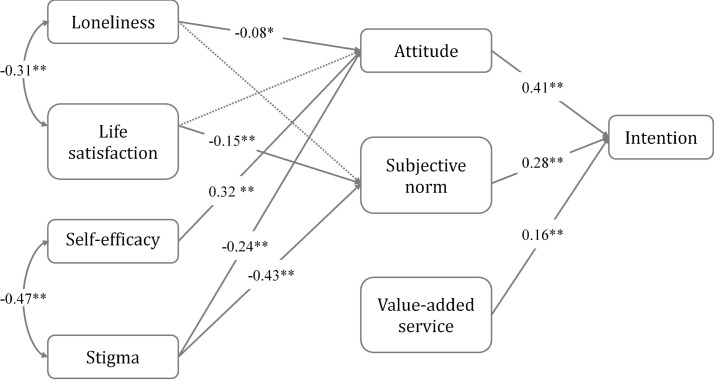
Results: Structural equation modelling analysis showed that the research model fits the data well (χ2/df=2.948, Comparative Fit Index=0.972 and root mean squared error of approximation =0.055). Attitude (β=0.41, p<0.01), subjective norm (β=0.28, p<0.01) and value-added service (β=0.16, p<0.01) were directly associated with enrolment intention, explaining 32% of variance in intention. Attitude was significantly influenced by loneliness (β=-0.08, p<0.05), self-efficacy (β=0.32, p<0.01) and stigma (β=-0.24, p<0.01), while subjective norm was significantly influenced by life satisfaction (β=-0.15, p<0.01) and stigma (β=-0.43, p<0.01).
Conclusions: This study advances knowledge regarding the influencing factors of older people's intention to enrol in nursing homes. It suggests that Chinese older persons' perceived stigma has the strongest indirect effect on their intention to enrol in nursing homes. This is unique to the Chinese context and has practical implications for eldercare in China and other Asian countries with similar sociocultural contexts.
Keywords: attitude; eldercare; stigma; structural equation modeling; subjective norm; survey.
© Author(s) (or their employer(s)) 2018. Re-use permitted under CC BY-NC. No commercial re-use. See rights and permissions. Published by BMJ.
Conflict of interest statement
Competing interests: None declared.
Figures
References
-
- Yang SL, Zheng-Long LI. The impact of aging population on the burden of elderly in Shanghai. Northwest Population Journal 2010;31:61–6.
-
- SRCo A. Statistics of old people ’s population and aging in Shanghai in 2016. Shanghai, 2017.
-
- Sciences SAoS. Shanghai academy of social sciences blue book: 2020 Shanghai "demographic dividend" will disappear. Shanghai, 2016.
Publication types
MeSH terms
LinkOut - more resources
Full Text Sources
Other Literature Sources
Medical
Miscellaneous
