


Prevalence of age-specific and sex-specific overweight and obesity in Ontario and Quebec, Canada: a cross-sectional study using direct measures of height and weight
- PMID: 30185572
- PMCID: PMC6129092
- DOI: 10.1136/bmjopen-2018-022029
Prevalence of age-specific and sex-specific overweight and obesity in Ontario and Quebec, Canada: a cross-sectional study using direct measures of height and weight
Abstract
Objective: To evaluate whether combining three cycles of the Canadian Health Measures Survey (CHMS) produces provincially representative and valid estimates of overweight and obesity in Ontario and Quebec.
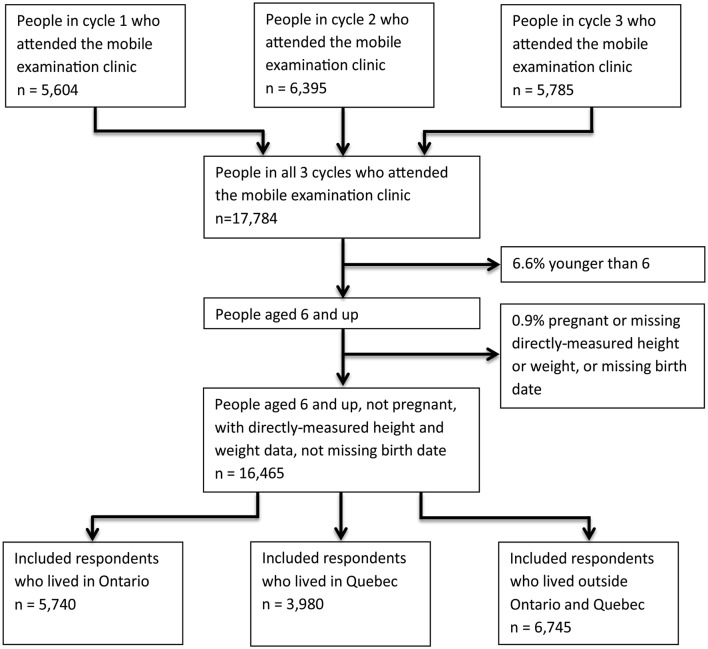
Setting: An ongoing, nationally representative health survey in Canada, with data released every 2 years. Objective measures of height and weight were taken at mobile examination centres located within 100 km of participants' residences. To increase sample size, we combined three cycles completed during 2007-2013.
Participants: 5740 Ontario residents and 3980 Quebec residents aged 6-79, with birth dates and directly measured height and weight recorded in the CHMS. Pregnant females were excluded. Sociodemographic characteristics of the Ontario and Quebec portions of the CHMS appeared similar to characteristics from the 2006 Canada Census.
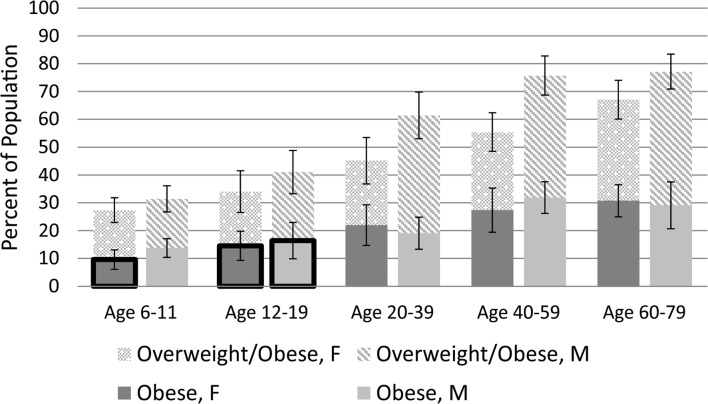
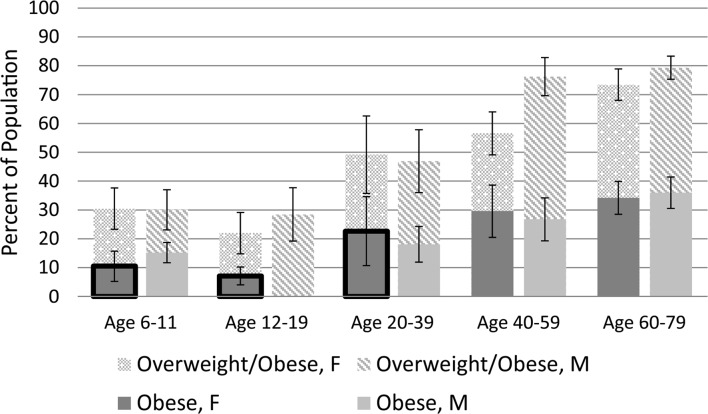
Primary outcome measures: Objectively measured overweight and obesity prevalence overall and among males and females in the following age groups: 6-11, 12-19, 20-39, 40-59 and 60-79. We compared these with provincially representative and objectively measured estimates from the 2015 Canadian Community Health Survey (CCHS)-Nutrition.
Results: 57.1% (95% CI 52.8% to 61.4%) of Ontarians were classified overweight or obese and 24.0% (95% CI 20.3% to 27.6%) obese, while Quebec's corresponding percentages were 56.2% (95% CI 51.3% to 61.1%) and 24.4% (95% CI 20.6% to 28.3%). Generally, overweight and obesity combined was higher in older age groups and males. Comparisons with the CCHS-Nutrition did not yield unexplainable differences between surveys.
Conclusions: Combining three CHMS cycles can produce estimates of overweight and obesity in populations representative of Ontario and Quebec. As new CHMS data are collected, these estimates can be updated and used to evaluate trends.
Keywords: epidemiology; preventive medicine; public health.
© Author(s) (or their employer(s)) 2018. Re-use permitted under CC BY-NC. No commercial re-use. See rights and permissions. Published by BMJ.
Conflict of interest statement
Competing interests: None declared.
Figures
References
-
- Public Health Ontario, 2013. ADdressing obesity in children and youth evidence to guide action for ontario:1–288 https://www.publichealthontario.ca/en/eRepository/Addressing_Obesity_Chi... (cited 21 Dec 2017).
-
- Healthy Kids Panel, 2013. No time to wait: the healthy kids strategy [Internet] http://www.health.gov.on.ca/en/common/ministry/publications/reports/heal....
-
- Centers for Disease Control and Prevention, 2001. Updated guidelines for evaluating public health surveillance systems [Internet] https://www.cdc.gov/mmwr/preview/mmwrhtml/rr5013a1.htm (cited 21 Dec 2017).
Publication types
MeSH terms
LinkOut - more resources
Full Text Sources
Other Literature Sources
Medical
Research Materials
