Review
. 2018 Sep 6;3(17):e121630.
doi: 10.1172/jci.insight.121630.

The complex landscape of microRNAs in articular cartilage: biology, pathology, and therapeutic targets

Affiliations
Review

The complex landscape of microRNAs in articular cartilage: biology, pathology, and therapeutic targets

Helal Endisha et al. JCI Insight. .

Abstract

The disabling degenerative disease osteoarthritis (OA) is prevalent among the global population. Articular cartilage degeneration is a central feature of OA; therefore, a better understanding of the mechanisms that maintain cartilage homeostasis is vital for developing effective therapeutic interventions. MicroRNAs (miRs) modulate cell signaling pathways and various processes in articular cartilage via posttranscriptional repression of target genes. As dysregulated miRs frequently alter the homeostasis of articular cartilage, modulating select miRs presents a potential therapeutic opportunity for OA. Here, we review key miRs that have been shown to modulate cartilage-protective or -destructive mechanisms and signaling pathways. Additionally, we use an integrative computational biology approach to provide insight into predicted miR gene targets that may contribute to OA pathogenesis, and highlight the complexity of miR signaling in OA by generating both unique and overlapping gene targets of miRs that mediate protective or destructive effects. Early OA detection would enable effective prevention; thus, miRs are being explored as diagnostic biomarkers. We discuss these ongoing efforts and the applicability of miR mimics and antisense inhibitors as potential OA therapeutics.


Conflict of interest statement

Conflict of interest: A US provisional patent application (62/299,305, filed February 24, 2016) and a PCT international patent application (PCT/CA2017/000019, filed Jan 31, 2017) have been filed with respect to therapeutic and diagnostic uses of miRNA-181a-5p and -4454.

Figures

Figure 1
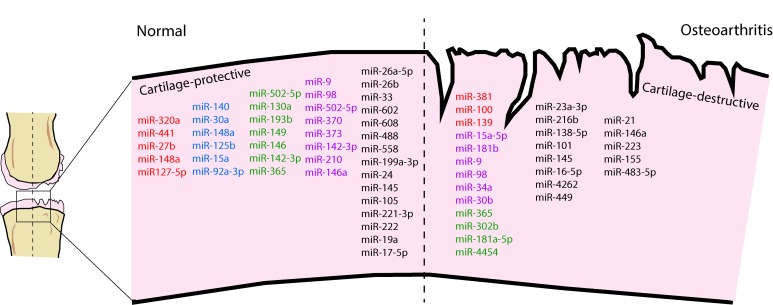
Figure 1. miRNAs involved in cartilage-protective and cartilage-destructive mechanisms.
miRNAs highlighted in red directly target MMPs. miRNAs highlighted in blue directly target ADAMTSs. miRNAs highlighted in green regulate inflammatory pathways. miRNAs highlighted in purple regulate cellular apoptosis mechanisms. The remaining miRNAs either maintain or disrupt the articular cartilage via alternate mechanisms. See Supplemental Tables 1 and 2.
Figure 2
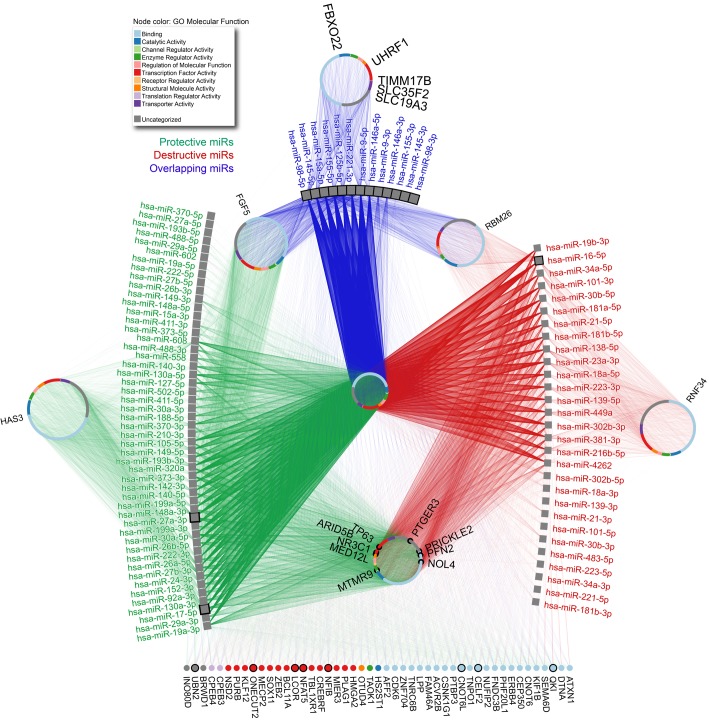
Figure 2. Unique and overlapping gene targets regulated by miRNAs involved in cartilage-protective and -destructive mechanisms.
Considering protective and destructive miRNAs, we used mirDIP ver. 4.1.6.6 portal to identify high-confidence mRNA targets. The resulting network was further annotated with gene ontology (GO) molecular function in NAViGaTOR version 3.0.3. Edge color corresponds to specific or overlapping miRNA-gene relationships.

References

    1. Rodriguez A, Griffiths-Jones S, Ashurst JL, Bradley A. Identification of mammalian microRNA host genes and transcription units. Genome Res. 2004;14(10A):1902–1910. doi: 10.1101/gr.2722704. - DOI - PMC - PubMed
    1. Lee Y, et al. The nuclear RNase III Drosha initiates microRNA processing. Nature. 2003;425(6956):415–419. doi: 10.1038/nature01957. - DOI - PubMed
    1. Yi R, Qin Y, Macara IG, Cullen BR. Exportin-5 mediates the nuclear export of pre-microRNAs and short hairpin RNAs. Genes Dev. 2003;17(24):3011–3016. doi: 10.1101/gad.1158803. - DOI - PMC - PubMed
    1. Gregory RI, Chendrimada TP, Cooch N, Shiekhattar R. Human RISC couples microRNA biogenesis and posttranscriptional gene silencing. Cell. 2005;123(4):631–640. doi: 10.1016/j.cell.2005.10.022. - DOI - PubMed
    1. Yang Z, Wang L. Regulation of microRNA expression and function by nuclear receptor signaling. Cell Biosci. 2011;1(1):31. doi: 10.1186/2045-3701-1-31. - DOI - PMC - PubMed

Publication types

Grants and funding