


The Platelet Count and its Implications in Sickle Cell Disease Patients Admitted for Intensive Care
- PMID: 30186009
- PMCID: PMC6108298
- DOI: 10.4103/ijccm.IJCCM_49_18
The Platelet Count and its Implications in Sickle Cell Disease Patients Admitted for Intensive Care
Abstract
Background and aims: In sickle cell disease (SCD) patients admitted for intensive care, evaluation of platelet counts in different types of sickle cell complications and its prognostic relevance are not well-studied. Illuminating these aspects were the objectives of this study.
Materials and methods: A chart review of 136 adult SCD patients consecutively admitted to our Intensive Care Unit (ICU) was done. The prognosis on day 1 was assessed by Acute Physiology and Chronic Health Evaluation (APACHE II) and multiple organ dysfunction scores (MODS). Receiver operating characteristic (ROC) curves evaluated the ability of platelet counts, MODS, and APACHE II scores to predict survival.
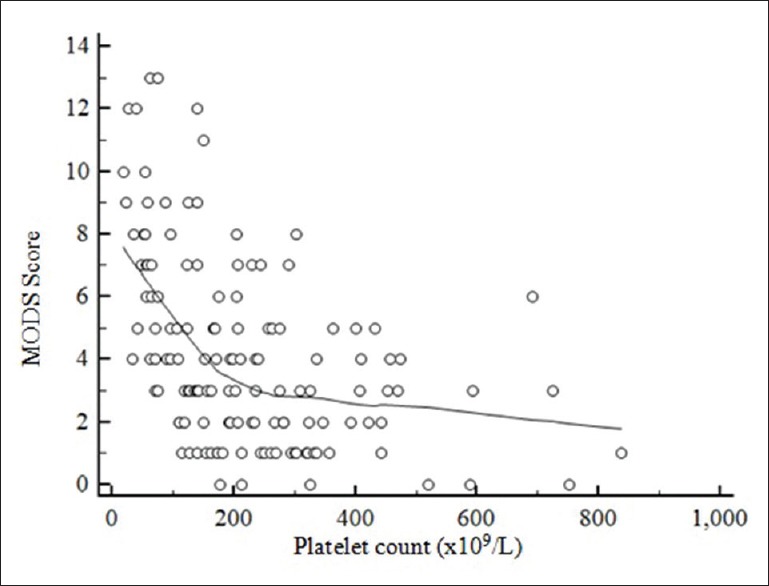
Results: The most common types of crises were severe pain (n = 53), acute chest syndrome (n = 40), and infection (n = 18); 17 patients were nonsurvivors. Platelet counts varied widely (range, 19-838 × 109/L) with thrombocytopenia (n = 30) and thrombocytosis (n = 11). Counts correlated directly with leukocytes and reticulocytes; inversely with lactate dehydrogenase, APACHE, and MODS scores. Areas under ROC curve for platelets, MODS, and APACHE scores to predict survival were 0.73, 0.85, and 0.93, respectively.
Conclusions: In severe sickle cell crisis thrombocytopenia is more common than thrombocytosis. In the ICU, day 1 platelet counts correlate inversely with prognostic scores and are significantly reduced in multi-organ failure and nonsurvivors. A platelet count above 175 × 109/L predicts patient survival with high specificity and positive predictive value but lacks sensitivity.
Keywords: Acute physiology; chronic health evaluation II; multi-organ dysfunction score; platelets; sickle cell disease; thrombocytopenia.
Conflict of interest statement
There are no conflicts of interest.
Figures


References
-
- Kuypers FA. Hemoglobin s polymerization and red cell membrane changes. Hematol Oncol Clin North Am. 2014;28:155–79. - PubMed
-
- Freedman ML, Karpatkin S. Elevated platelet count and megathrombocyte number in sickle cell anemia. Blood. 1975;46:579–82. - PubMed
-
- Okpala I. Steady-state platelet count and complications of sickle cell disease. Hematol J. 2002;3:214–5. - PubMed
LinkOut - more resources
Full Text Sources
Other Literature Sources
Medical