


Self-reported social and activity restrictions accompany local impairments in posterior tibial tendon dysfunction: a systematic review
- PMID: 30186369
- PMCID: PMC6117981
- DOI: 10.1186/s13047-018-0292-z
Self-reported social and activity restrictions accompany local impairments in posterior tibial tendon dysfunction: a systematic review
Abstract
Background: Posterior tibial tendon dysfunction (PTTD) is a painful, progressive tendinopathy that reportedly predominates in middle-age, overweight women. There is no evidence based guidelines that clinicians can use to guide treatment planning, which leaves clinicians to make decisions on the basis of presenting clinical impairments and self-reported pain and disability. The purpose of this systematic review was to quantify clinical impairments, pain and disability in individuals with PTTD compared with controls.
Methods: Five databases were searched for terms referring to the posterior tibial tendon and flatfoot up to and including 11 March 2018. The systematic review was registered with PROSPERO (CRD: 42016046951). Studies were eligible if they were published in the English language and contained data on clinical impairments, pain or disability compared between participants diagnosed with PTTD and pain-free individuals. Standardised mean differences (SMDs) were calculated where possible and meta-analysis was performed when homogeneity of outcomes allowed.
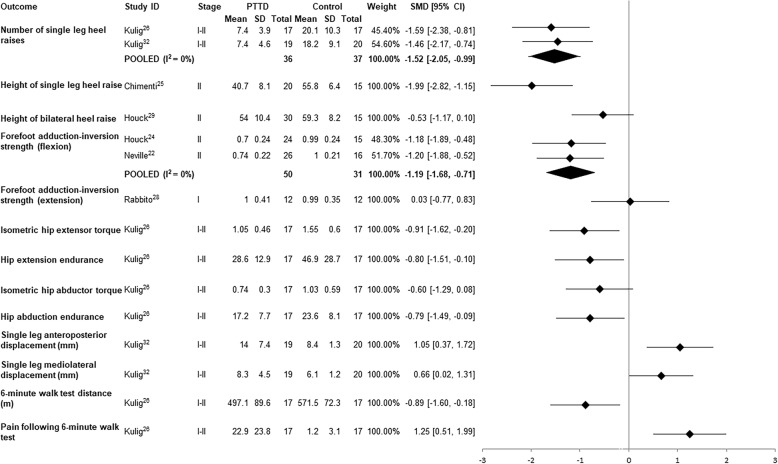
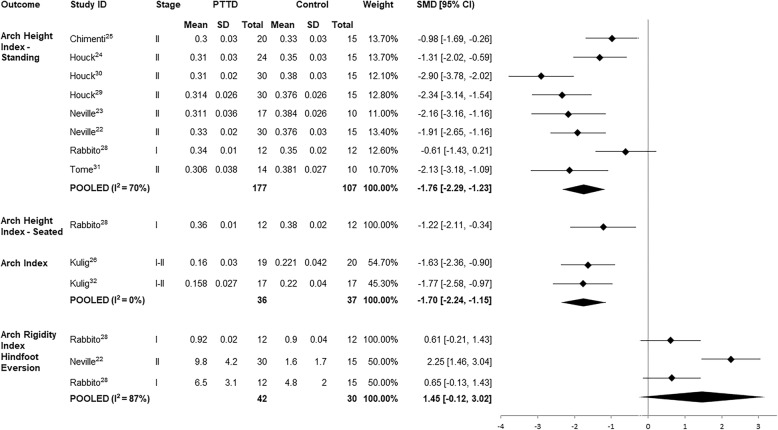
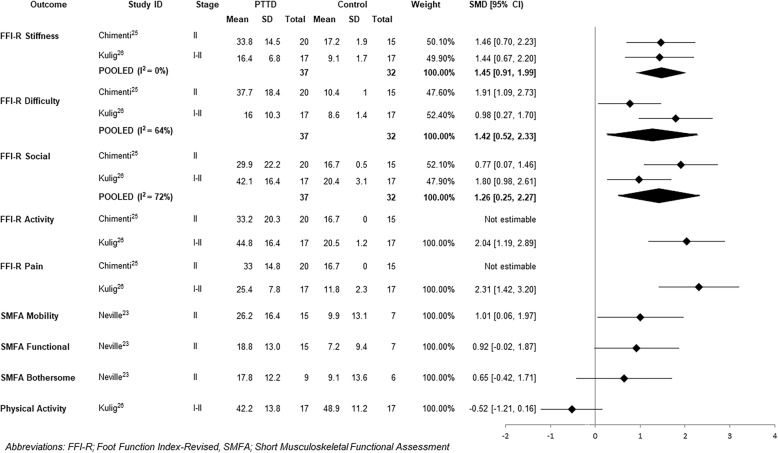
Results: Ten eligible studies were identified and pooled in the meta-analyses. Strong effects were revealed for poor heel rise endurance (SMD -1.52, 95% CI -2.05 to - 0.99), less forefoot adduction-inversion strength (SMD -1.19, 95% CI -1.68 to - 0.71) and lower arch height (SMD -1.76, 95% CI -2.29 to - 1.23). Compared to controls, individuals with PTTD also had more self-reported stiffness (SMD 1.45, 95% CI 0.91 to 1.99), difficulties caused by foot problems (SMD 1.42, 95% CI 0.52 to 2.33) and social restrictions (SMD1.26, 95% CI 0.25 to 2.27).
Conclusion: There is evidence of impaired tibialis posterior capacity and lowered arch height in individuals with PTTD compared to controls. Further to addressing the expected impairments in local tendon function and foot posture, pain, stiffness, functional limitations and social participation restrictions should be considered when managing PTTD.
Keywords: Disability; Foot; Orthoses; Pain; Tendinopathy.
Conflict of interest statement
Not applicable.Not applicable.The authors declare that they have no competing interests.Springer Nature remains neutral with regard to jurisdictional claims in published maps and institutional affiliations.
Figures
Similar articles
-
Choosing among 3 ankle-foot orthoses for a patient with stage II posterior tibial tendon dysfunction.J Orthop Sports Phys Ther. 2009 Nov;39(11):816-24. doi: 10.2519/jospt.2009.3107. J Orthop Sports Phys Ther. 2009. PMID: 19881002 Free PMC article.
-
Deep posterior compartment strength and foot kinematics in subjects with stage II posterior tibial tendon dysfunction.Foot Ankle Int. 2010 Apr;31(4):320-8. doi: 10.3113/FAI.2010.0320. Foot Ankle Int. 2010. PMID: 20371019 Free PMC article.
-
Comparison of foot kinematics between subjects with posterior tibialis tendon dysfunction and healthy controls.J Orthop Sports Phys Ther. 2006 Sep;36(9):635-44. doi: 10.2519/jospt.2006.2293. J Orthop Sports Phys Ther. 2006. PMID: 17017268
-
Gait alterations in posterior tibial tendonitis: A systematic review and meta-analysis.Gait Posture. 2020 Feb;76:28-38. doi: 10.1016/j.gaitpost.2019.11.002. Epub 2019 Nov 4. Gait Posture. 2020. PMID: 31715431
-
Biomechanics and Orthotic Treatment of the Adult Acquired Flatfoot.Clin Podiatr Med Surg. 2020 Jan;37(1):71-89. doi: 10.1016/j.cpm.2019.08.007. Clin Podiatr Med Surg. 2020. PMID: 31735271 Review.
Cited by
-
A New Anatomical Classification for Tibialis Posterior Tendon Insertion and Its Clinical Implications: A Cadaveric Study.Diagnostics (Basel). 2021 Sep 4;11(9):1619. doi: 10.3390/diagnostics11091619. Diagnostics (Basel). 2021. PMID: 34573961 Free PMC article.
-
Comparison and Relationship of Isometric Strength, Range of Motion, Ankle Mobility in Participants with Normal Medial Longitudinal Arch and Flat Foot.Med Arch. 2025;79(1):20-26. doi: 10.5455/medarh.2025.79.20-26. Med Arch. 2025. PMID: 40322308 Free PMC article.
-
"I need somebody who knows about feet" a qualitative study investigating the lived experiences of conservative treatment for patients with posterior tibial tendon dysfunction.J Foot Ankle Res. 2019 Nov 7;12:51. doi: 10.1186/s13047-019-0360-z. eCollection 2019. J Foot Ankle Res. 2019. PMID: 31719845 Free PMC article.
-
Dual Transverse Arch Foot Orthosis Improves Gait Biomechanics in Females with Flexible Flatfoot.Bioengineering (Basel). 2025 Apr 14;12(4):418. doi: 10.3390/bioengineering12040418. Bioengineering (Basel). 2025. PMID: 40281778 Free PMC article.
-
Histoarchitecture of the fibrillary matrix of human fetal posterior tibial tendons.Sci Rep. 2022 Oct 26;12(1):17922. doi: 10.1038/s41598-022-19695-3. Sci Rep. 2022. PMID: 36289254 Free PMC article.
References
-
- Mann RA, Thompson FM. Rupture of the posterior tibial tendon causing flat foot. Surgical treatment. J Bone Joint Surg Am. 1985;67(4):556–61. - PubMed
-
- Kohls-Gatzoulis J, Angel J, Singh D. Tibialis posterior dysfunction as a cause of flatfeet in elderly patients. Foot. 2004;14(4):207–9.
Publication types
MeSH terms
LinkOut - more resources
Full Text Sources
Other Literature Sources
