Review
. 2019 Feb;37(1):3-14.
doi: 10.1002/hon.2540. Epub 2018 Sep 5.

Management of adverse events associated with idelalisib treatment in chronic lymphocytic leukemia and follicular lymphoma: A multidisciplinary position paper

Affiliations
Review

Management of adverse events associated with idelalisib treatment in chronic lymphocytic leukemia and follicular lymphoma: A multidisciplinary position paper

Antonio Cuneo et al. Hematol Oncol. 2019 Feb.

Abstract

The introduction of new therapeutic agents in chronic lymphocytic leukemia (CLL) and follicular lymphoma (FL), including the new kinase inhibitor idelalisib, has changed the therapeutic landscape of these diseases. However, the use of idelalisib is associated with a peculiar profile of side effects, which require an optimization of the current approach to prophylaxis and supportive treatment. Moving from the recognition that the abovementioned issue represents an unmet need in CLL and FL, a multidisciplinary panel of experts was convened to produce a consensus document aiming to provide practical recommendations for the management of the side effects during idelalisib therapy for CLL and FL. The present publication represents a consensus document from a series of meetings held during 2017. The Panel generated clinical key questions using the criterion of clinical relevance through a Delphi process and explored 4 domains, ie, diarrhea/colitis, transaminitis, pneumonitis, and infectious complications. Using the consensus method, the Panel was able to shape recommendations which may assist hematologist to minimize adverse events and guarantee adherence to treatment in patients with CLL and FL candidate to receive idelalisib.

Keywords: adverse events; chronic lymphocytic leukemia; follicular lymphoma; idelalisib.


Conflict of interest statement

Funding of the project was provided from at‐arm's‐length contribution from Gilead (Italy). The funding source had no role in identifying statements, abstracting data, synthesizing results, or preparing the manuscript or in the decision to submit the manuscript for publication.

Figures

Figure 1
Figure 1
The issue of diarrhea/colitis: assessment of patients assigned to treatment with idelalisib ± rituximab as first option
Figure 2
Figure 2
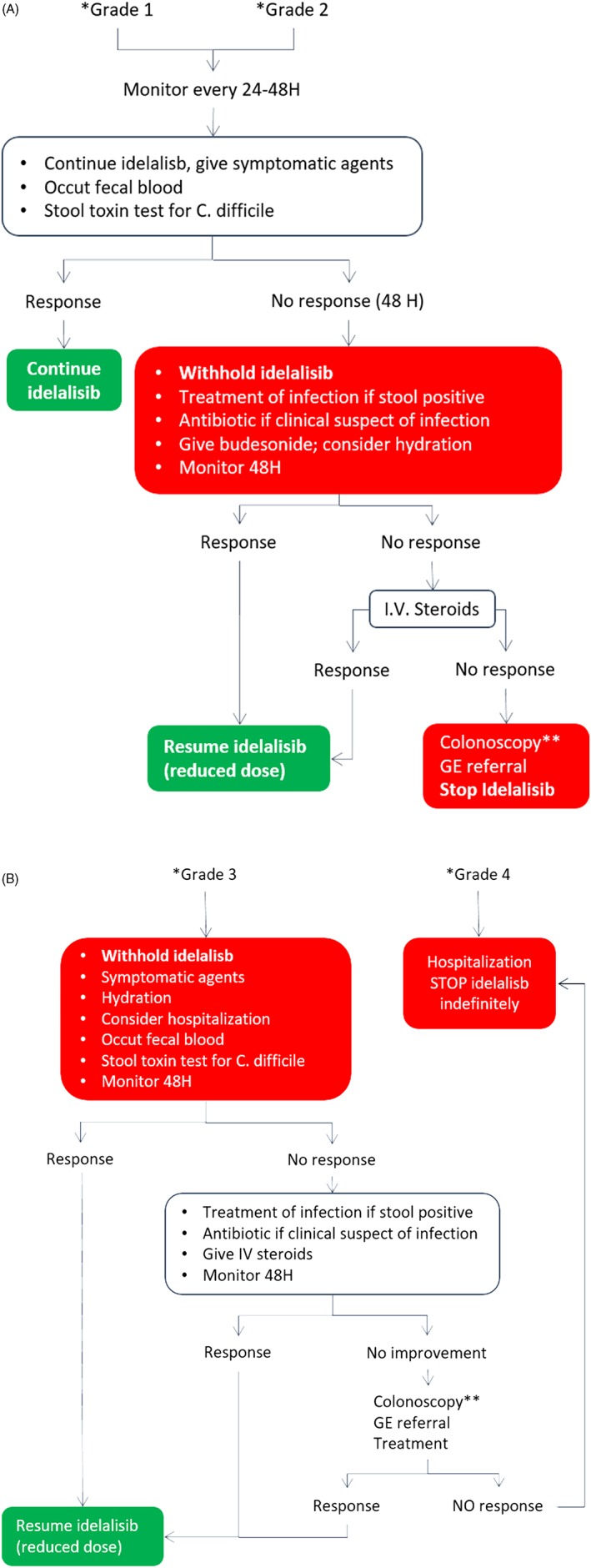
Management of idelalisib‐induced diarrhea. (*grade 1 = stool increase <4/day over baseline; grade 2 = stool increase 4‐6; grade 3 = stool increase ≥7, hospitalization required; grade 4 = life threatening; **always if bleeding)
Figure 3
Figure 3
The issue of transaminitis: assessment of patients assigned to treatment with idelalisib ± rituximab as first option. (UNL, upper normal limit; DAA, directly acting antivirals; *>5 UNL because of a histologically proved CLL‐dependent or FL‐dependent liver disease)
Figure 4
Figure 4
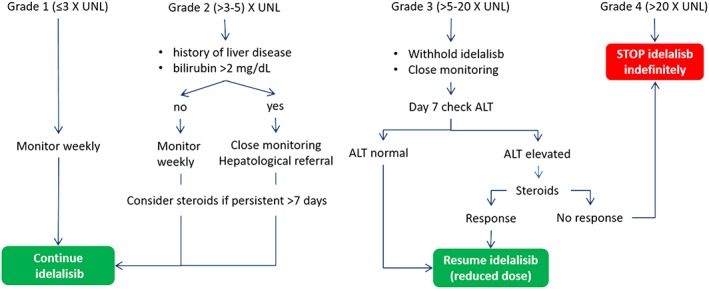
Management of transaminitis. (UNL, upper normal limit; ALT, alanine aminostransferase)
Figure 5
Figure 5
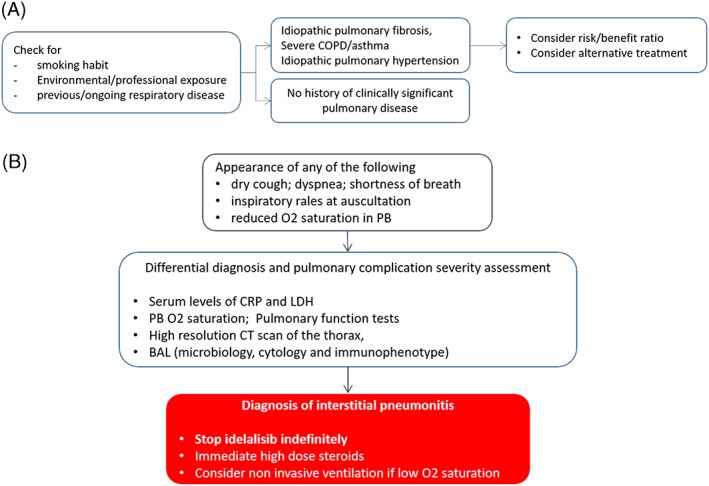
The issue of pneumonitis: management algorithm for patients assigned to treatment with idelalisib ± rituximab as first option (UNL, upper normal limit; PB, peripheral blood; COPD, chronic obstructive pulmonary disorder; CRP, C‐reactive protein; BAL, bronchoalveolar lavage; *>5 UNL because of a histologically proved CLL‐dependent or FL‐dependent liver disease; DAA, directly acting antivirals)
Figure 6
Figure 6
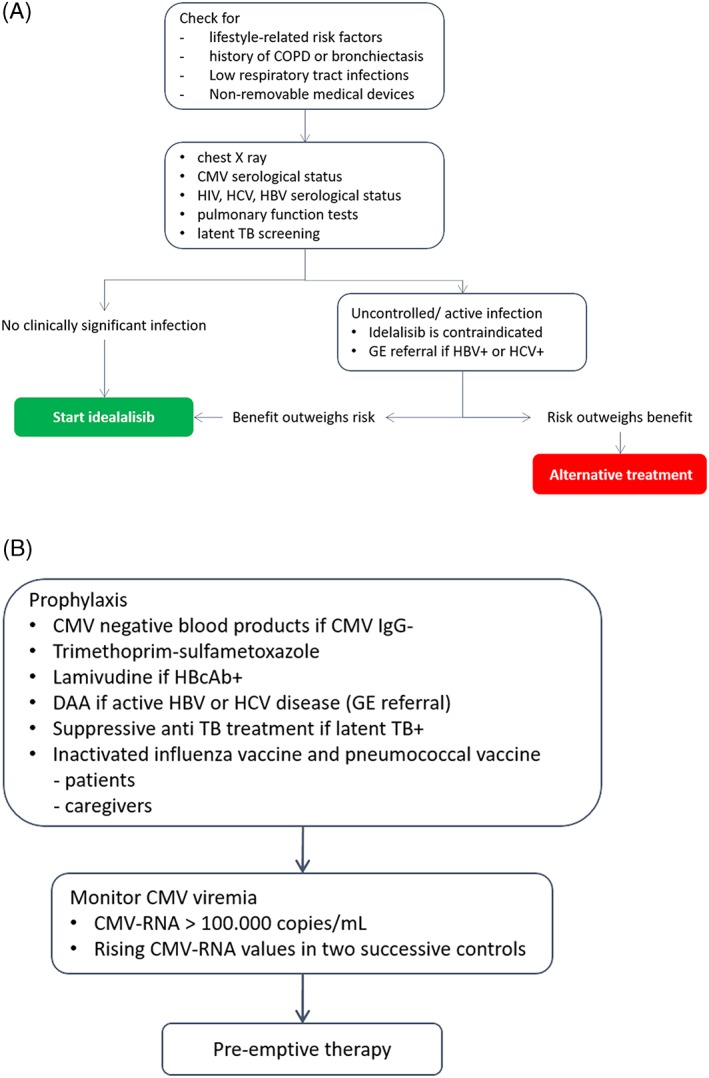
The issue of infectious complications: management algorithm for patients assigned to treatment with idelalisib ± rituximab as first option. (UNL, upper normal limit; PB, peripheral blood; BAL, bronchoalveolar lavage; GE, gastroenterologist; TB, tubercolosis; *>5 UNL because of a histologically proved CLL‐dependent or FL‐dependent liver disease; DAA, directly acting antivirals)
Figure 7
Figure 7
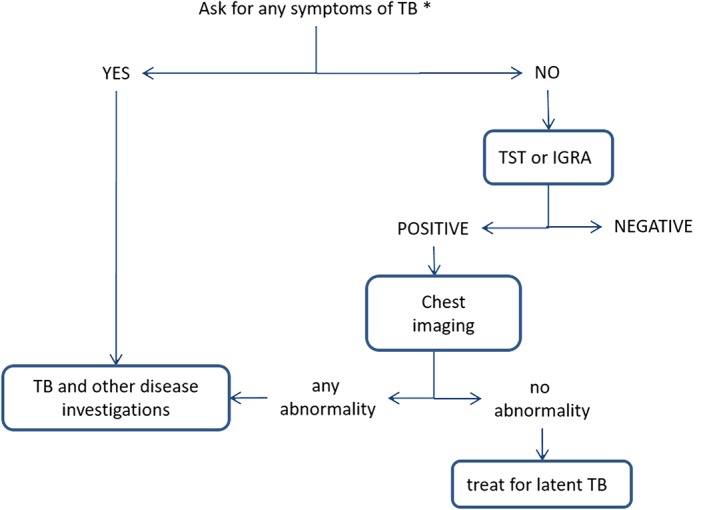
Algorithm for tuberculosis screening. (*any symptoms of TB include any 1 of cough, hemoptysis, fever, night sweats, weight loss, chest pain, shortness of breath, fatigue; TST, tubercolin skin test; IGRA, interferon‐gamma release assays)

References

    1. Wiestner A. Emerging role of kinase‐targeted strategies in chronic lymphocytic leukemia. Hematology Am Soc Hematol Educ Program. 2012;2012:88‐96. - PubMed
    1. Lannutti BJ, Meadows SA, Herman SE, et al. CAL‐101, a p110delta selective phosphatidylinositol‐3‐kinase inhibitor for the treatment of B‐cell malignancies, inhibits PI3K signaling and cellular viability. Blood. 2011;117(2):591‐594. - PMC - PubMed
    1. Herman SE, Gordon AL, Wagner AJ, et al. Phosphatidylinositol 3‐kinase‐δ inhibitor CAL‐101 shows promising preclinical activity in chronic lymphocytic leukemia by antagonizing intrinsic and extrinsic cellular survival signals. Blood. 2010;116(12):2078‐2088. - PMC - PubMed
    1. Uno JK, Rao KN, Matsuoka K, et al. Altered macrophage function contributes to colitis in mice defective in the phosphoinositide‐3 kinase subunit p110d. Gastroenterology. 2010;139(5):1642‐1653. - PMC - PubMed
    1. Brown JR, Byrd JC, Coutre SE, et al. Idelalisib, an inhibitor of phosphatidylinositol 3‐kinase p110δ, for relapsed/refractory chronic lymphocytic leukemia. Blood. 2014;123(22):3390‐3397. - PMC - PubMed

MeSH terms

LinkOut - more resources